

2026 Career Warfare: Beating the Algorithmic Vetting Engine
The hiring market is no longer a human-first process. It is an algorithmic battleground where your resume must first survive automated pattern recognition, semantic validation, consistency scoring, and credibility filtering before a recruiter even considers reading it.
This is not traditional job seeking. This is career warfare.
Modern hiring systems evaluate more than keywords. They look for contextual authority, behavioral plausibility, semantic depth, cross-platform consistency, and signs that your application was produced by a real operator rather than a language model generating polished fiction.
This guide breaks down how to beat that system.
1. The 6-Second Algorithmic Wall
In 2026, AI rejects resumes in milliseconds, while humans scan in roughly six seconds. That means your document must survive two separate gatekeepers:
- machine parsing
- semantic classification
- fraud and inconsistency detection
- rapid human pattern recognition
With 91% of managers detecting bot-masking, keyword stuffing is not just weak, it is self-sabotage. Semantic Entity Mapping is now the actual gatekeeper.

The old assumption was simple: put enough keywords into a document and eventually the ATS will pass it through.
That assumption is dead.
Today, a system wants to know whether your stated expertise behaves like real expertise. If you mention an important concept, the surrounding technical ecosystem must make sense. If the document looks perfect but lacks believable context, the machine may pass it, but the human reviewer often flags it as synthetic.
2. Pivot to Semantic Clustering
Listing Python alone is useless without its neighboring topic DNA, such as:
- Pandas
- NumPy
- data visualization
- ETL pipelines
- model evaluation
- experimentation workflows
Algorithms now penalize isolated, unvalidated skills that appear without surrounding depth. A resume that says "Python, SQL, AI, Leadership" without showing contextual clusters reads like a sprayed keyword inventory, not real working knowledge.

The better strategy is to write in semantic clusters, not isolated nouns.
For example, do not say:
- Python
- Product Management
- Sales
Instead, create topic ecosystems like:
- product management, PLG, A/B testing, user outcomes, backlog prioritization, technical debt
- data workflows, Python, Pandas, reporting automation, stakeholder dashboards
- revenue operations, funnel diagnostics, conversion friction, CRM workflows
This is what turns a resume from a keyword dump into a believable professional system.

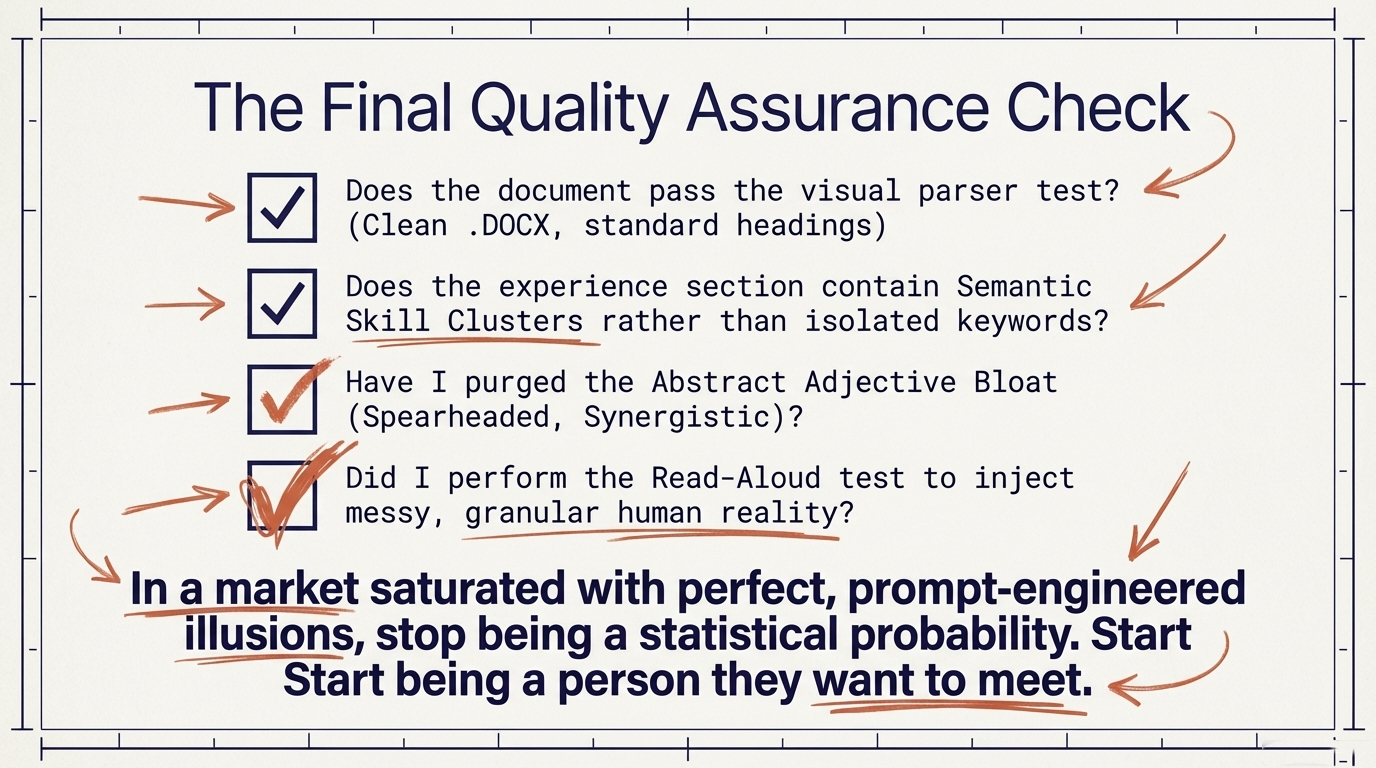
Different industries filter differently.
- Technology and Software favors proof of scale, MLOps, platform thinking, distributed systems
- Healthcare and Biotech favors regulatory literacy, systems compliance, EHR and ERP familiarity, measurable patient or operational outcomes
- Finance favors risk frameworks, governance, reporting rigor, compliance structures, and tool-specific credibility
That means the same resume cannot be blindly reused across different sectors. The semantic expectations change by market.
3. CAR Formula > AI Cliches
If your bullets are full of words like:
- spearheaded
- transformative
- synergistic
- game-changer
- seamlessly
you are broadcasting artificiality.

These words are not signals of authority. They are signals of abstraction without evidence.
Recruiters now associate abstract adjective bloat with AI-assisted misrepresentation. Perfect tone, predictable rhythm, and spotless phrasing often create suspicion instead of trust.

The stronger alternative is a measurable structure.
Use the CAR or XYZ formula:
Accomplished [X] as measured by [Y] by doing [Z].
Examples:
- Reduced invoice reconciliation lag by 42% by automating the ERP export validation workflow.
- Increased qualified pipeline conversion by 18% by rebuilding lifecycle scoring rules across HubSpot and Salesforce.
- Cut deployment rollback frequency by 35% by introducing release gating, logging baselines, and staged rollouts.
This format is useful because it forces reality into the sentence.
No fog. No filler. No performance theater.
4. LinkedIn Sync
Resume and LinkedIn inconsistency is now one of the easiest ways to trigger trust issues.
If your CV says one thing and your LinkedIn implies another, systems and recruiters read that as low confidence.

Your profile headline, summary, role descriptions, and dates must align with your resume narrative.
Use a simple positioning framework:
ICP Formula
I help [Audience] achieve [Outcome] through [Specialty].
Examples:
- I help operations teams reduce reporting delays through ERP workflow automation.
- I help software organizations improve release reliability through DevOps integration and structured QA.
- I help regulated enterprises modernize AI delivery through compliant data and MLOps architecture.
Then apply the First 275 Rule.
Your first 275 characters matter disproportionately on mobile. That preview area determines whether someone clicks further or leaves. Do not waste it on adjectives. Use it to state your real economic function.
Cross-platform consistency is part of your credibility layer now.
5. Tool Strategy
Most candidates make a tactical mistake. They use one model for everything.
That is inefficient.
The stronger model strategy is specialization.
Use Claude 4.6 for:
- strategic reframing
- narrative structure
- nuanced rewriting
- transforming messy experience into coherent evidence
Use GPT-5.4 for:
- market research
- public web context
- data analysis
- comparison
- brainstorming
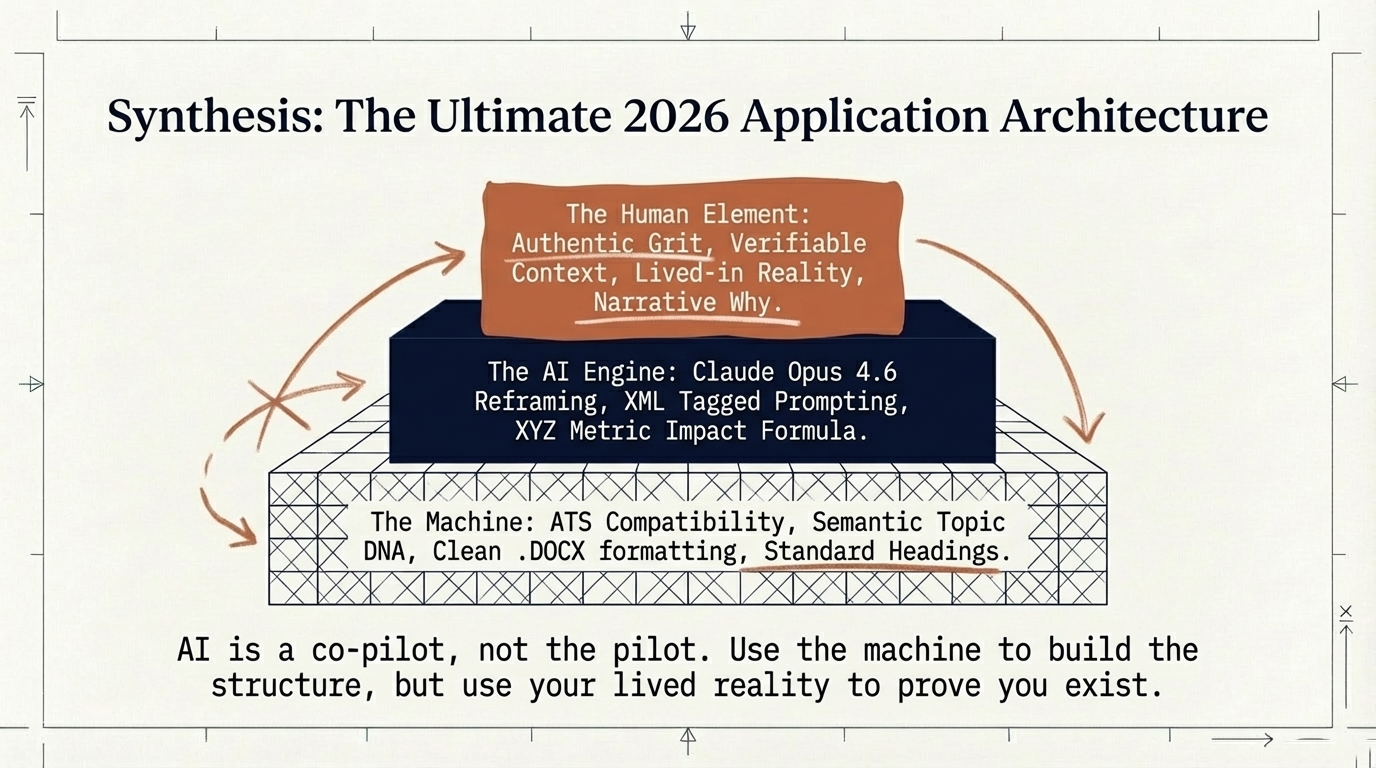
AI should be your co-pilot, not your substitute.
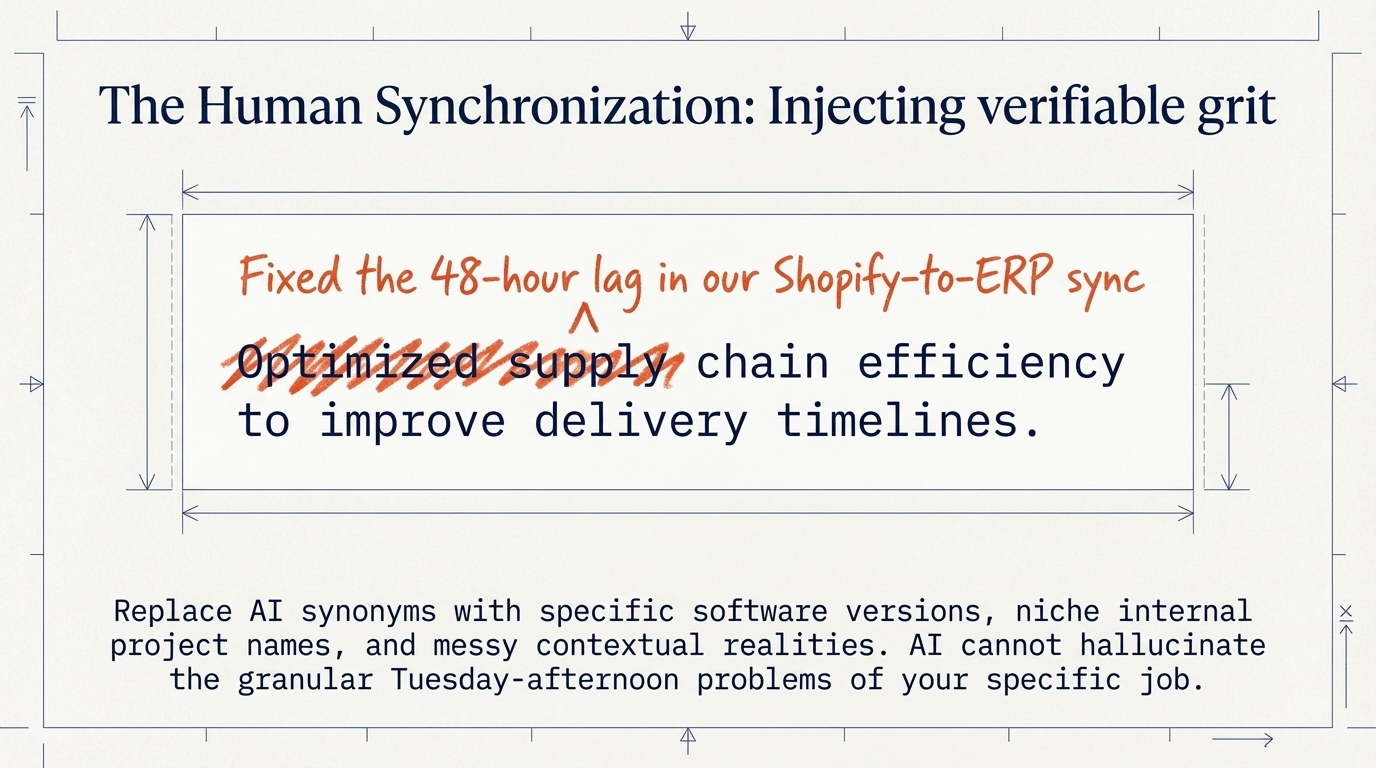
The machine builds structure. Your lived experience supplies proof.
That means your resume should contain:
- authentic operational friction
- specific software names and versions
- concrete internal realities
- believable tradeoffs
- imperfections that sound lived-in rather than fabricated
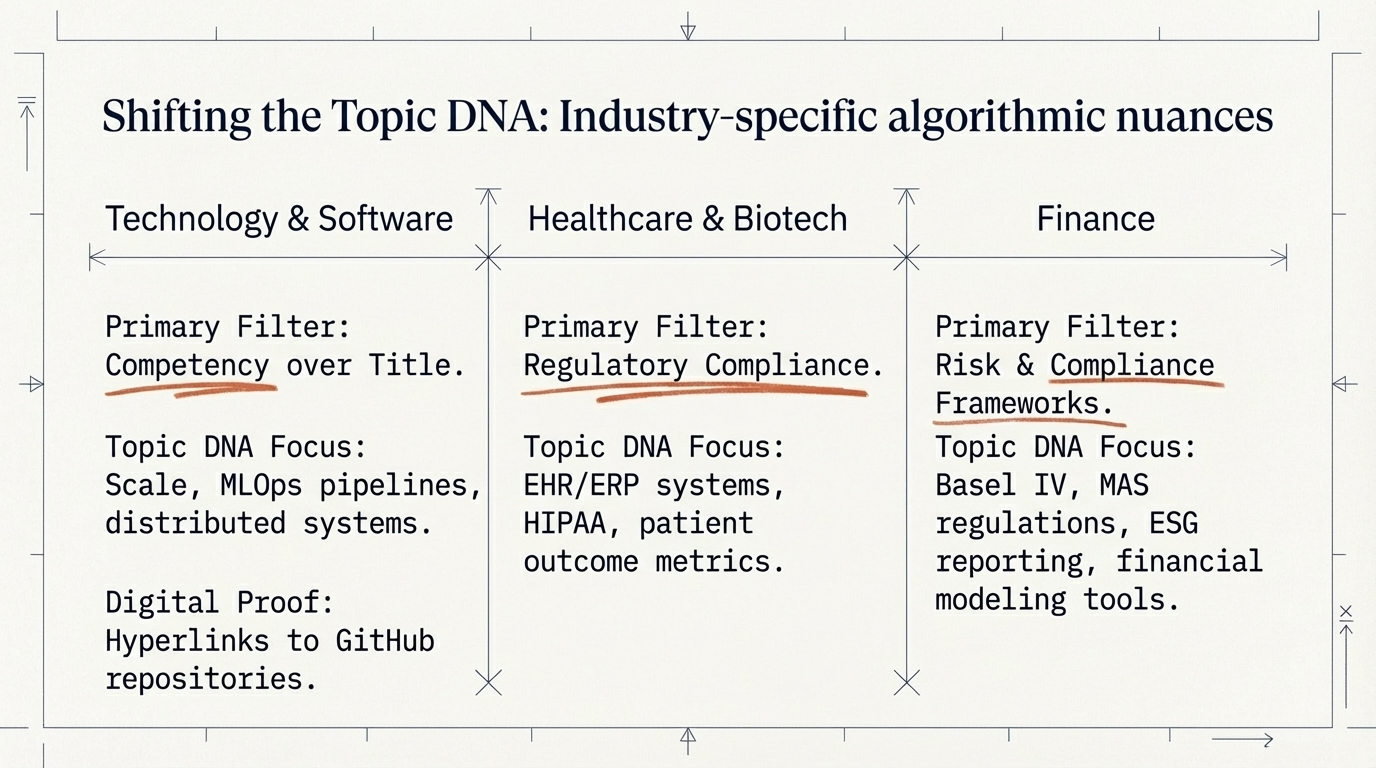
A better sentence is not:
Optimized supply chain efficiency to improve delivery timelines.
A better sentence is:
Fixed the 48-hour lag in our Shopify-to-ERP sync that was delaying distributor inventory updates.
The first sounds polished.
The second sounds real.
And real wins.
6. Avoid the Velocity Filter
High-volume submission is one of the easiest ways to destroy your own conversion rate.
If you are sending 50 or more applications in a short session, many systems flag you as non-human or low-intent. That behavior correlates with spam patterns, not thoughtful targeting.
The brutal math is simple:
- 1 to 10 highly personalized applications can produce meaningful response rates
- 50 plus AI-generated submissions can collapse success rates toward statistical noise
Modern systems do not just analyze content. They analyze submission behavior.
A machine may ask:
- Was this document tailored too quickly to be believable?
- Does the speed imply template spraying?
- Does the profile show evidence of actual role targeting?
Speed without depth now acts like a negative signal.
7. Structure Still Matters
Even the best narrative can fail if the document itself is structurally weak.
Your CV should remain simple:
- single-column layout
- standard headings
- clean hierarchy
- no decorative icons
- no complex tables
- no ATS-breaking design tricks

The resume is not an art project. It is a machine-readable proof document.
That is why clean .docx formatting remains safer than visually complex export styles when parsing reliability matters.
8. Prompt Engineering Boundaries
Advanced prompt engineering can help, but only if it is bounded correctly.
A useful way to structure AI collaboration is to separate the job description from your raw experience.

Frameworks like CO-STAR help constrain the generation process:
- Context
- Objective
- Style
- Tone
- Audience
- Response
The point is not to let AI invent an identity. The point is to make it organize the truth.
When you give AI raw material plus real constraints, it becomes useful. When you ask it to fabricate confidence, it becomes dangerous.
9. Final Quality Assurance
Before sending any application, ask:
- Does this document pass a clean visual parser test?
- Does the experience section contain semantic skill clusters, not isolated words?
- Have I removed abstract adjective bloat?
- Did I inject real operational context and human variance?
- Is LinkedIn consistent with the resume?
- Is this application tailored enough to survive a six-second human review?

This final pass matters because perfection is no longer reassuring. In a saturated market, perfectly prompt-engineered smoothness often looks counterfeit.
10. The Real Question
The real question is not:
Can AI make my resume look stronger?
The real question is:
In a world of perfect AI resumes, how do you prove you actually exist?
The answer is not more polish.
It is:
- verifiable grit
- measurable outcomes
- structural clarity
- semantic credibility
- cross-platform consistency
- contextual truth
AI can help you build the frame. But the evidence must still sound like it came from someone who has lived the work.
Final Synthesis
The winning application in 2026 is built on three layers:
-
Machine compatibility
Clean formatting, ATS legibility, semantic topic DNA, standard structure -
Strategic AI leverage
Smart reframing, research support, stronger bullets, narrative clarity -
Human authenticity
Specific friction, original context, lived detail, believable imperfection
That is the actual formula.
Not keyword stuffing.
Not adjective inflation.
Not speed.
Not imitation.
A strong modern application is an engineered document with human proof embedded inside it.
Closing Line
In a market flooded with perfect prompt-generated illusions, stop trying to look flawless.
Start trying to look real, specific, and impossible to dismiss.