
Engineering Precision RAG Chunking
A retrieval-augmented generation system can use a strong language model, a capable embedding model, and a well-tuned vector index—and still fail before retrieval begins. If ingestion cuts a definition away from its qualifier, separates a function signature from its body, or strips a table cell from its row and column context, the retriever is being asked to recover meaning that was never preserved in the index.
That makes chunking more than preprocessing. It is foundational data modeling for retrieval: the point where a source document is converted into the units that search, ranking, and generation will later treat as evidence.
The engineering goal is therefore not to discover one universally correct chunk size. It is to preserve enough structure and semantic continuity that retrieval can return complete, relevant evidence at the right granularity. Fixed windows can be useful baselines, but mature systems progressively add structural, semantic, hierarchical, agentic, late, and query-adaptive techniques where the data justifies them.
1. Retrieval Accuracy Starts at the Boundary
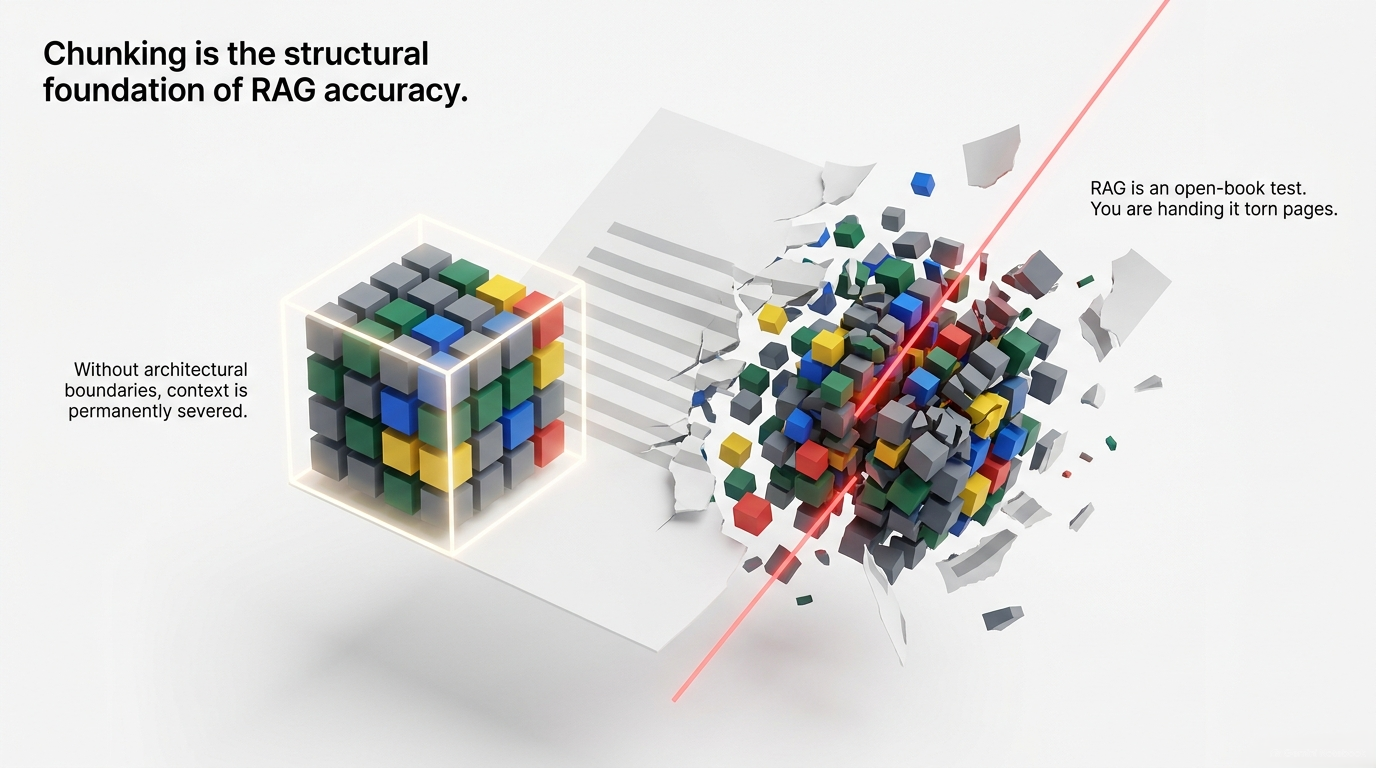
RAG behaves like an open-book test. The model can only reason over the pages that retrieval hands it, and retrieval can only return units that ingestion created. A bad boundary is therefore a permanent information-loss event.
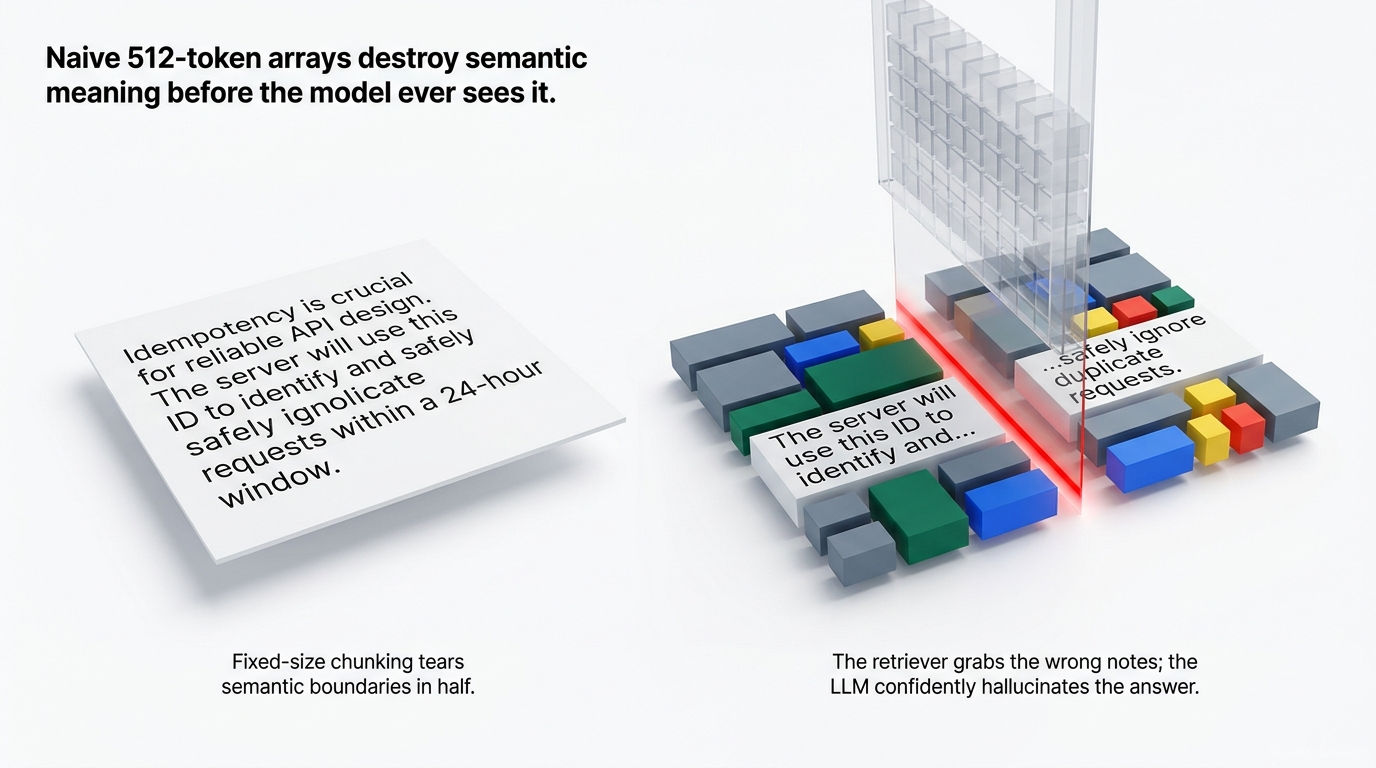
The failure mode is easy to underestimate. A fixed token limit may split an idempotency rule from the API behavior it constrains, leaving one chunk with the concept and another with the operational detail. Each fragment can look locally plausible while being globally incomplete. The retriever then selects the wrong fragment, and the generator may confidently fill in the missing relationship.
This is why embedding quality cannot compensate for structural damage. Embeddings can represent the content they receive; they cannot reconstruct context that was discarded or separated at ingestion time.
A useful design question is not simply, “How many tokens fit in a chunk?” It is: What unit of evidence must remain intact for a downstream question to be answerable?
2. Tokens Optimize Computation; Chunks Preserve Meaning
Tokenization and chunking address different concerns. Tokenization turns text into machine-processable units and supports efficiency, vocabulary control, and model execution. Chunking decides which portions of the source should travel together through indexing and retrieval.
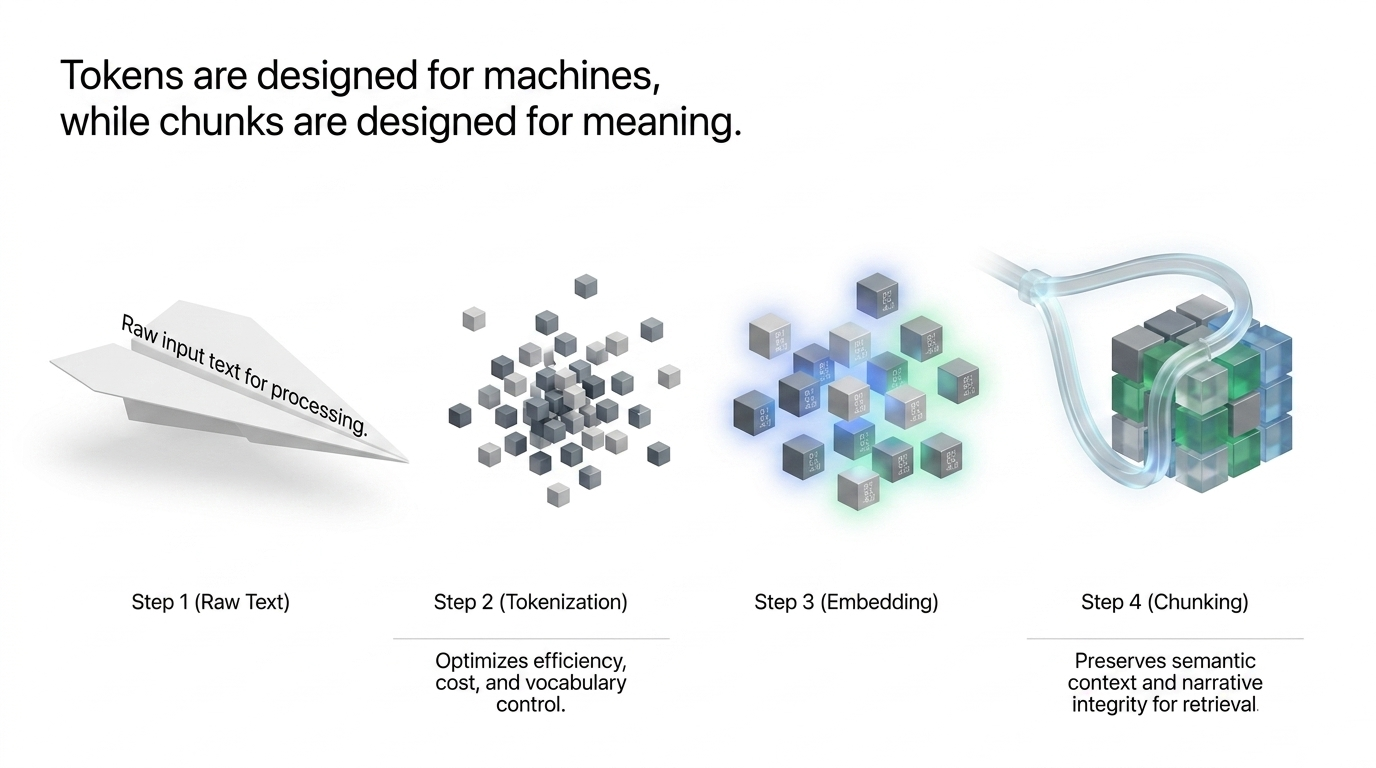
The conceptual pipeline in the source material separates raw text, tokenization, embedding representation, and semantic grouping. The important engineering distinction is that token boundaries are implementation artifacts, while chunk boundaries are retrieval semantics.
That distinction changes how chunk size should be chosen. A 500-token interval is mathematically convenient, but the content may contain a 70-token definition that should remain isolated, a 900-token section that should be preserved as a parent, or a table whose meaning depends on headers far outside the local cell text.
Treating chunks as modeled evidence also suggests richer metadata. A chunk can carry its document identifier, section path, parent identifier, content type, source offsets, and lineage. Those fields let the retrieval layer reconstruct context instead of pretending that every chunk is a self-contained text blob.
3. Fixed Windows Are a Baseline, Not an Architecture
Fixed-size chunking is popular because it is fast, deterministic, easy to reason about, and simple to put into production. Token overlap softens some boundary errors by duplicating material around each cut.
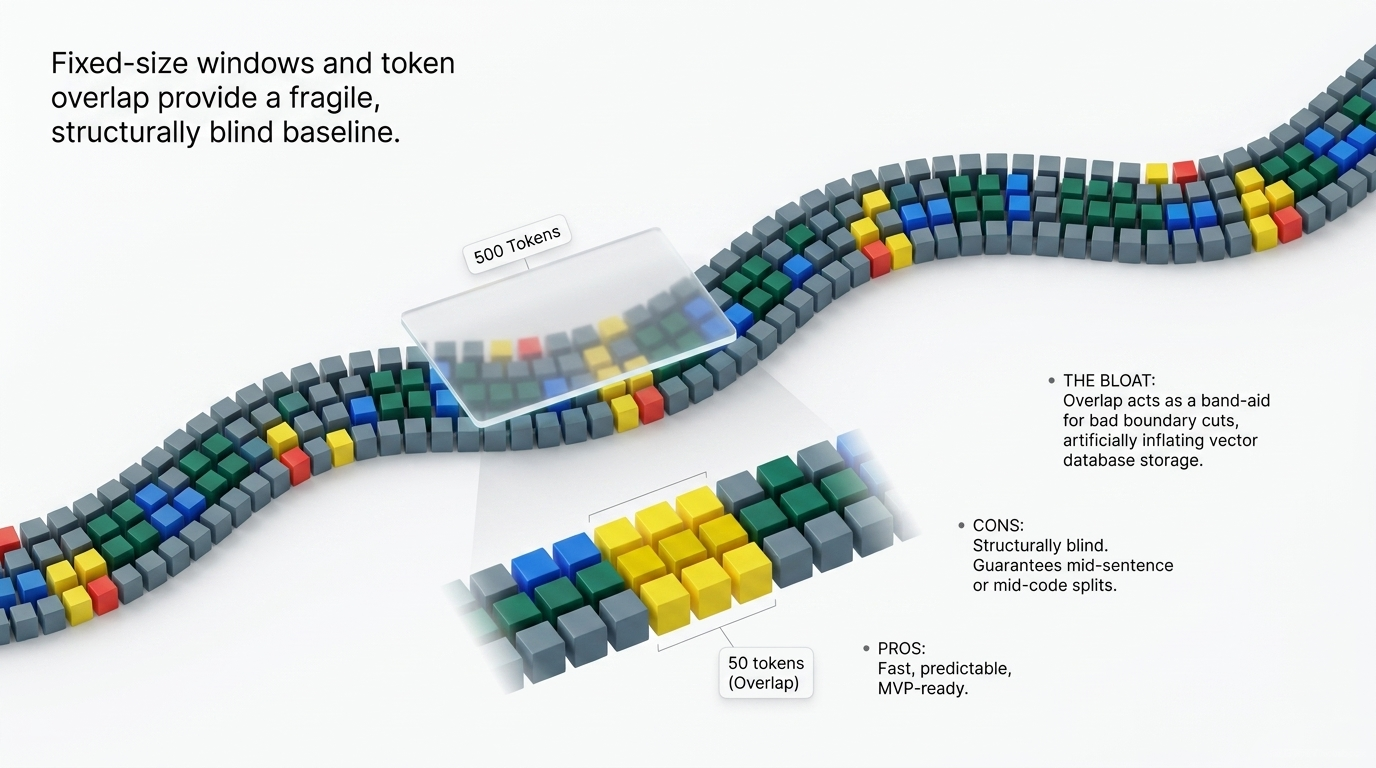
The trade-off is structural blindness. A fixed window does not know whether it is cutting a sentence, a code block, a contract clause, or a conversational exchange. Overlap acts as a bandage: it increases the probability that important context appears in at least one neighboring chunk, but it also duplicates indexed text and inflates vector storage.
The source visual frames fixed windows as an MVP-ready technique, which is a good way to position them. They are valuable when the input is regular, latency matters, and the cost of occasional boundary errors is low. They are dangerous when teams mistake operational simplicity for semantic correctness.
A pragmatic baseline is therefore:
- choose a predictable maximum size;
- use limited overlap only where it has measurable retrieval value;
- record source offsets so chunks can be traced back to their origin; and
- treat boundary failures as evidence that the strategy needs to become structure-aware.
4. Structural Chunking Respects the Document’s Native Hierarchy
Many documents already contain a schema: headings, paragraphs, lists, DOM nodes, Markdown sections, table regions, or code blocks. Structural chunking uses those boundaries before falling back to size-based splitting.
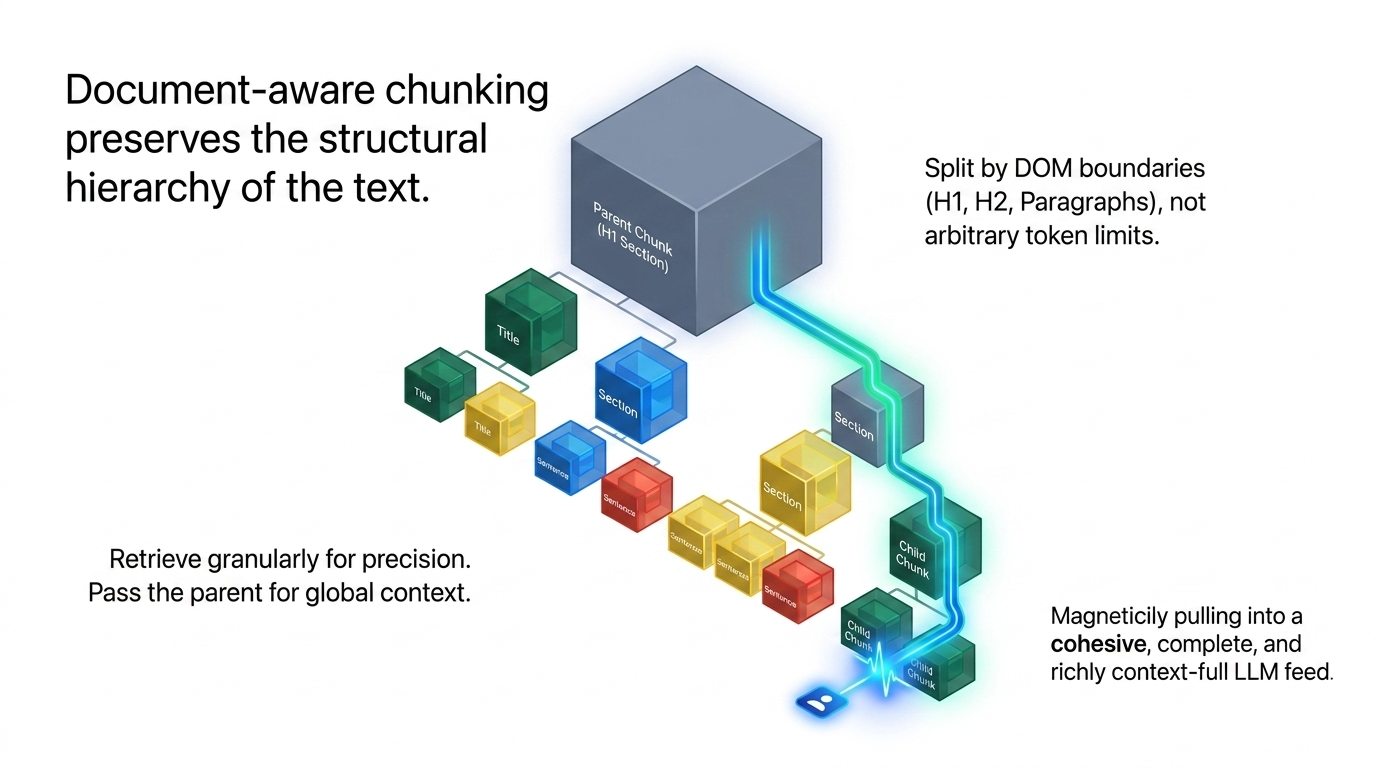
The pattern shown here is hierarchical. A large parent chunk preserves the section-level context, while smaller child chunks provide more precise retrieval targets. The retriever can search at child granularity and then pass the parent—or selected neighboring context—to the model.
This is a stronger abstraction than “split every N tokens” because it keeps the source’s own organization available to the retrieval layer. It also supports a useful recursive policy:
- split at the strongest available structural boundary;
- keep well-formed segments intact when they fit;
- recursively split only segments that exceed the size constraint; and
- reattach parent context or metadata when serving the final evidence.
The main risk is oversized structural units. A long section or code block can exceed practical embedding or retrieval limits. That is why structural awareness and size enforcement should cooperate rather than compete.
5. Semantic Chunking Detects Topic Shifts
Structure is not always explicit. Long prose can move between topics without a heading, transcripts can drift gradually, and machine-generated text can have weak formatting. Semantic chunking addresses this by looking for changes in meaning rather than only changes in syntax.
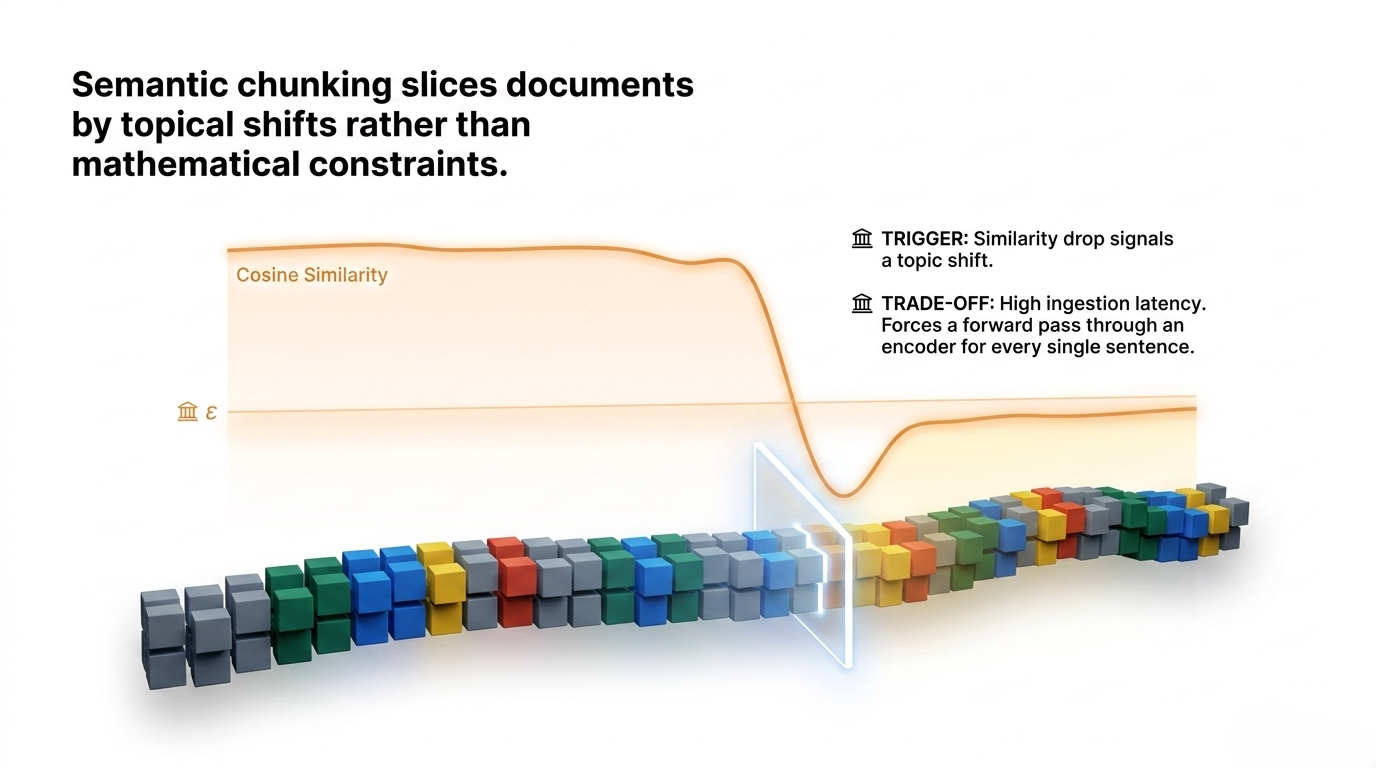
The source material illustrates a similarity curve across adjacent units. A sufficiently large drop signals a potential topic shift, and a boundary is placed around that change. This makes the chunker sensitive to narrative transitions that a fixed window would ignore.
The trade-off is ingestion cost. If semantic boundary detection requires an encoder pass over every sentence or candidate unit, preprocessing becomes more expensive and higher latency. The threshold also becomes a model parameter: too sensitive, and the document fragments into small islands; too permissive, and unrelated topics remain fused.
Semantic chunking is most useful when topical coherence matters more than strict structural fidelity. It should be evaluated against the questions the corpus is expected to answer, not just by inspecting whether the boundaries “look right.”
6. Agentic and Multi-Modal Extraction Handle Irregular Sources
Some corpora do not have a reliable text hierarchy at all. Financial tables, scanned forms, mixed text-and-image reports, and noisy transcripts often require interpretation before sensible boundaries can be drawn.
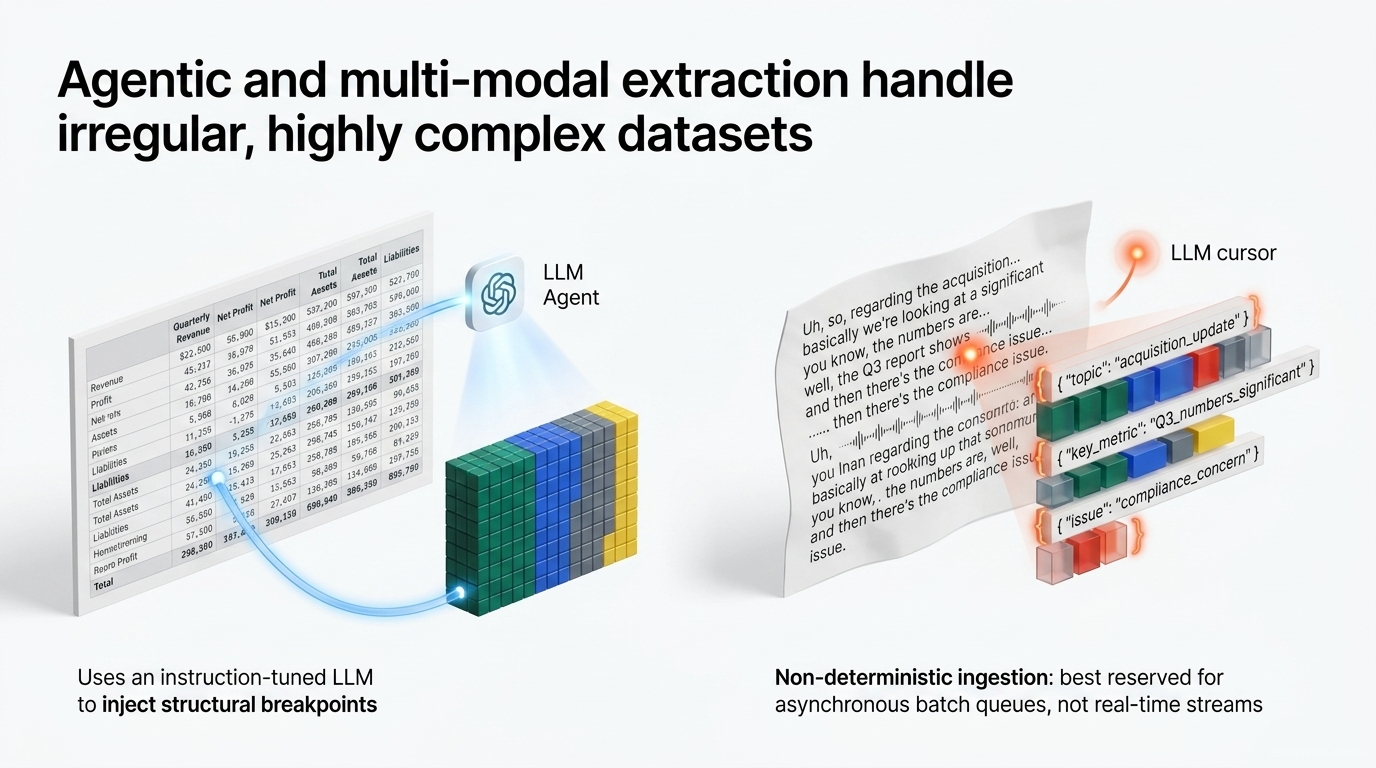
The source material shows two related patterns. In one, an instruction-tuned LLM injects structural breakpoints into a complex table. In another, an LLM cursor emits structured fields from narrative content. Both approaches use model reasoning as part of ingestion rather than treating the source as a flat token stream.
This expands what chunking can preserve, but it changes the operational profile. The slide explicitly characterizes this kind of ingestion as non-deterministic and better suited to asynchronous batch queues than real-time streams. That matters for reproducibility, cost, retry behavior, and change management.
For production, a model-driven chunker should emit not only chunk text but also provenance: source span, extraction version, prompt or policy version, parent object, and any confidence or validation signals the pipeline maintains. The slides do not define a governance design, so this lineage requirement is a production engineering extension rather than a source claim.
7. Match the Chunking Strategy to the Data Shape
A mature retrieval system rarely has one kind of source. Logs, prose, Markdown, contracts, code, tables, and chat all encode relationships differently, so they should not be forced through one boundary rule.
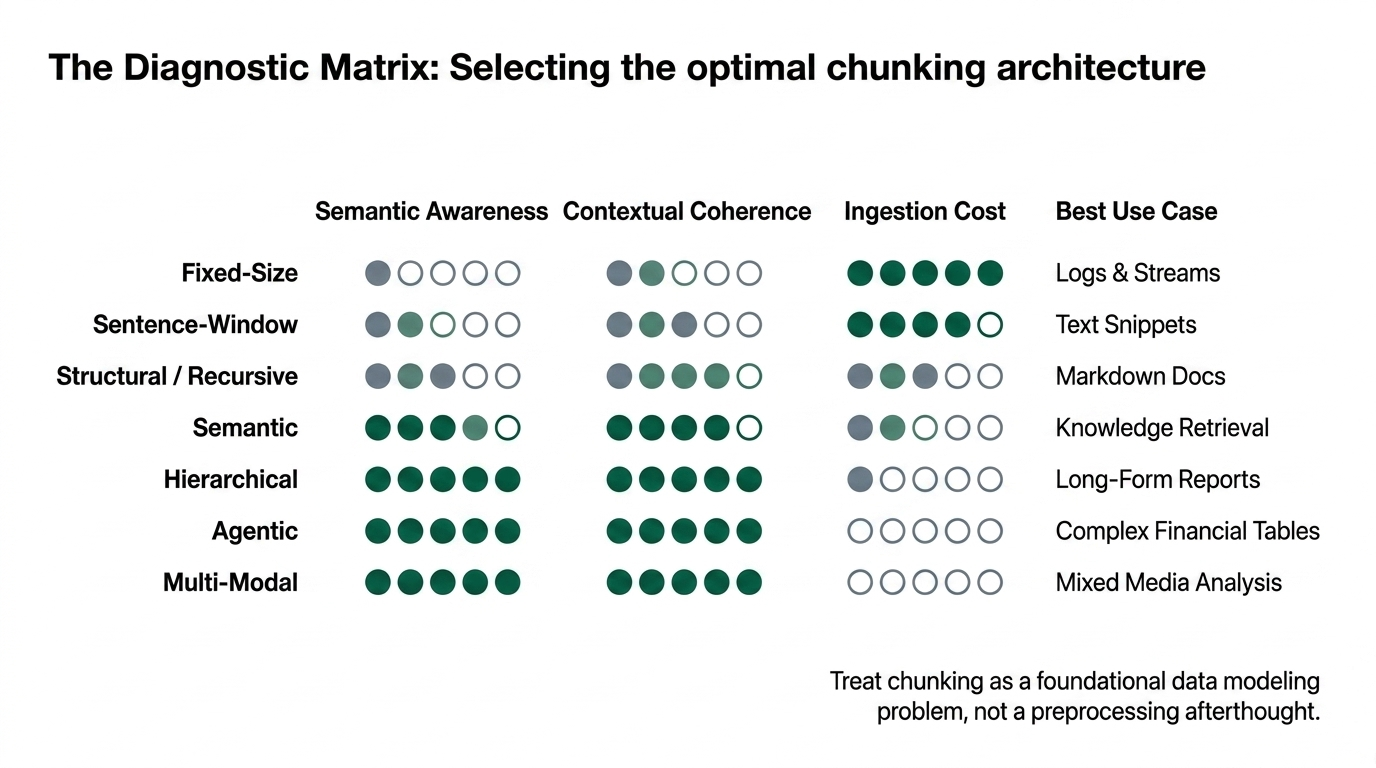
The diagnostic matrix makes the trade-off explicit. Fixed-size methods are low-cost and suitable for logs or streams. Structural or recursive methods fit Markdown-style documents. Semantic methods trade ingestion cost for stronger meaning-aware boundaries. Hierarchical, agentic, and multi-modal approaches maximize contextual coherence for long-form or irregular sources.
The implication is architectural: chunker selection belongs in the ingestion router. Content type, source schema, document size, and workload constraints should determine the strategy before data reaches the index.
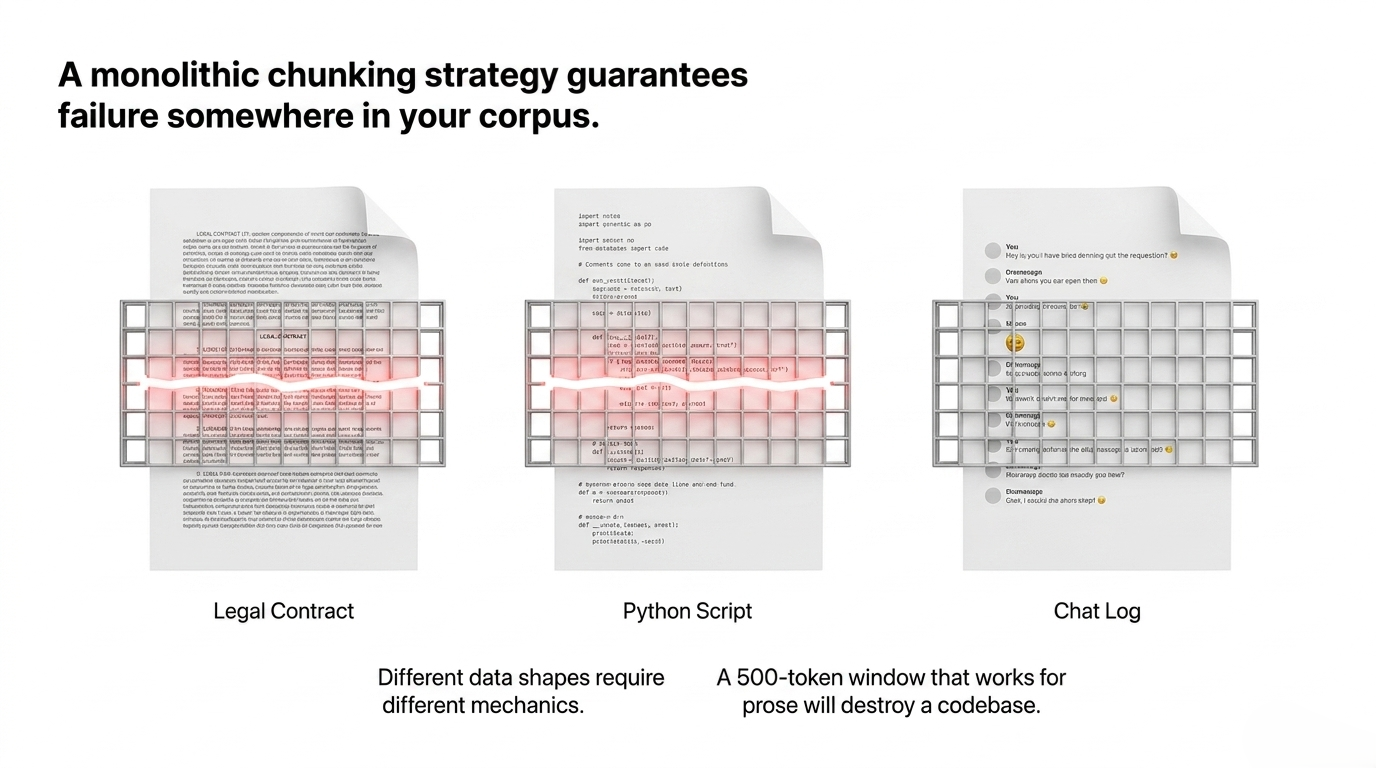
The second visual makes the failure concrete. A legal contract, Python script, and chat log may all contain roughly the same number of tokens, but the units that must stay together are completely different. A prose window can bisect a function body; a code-aware splitter can be useless on a table; a sentence window can lose speaker turns in chat.
The right target is not a single global chunk size. It is a portfolio of chunking mechanics behind a common interface.
8. Evaluate Chunk Quality Before Blaming the LLM
End-to-end answer quality is important, but it is a noisy way to diagnose an ingestion problem. A poor answer can come from chunking, retrieval, ranking, prompting, or generation. Intrinsic chunk metrics help isolate the data layer.
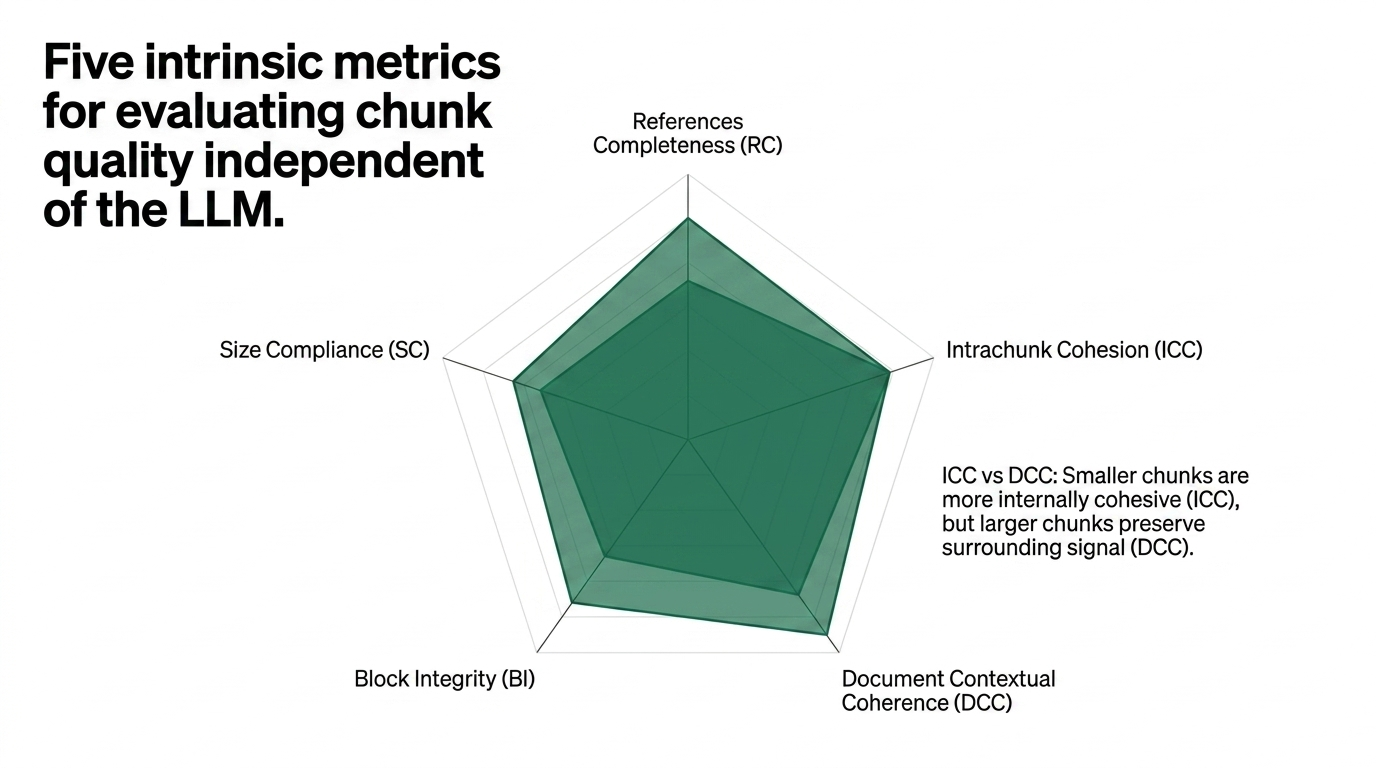
The source proposes five dimensions:
- Reference Completeness (RC): whether necessary references remain available with the chunk.
- Intrachunk Cohesion (ICC): whether the content inside the chunk belongs together.
- Document Contextual Coherence (DCC): whether the chunk preserves enough surrounding document signal.
- Block Integrity (BI): whether natural structural units remain intact.
- Size Compliance (SC): whether chunks stay within operational size constraints.
These metrics expose a core tension. Smaller chunks can improve internal cohesion and retrieval precision, while larger chunks can preserve more context. Good chunking is therefore a multi-objective optimization problem rather than a race toward the smallest possible segment.
A practical evaluation loop should combine intrinsic scores with retrieval tests. Create representative questions, identify the evidence spans required to answer them, inspect whether those spans survive chunking, then measure whether retrieval returns them. This makes boundary quality observable before generation enters the loop.
9. Post-Processing Can Regularize an Otherwise Good Boundary
Meaning-aware chunkers can still produce pathological sizes. A semantic unit may be too large for efficient retrieval, while a sequence of tiny fragments may produce noisy vectors. Post-processing lets the pipeline enforce operational bounds without throwing away the semantic work already done.
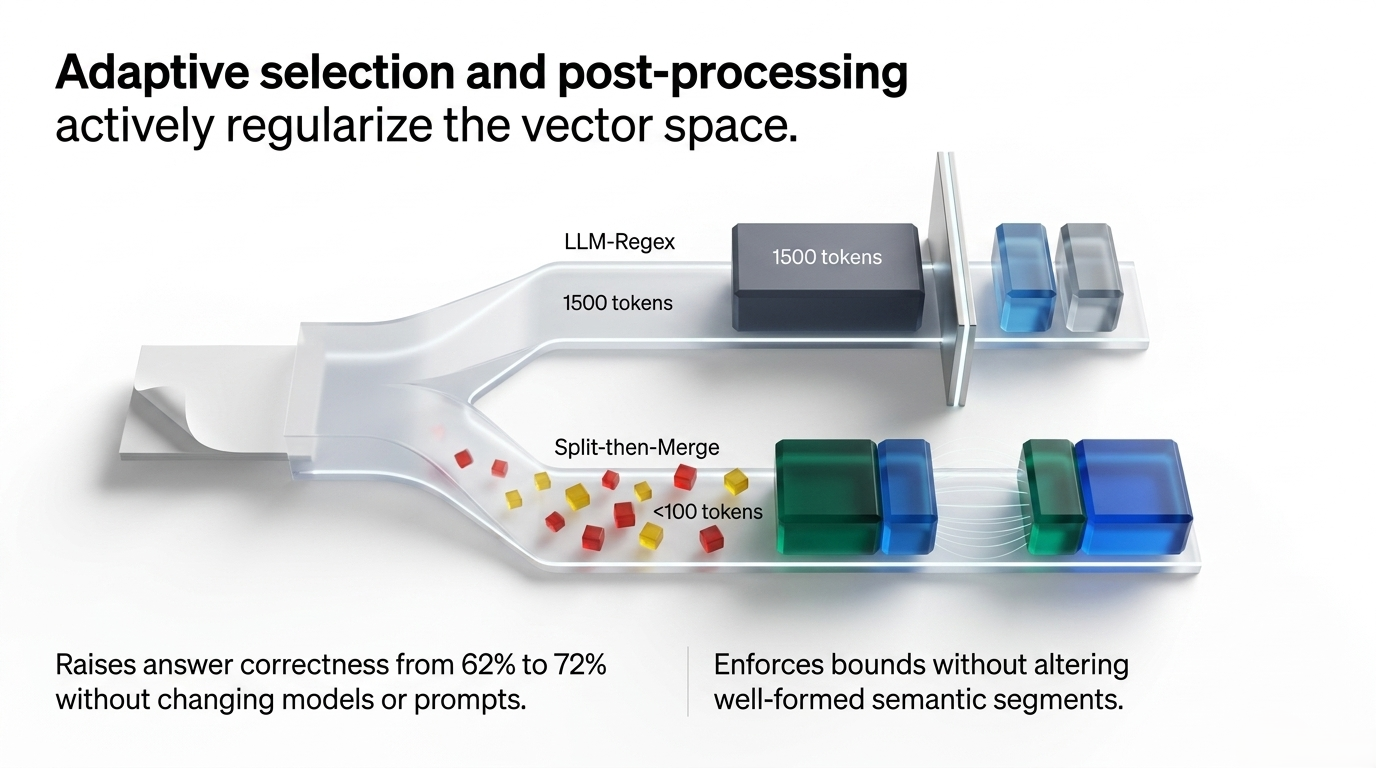
The source illustrates two complementary mechanisms. An LLM-regex path enforces a maximum around 1,500 tokens, while a split-then-merge path combines fragments below 100 tokens into larger, better-formed units. The conceptual goal is to regularize chunk sizes after meaningful boundaries have been detected.
The visual also reports answer correctness increasing from 62% to 72% without changing models or prompts. Because the underlying benchmark details are not provided in the source material, that number should be treated as an example of the potential leverage of chunk post-processing, not as a universal expected gain.
The engineering lesson is still strong: retrieval quality can improve materially by fixing the data representation before changing the model stack.
10. Late Chunking Preserves Global Context Before Pooling
Most chunking strategies decide boundaries before the final vector representation is formed. Late chunking reverses that logic: the document is first processed in a way that lets token representations communicate across broader context, then boundary cues and pooling produce one dense vector per chunk.
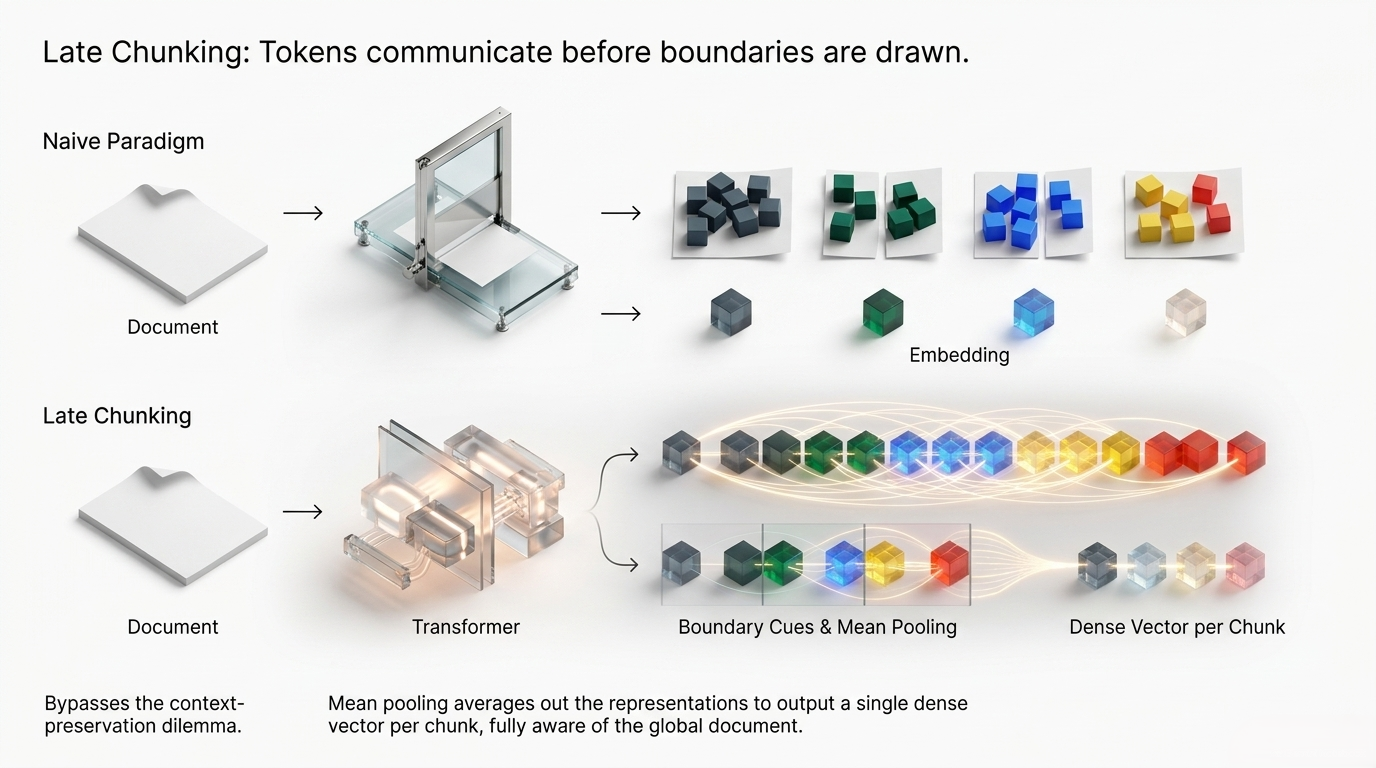
The source frames this as a way to bypass the context-preservation dilemma. Instead of isolating segments before contextualization, it allows representations to become aware of the surrounding document and only then aggregates them into chunk vectors.
Conceptually, this is important because a phrase can mean different things depending on the document it came from. A chunk vector that incorporates broader context can represent the local text while retaining information about its role in the full document.
Late chunking therefore sits at a more advanced layer of the architecture: it changes not only where boundaries are drawn, but also when representation is computed relative to those boundaries.
11. Query-Adaptive Chunking Makes Boundaries Conditional on Intent
Static chunking assumes the same evidence units should serve every question. Query-adaptive semantic chunking (QASC), as shown in the source, treats the user’s intent as part of the boundary decision.
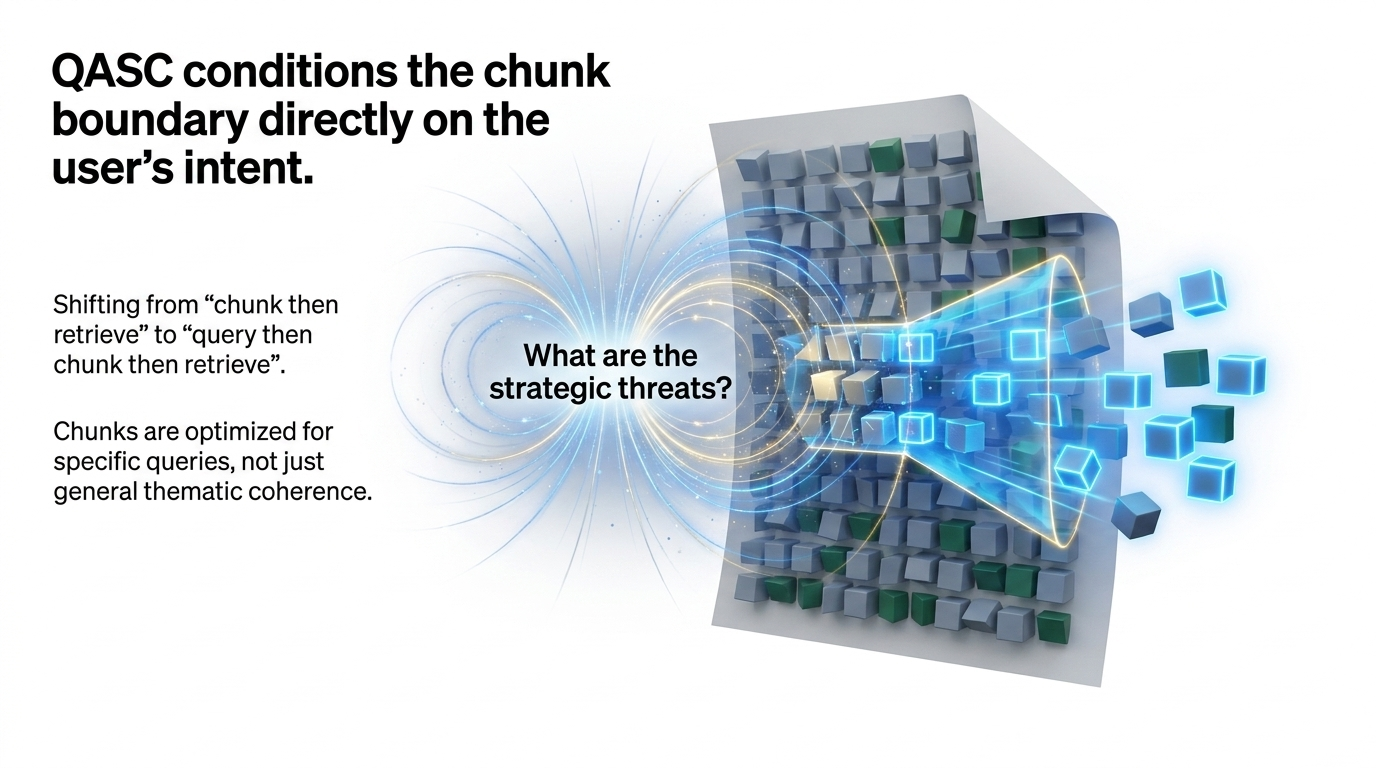
The shift is from “chunk, then retrieve” to “query, then chunk, then retrieve.” A broad strategy question may require larger context around themes and dependencies, while a narrow factual question may benefit from smaller, more targeted evidence.
This moves chunking from an ingestion-only concern toward the retrieval path itself. It also introduces architectural consequences: more compute can occur at query time, caching becomes harder, and reproducibility depends on both the document and the query.
The payoff is precision. Rather than optimizing a static corpus representation for an average future question, the system can construct evidence units that are specific to the question being asked.
12. Better Boundaries Compound Through Retrieval and Generation
Chunk quality influences what can be indexed, what can be retrieved, what can be ranked, and what the model eventually sees. Improvements therefore compound through the entire RAG path.
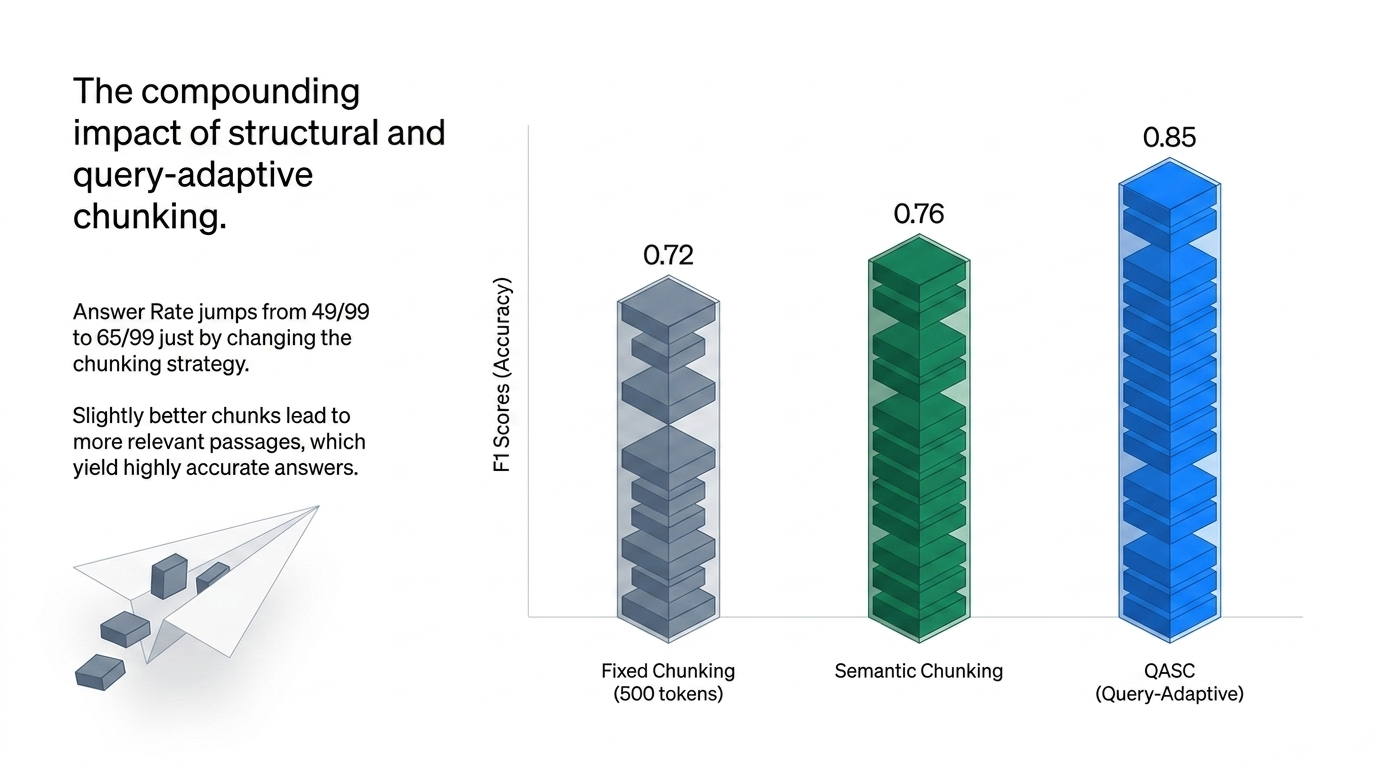
The source’s illustrated benchmark reports F1 scores of 0.72 for fixed chunking, 0.76 for semantic chunking, and 0.85 for QASC, along with an answer-rate change from 49/99 to 65/99 after changing chunking strategy. Those figures are specific to the example presented and should not be generalized without the underlying evaluation setup.
What is generalizable is the causal chain. Better boundaries produce more relevant passages; more relevant passages improve the evidence presented to the model; better evidence increases the ceiling on answer quality. This is why chunking changes can outperform model or prompt changes in systems where ingestion is the real bottleneck.
The safest way to validate that leverage is to run an ablation: hold the model, prompt, retriever, and evaluation set constant while changing only the chunking strategy. That turns chunking from an intuition into a measurable architectural variable.
Engineering Principles
The architecture ultimately depends on several principles:
-
Model evidence, not token counts.
Choose chunk boundaries around the units a retriever must return intact, then use size constraints as guardrails. -
Exploit deterministic structure first.
Headings, DOM nodes, code blocks, tables, and parent-child relationships are cheap, reproducible signals. Use semantic or agentic methods when native structure is insufficient. -
Route by source type.
A heterogeneous corpus needs multiple chunkers behind one ingestion contract rather than one global window. -
Measure chunk quality independently.
Track completeness, cohesion, contextual coherence, block integrity, and size compliance alongside downstream retrieval and answer metrics. -
Preserve lineage across every transformation.
The source slides do not specify a security, governance, or observability layer, but a production implementation should be able to trace every chunk back to its source span, strategy, and version. Access-control metadata should inherit correctly when parent documents are split, and evaluation traces should expose which chunks were retrieved and why.
Final Synthesis
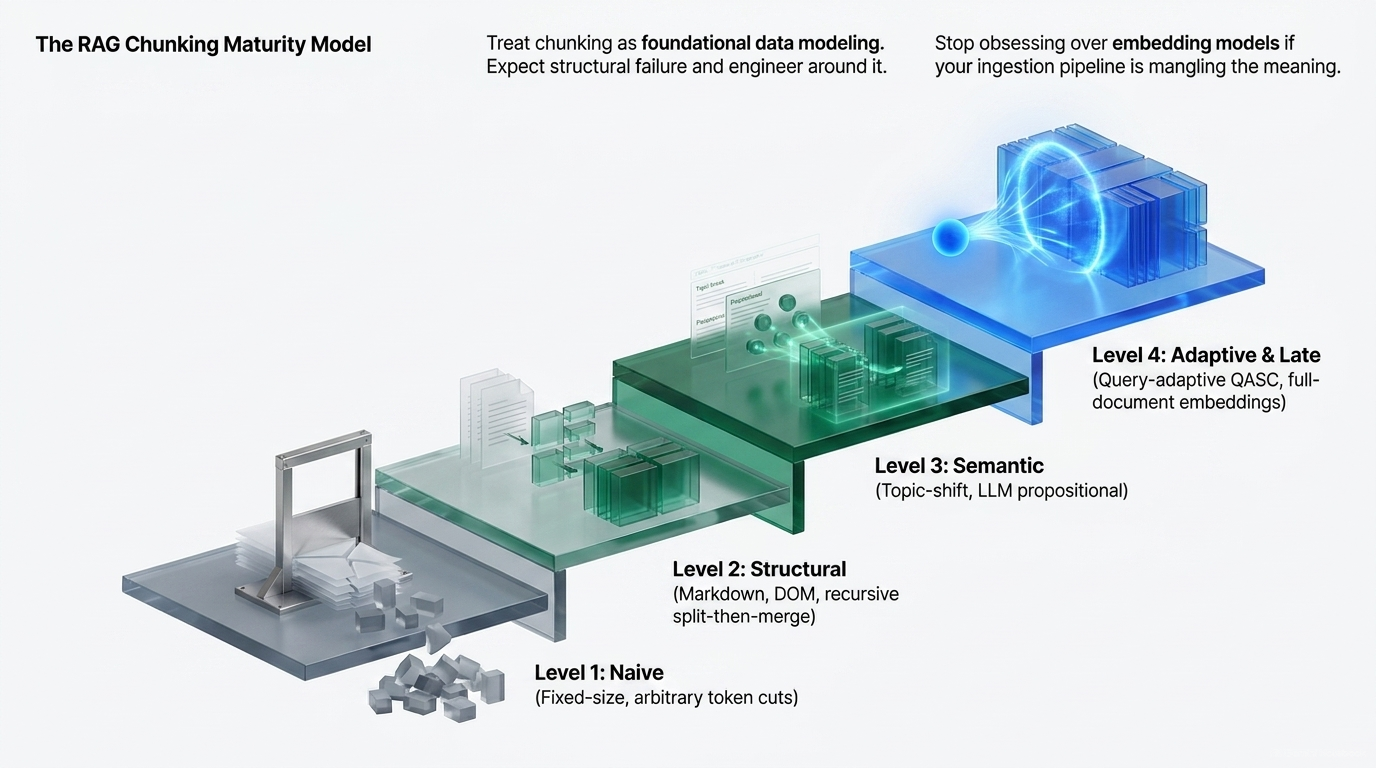
The progression across the source material forms a clear maturity model. Teams begin with fixed-size windows because they are cheap and predictable. They advance to structural chunking when document hierarchy becomes important, semantic chunking when topical transitions matter more than syntax, and agentic or multi-modal extraction when the source cannot be represented faithfully by plain text rules. At the most advanced end, late and query-adaptive techniques make context or user intent part of the representation itself.
A production-ready RAG ingestion architecture therefore combines:
- A deterministic foundation that recognizes source type and preserves native document structure.
- A testing layer that evaluates chunk quality intrinsically and with retrieval-focused question sets.
- A semantic or agentic layer for documents whose meaning cannot be captured by structural rules alone.
- A security and governance layer that preserves source lineage and access-control metadata across derived chunks.
- An observability layer that records strategy selection, chunk size distributions, retrieval traces, and evaluation outcomes.
- An adaptive retrieval path that can use parent context, late representations, or query-conditioned boundaries when the use case justifies the added complexity.
The maturity model is not a mandate to deploy the most sophisticated method everywhere. It is a map for matching ingestion mechanics to information shape and retrieval risk.
Closing Thought
RAG accuracy is constrained by the quality of the evidence units the system creates before a user ever asks a question. The most capable retriever cannot recover relationships that the ingestion pipeline has already severed.
Treat chunking as data modeling, and retrieval starts with meaning intact.