
Engineering Production-Ready Agentic Systems
The hardest part of building an agentic system is rarely the prompt. It is deciding where reasoning belongs, where deterministic software should take over, how responsibilities should be divided, and how the resulting system can be governed in production.
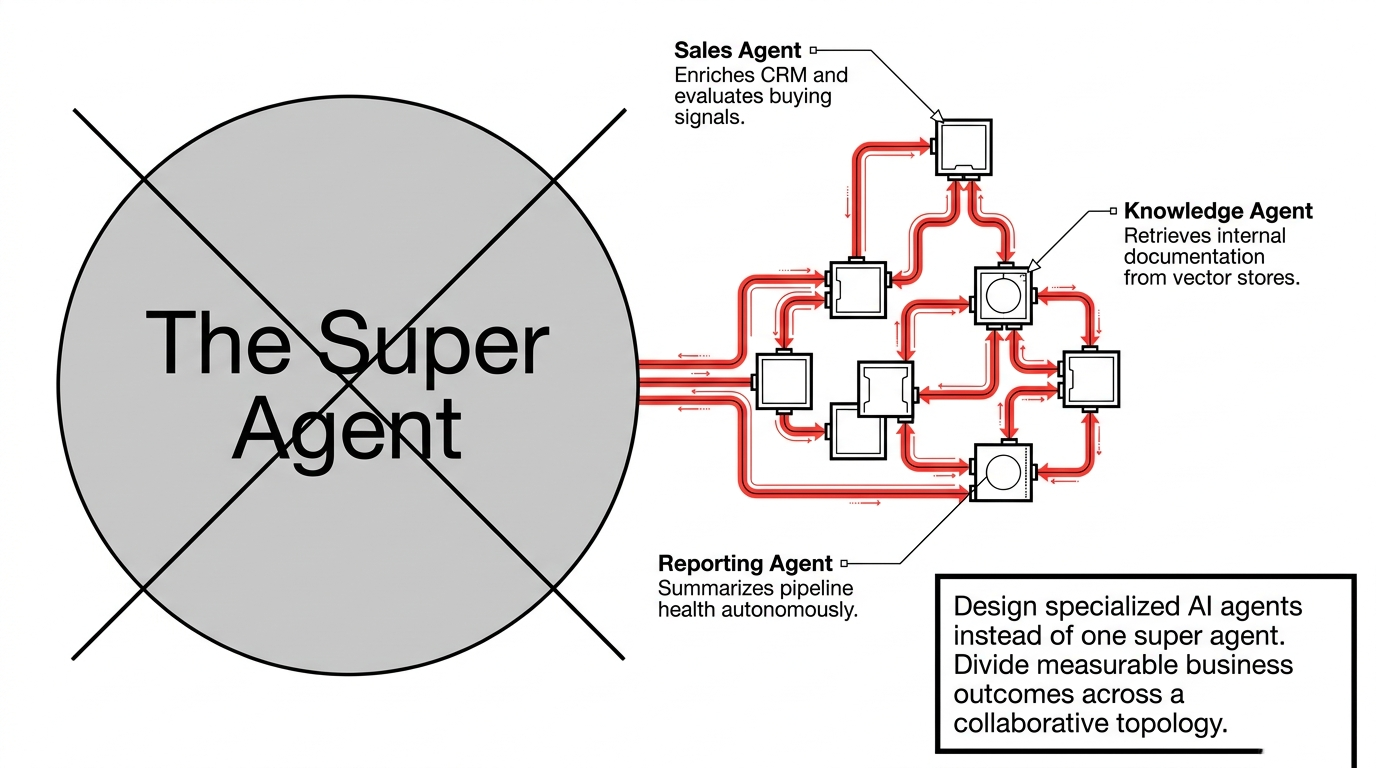
A single “super agent” is attractive because it appears simple: one model, one context window, one place to put tools, rules, memory, and instructions. But that simplicity is deceptive. As the workload expands, the agent accumulates unrelated responsibilities, tool schemas, retrieval contexts, and failure modes. The result becomes difficult to test, difficult to observe, expensive to scale, and hard to control.
The architecture shown across these diagrams argues for a different engineering direction: specialized agents coordinated through explicit topology, deterministic tool layers, shared knowledge, dynamic skill discovery, risk-based human intervention, and end-to-end observability. The goal is not to make every workflow more agentic. It is to make agentic behavior more modular, measurable, and operationally bounded.
1. Replace the Super Agent with Specialized Responsibilities
The first design move is organizational: stop treating one model instance as the entire application.
Instead, assign agents narrow business roles such as sales enrichment, knowledge retrieval, and pipeline reporting. Each role can operate against its own objective while collaborating through a shared workflow. This turns an undifferentiated reasoning blob into a system whose responsibilities can be inspected and changed independently.
Specialization improves several engineering properties at once. Prompts become smaller because each agent needs less policy and domain context. Tool access can be restricted by role. Evaluation becomes more targeted because success criteria can be attached to individual business functions. Failures also become easier to localize: a bad knowledge lookup no longer looks identical to a bad CRM update.
The critical point is that specialization should follow measurable business outcomes, not arbitrary model boundaries. An agent is useful when its responsibility maps to an outcome the organization can reason about, test, and govern.
2. Separate Reasoning from Deterministic Execution
A production agent should not be responsible for both deciding what to do and implementing every action through unconstrained model output.
The second diagram separates the system into a reasoning layer and a tool layer. The reasoning layer answers questions such as: What is the user trying to accomplish? What information is missing? Which capability should be invoked next? The tool layer performs concrete operations such as searching CRM, sending email, or querying a database.
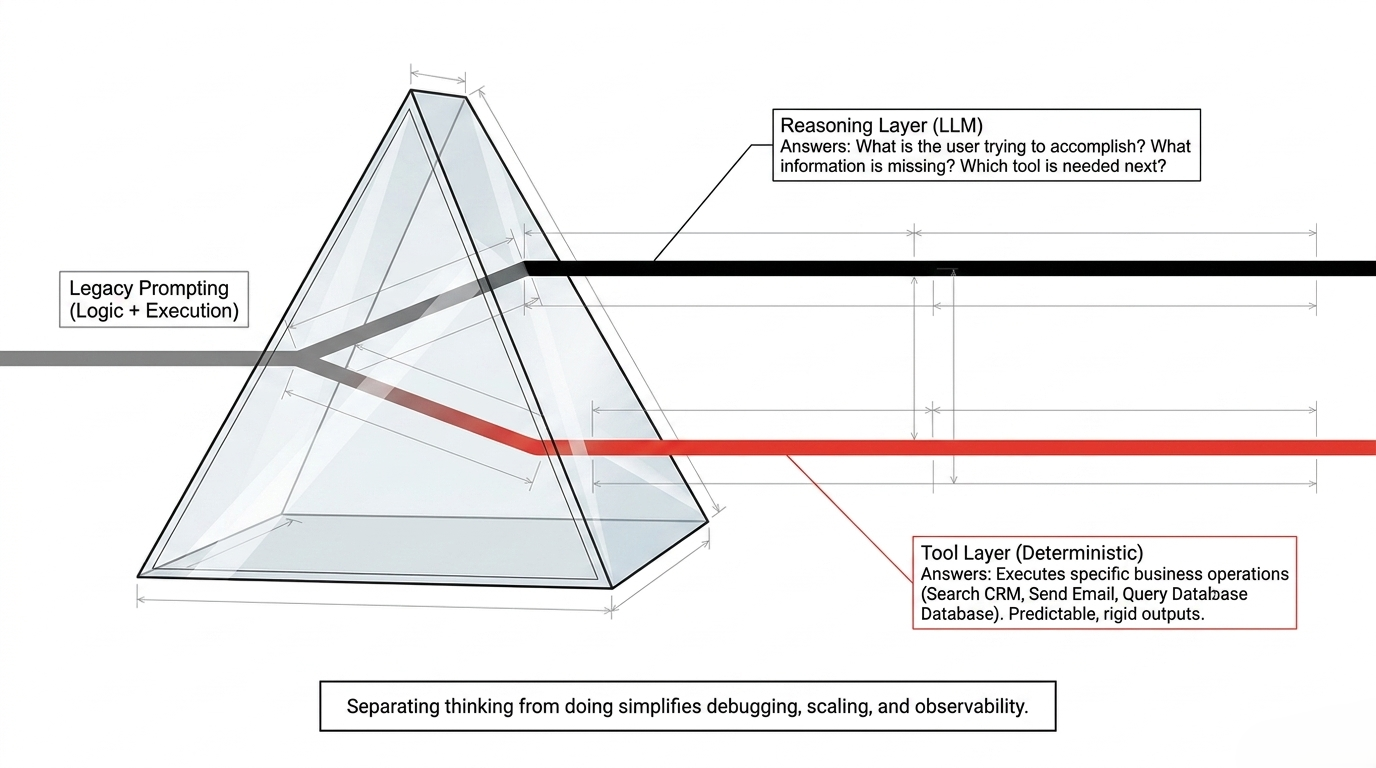
This boundary is one of the most important architectural simplifications in an agentic system. The language model remains probabilistic, but tool execution can be made deterministic, typed, logged, retried, permissioned, and tested with ordinary software techniques.
The separation also creates a cleaner debugging model. When an outcome is wrong, engineers can ask two distinct questions: Was the decision wrong, or was the execution wrong? Without that boundary, reasoning errors and integration failures become entangled inside a single opaque loop.
3. Choose the Topology Before Tuning the Model
Agentic systems can be assembled in different coordination patterns, and the topology changes the system’s operational behavior.
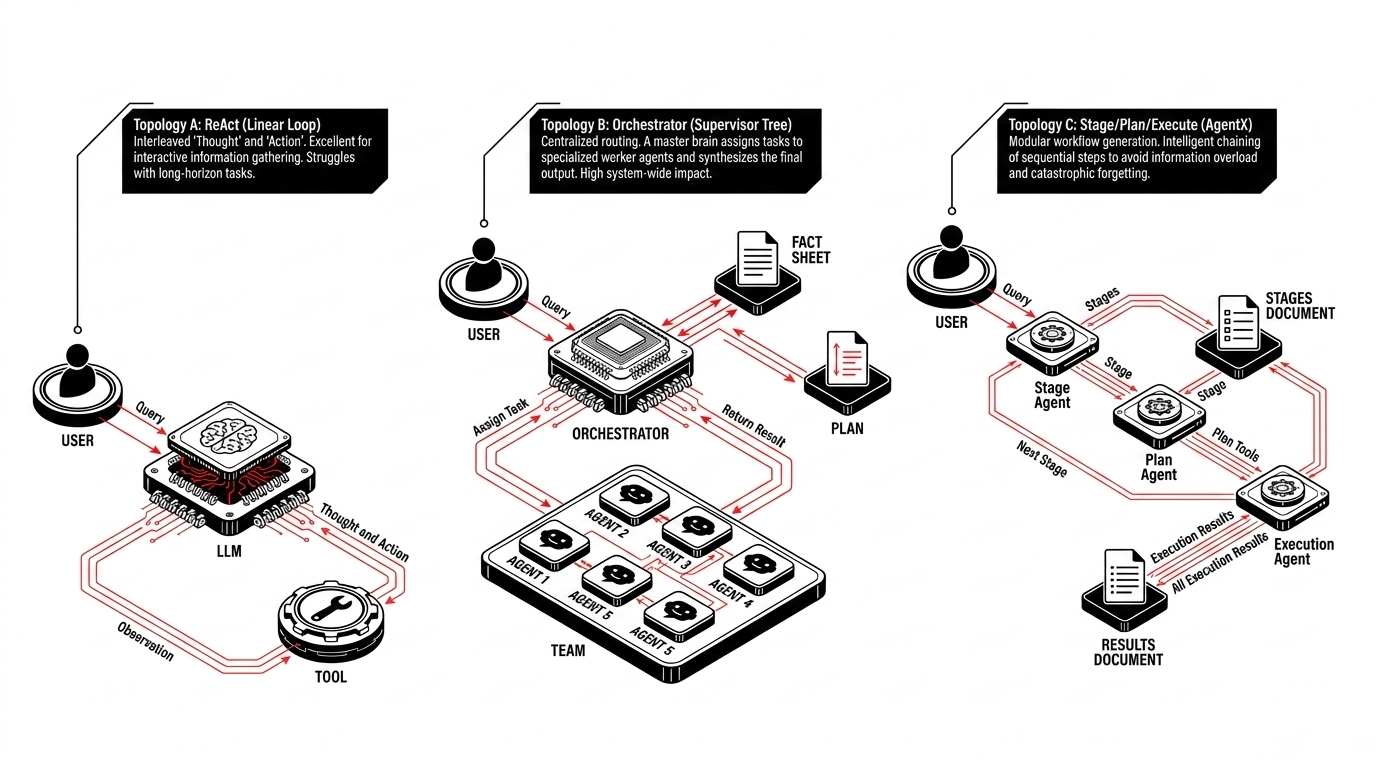
A ReAct-style loop interleaves thought, action, and observation. It is compact and useful when a task needs iterative information gathering, but long-running loops can accumulate context and may struggle when the task requires explicit long-horizon structure.
An orchestrator or supervisor pattern centralizes routing. A coordinating agent decomposes work, assigns tasks to specialists, and synthesizes results. This creates a clear control plane, although it also concentrates coordination cost and can create a system-wide bottleneck if the orchestrator carries too much context or authority.
A stage/plan/execute pattern externalizes intermediate work into explicit artifacts such as stage documents, plans, and results. That makes the workflow easier to inspect and resume. It also reduces the need for every step to retain the complete conversational history.
The engineering lesson is straightforward: architecture is part of model performance. The same underlying models can behave very differently depending on how work, state, and context are routed.
4. Measure Architectural Cost Against Task Complexity
The diagrams explicitly warn against optimizing the model before optimizing the architecture.
One illustrated comparison places a ReAct pattern at lower input-token consumption and an orchestrated pattern at substantially higher input-token consumption, while also showing higher adherence and data-accuracy for the more structured approach. The exact figures in the illustration should be treated as workload-specific, not universal benchmarks. The important point is the trade-off it represents.
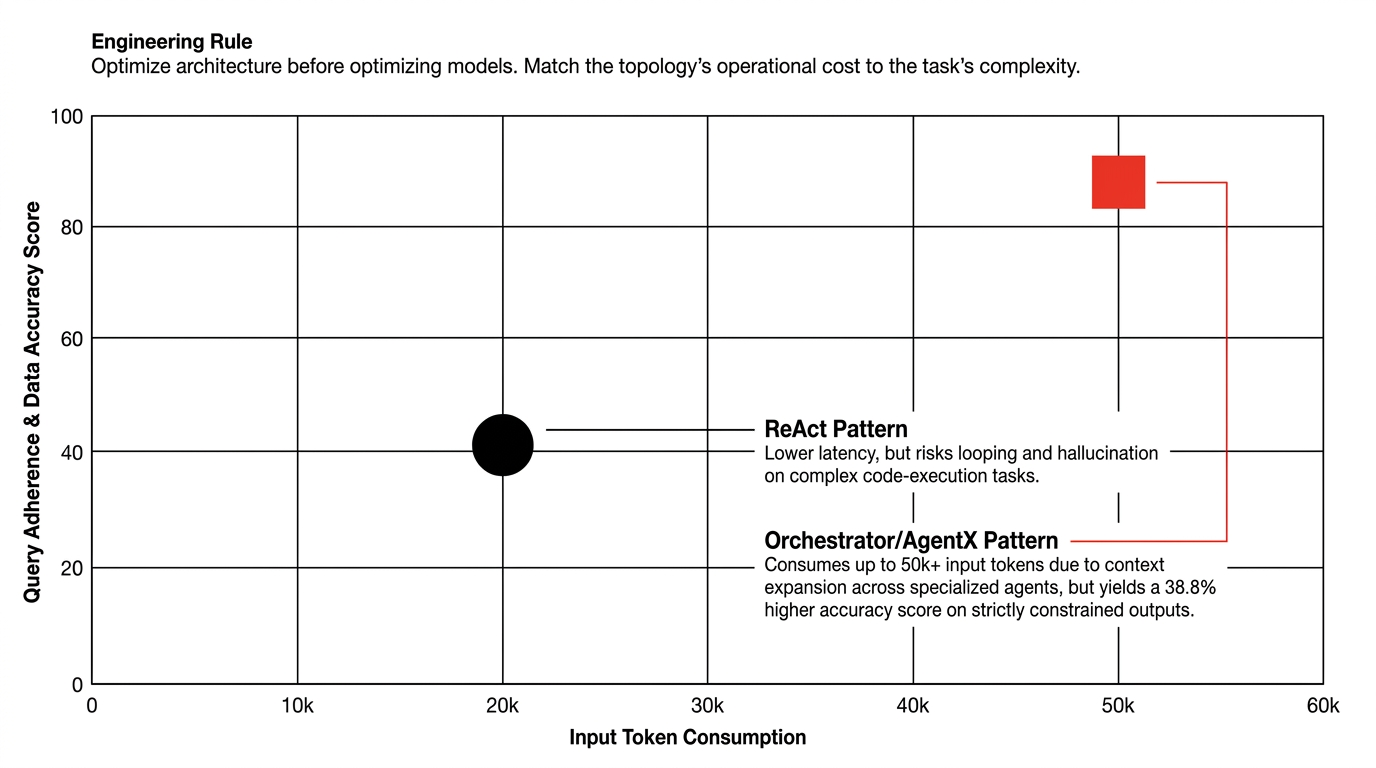
A topology that improves accuracy by multiplying context across several agents can also create a large cost surface. Context may be copied into planners, workers, reviewers, and synthesizers. The system can become more reliable on tightly constrained outputs while simultaneously becoming slower and more expensive.
That means evaluation must include both quality and operating cost. Useful measurements include:
- task success and output adherence;
- total input and output tokens;
- number of model turns;
- tool invocation count and failure rate;
- end-to-end latency;
- retry and escalation frequency;
- context growth per workflow.
The optimization target is not “the smartest agent.” It is the least expensive architecture that reliably satisfies the task’s constraints.
5. Match Framework Philosophy to the Workflow
Framework selection should follow the control model the application needs rather than popularity.
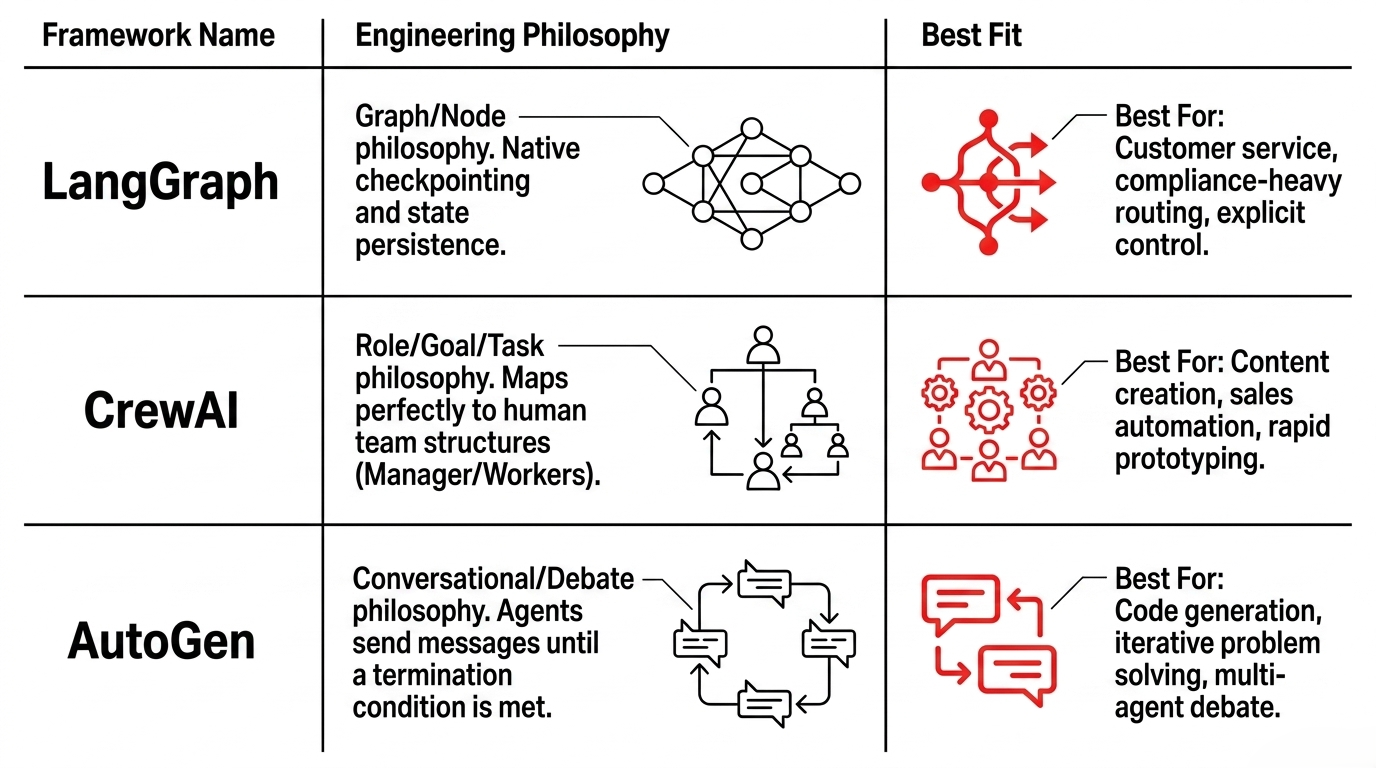
The framework comparison highlights three different mental models. LangGraph is presented as a graph/node system with checkpointing and state persistence, which aligns well with workflows requiring explicit routing and durable state. CrewAI models work in terms of roles, goals, and tasks, making it natural for manager/worker structures and business-process prototyping. AutoGen emphasizes conversational exchange between agents until a termination condition is reached, which fits iterative multi-agent discussion and code-oriented problem solving.
These are not merely API differences. They shape how engineers represent control flow, recovery, state, and agent collaboration.
A practical framework evaluation should therefore ask:
- How explicit is the workflow graph?
- Can state be persisted and resumed?
- How are tool permissions expressed?
- How are retries, timeouts, and termination handled?
- What observability is available around each agent turn?
- Can human approvals be inserted without redesigning the application?
The best framework is the one that makes the desired operating model obvious in code.
6. Give Every Agent a Shared Knowledge Substrate
Specialized agents should not become isolated islands with their own competing copies of product facts, SOPs, customer history, and policy documents.
The shared knowledge diagram instead uses a common retrieval layer: a central knowledge substrate receives business inputs and exposes retrieval through techniques such as retrieval-augmented generation, semantic or hybrid search, and metadata filtering.
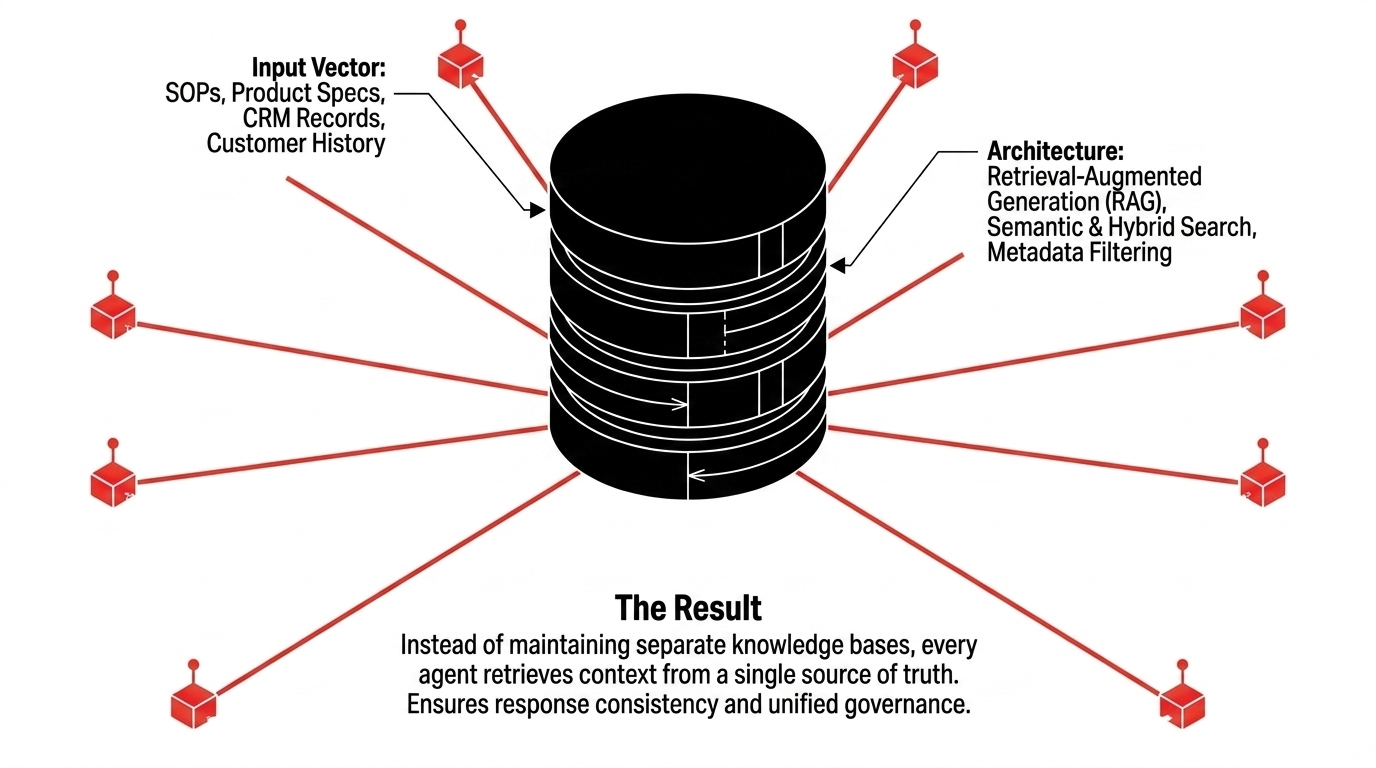
This arrangement matters for consistency. If every agent maintains its own knowledge base, the organization inherits multiple refresh pipelines, separate embedding states, divergent metadata schemes, and competing versions of “truth.” A shared retrieval layer reduces those inconsistencies and centralizes governance.
The shared layer should still enforce role-aware access. A support agent and a finance agent may query the same substrate but receive different document scopes, fields, or metadata filters. Centralization of knowledge is not the same thing as universal visibility.
A robust retrieval service should therefore provide versioned ingestion, provenance, document-level permissions, relevance evaluation, stale-content handling, and traceable citations back to source material.
7. Invert the Integration Model: Skills First, Routes Second
Traditional application architecture often starts from delivery mechanisms: an HTTP route is implemented, then separate tool wrappers or agent integrations are added around the same business logic.
The “skill-first” inversion makes the reusable capability the primary unit. A skill folder contains the handler and its input/output models, and the same skill can be exposed through an HTTP route or an MCP tool.
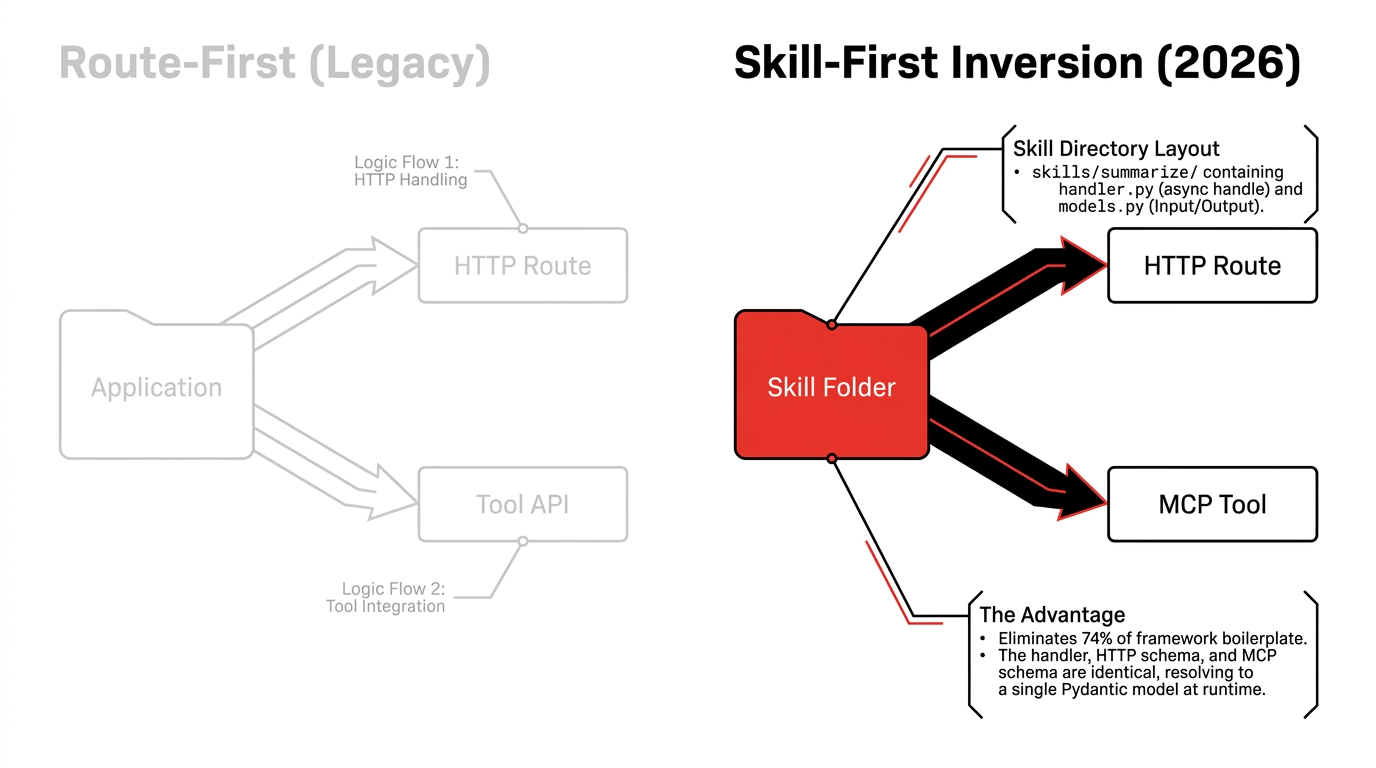
The architectural benefit is not the specific directory name. It is that business logic has one canonical implementation. Transport adapters become thin surfaces over a shared capability contract.
This also aligns agent tooling with ordinary software design. Instead of writing an “agent-only” version of a capability, teams can create a typed function that is usable by API clients, background jobs, tests, and agents. The agent interface becomes another adapter rather than a second application.
The diagram claims a large reduction in framework boilerplate for this approach. That percentage is specific to the illustrated implementation, but the general principle is broadly useful: every duplicated schema, validator, and handler is another opportunity for interface drift.
8. Discover Tools Dynamically Instead of Loading Everything
As tool catalogs grow, attaching every available tool definition to every model call becomes expensive and cognitively noisy.
The skill registry / adapter hub pattern addresses this by turning tool discovery into a retrieval problem.
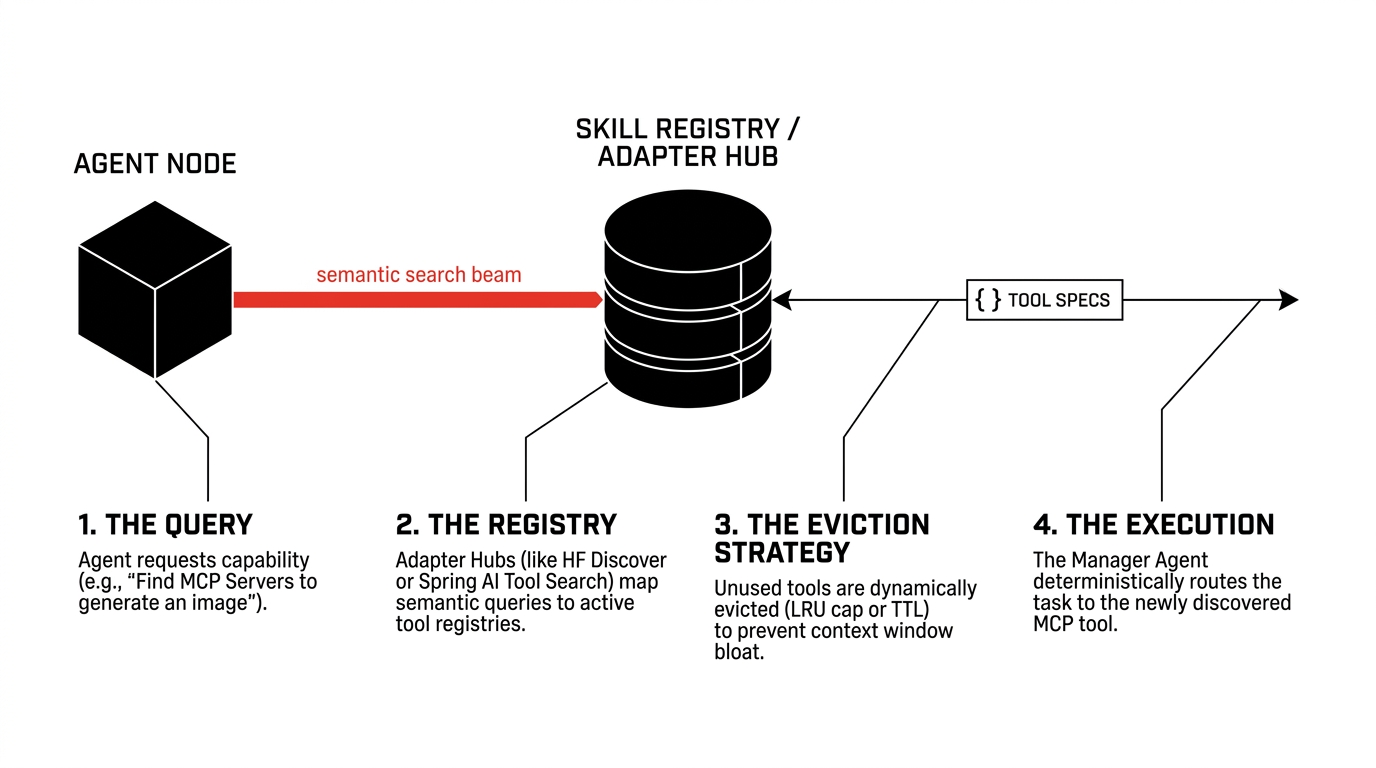
The flow is explicit:
- The agent requests a capability rather than naming a specific implementation.
- A registry maps the semantic query to active tool definitions.
- Unused tools can be evicted from active context using policies such as an LRU cap or TTL.
- A manager or routing component deterministically sends the task to the selected tool.
This pattern keeps the active context proportional to the current task rather than proportional to the entire enterprise integration catalog.
It also creates a natural governance point. The registry can filter tools by tenant, environment, user role, risk class, data residency, or approval state before a tool specification ever reaches the model.
Dynamic discovery becomes especially important when MCP and similar tool protocols expand the number of available integrations. Without a registry, context growth can become an architectural failure mode of its own.
9. Scale Human Intervention with Workflow Risk
Autonomy should not be a global switch.
The risk curve in the next diagram maps the level of human intervention to the risk of the workflow. Low-risk tasks such as CRM enrichment, document classification, or meeting summaries can often run autonomously. Medium-risk workflows can use human-on-the-loop supervision, where people monitor and intervene on exceptions. High-risk actions such as financial approvals or contract generation can require a human-in-the-loop approval gate before execution continues.
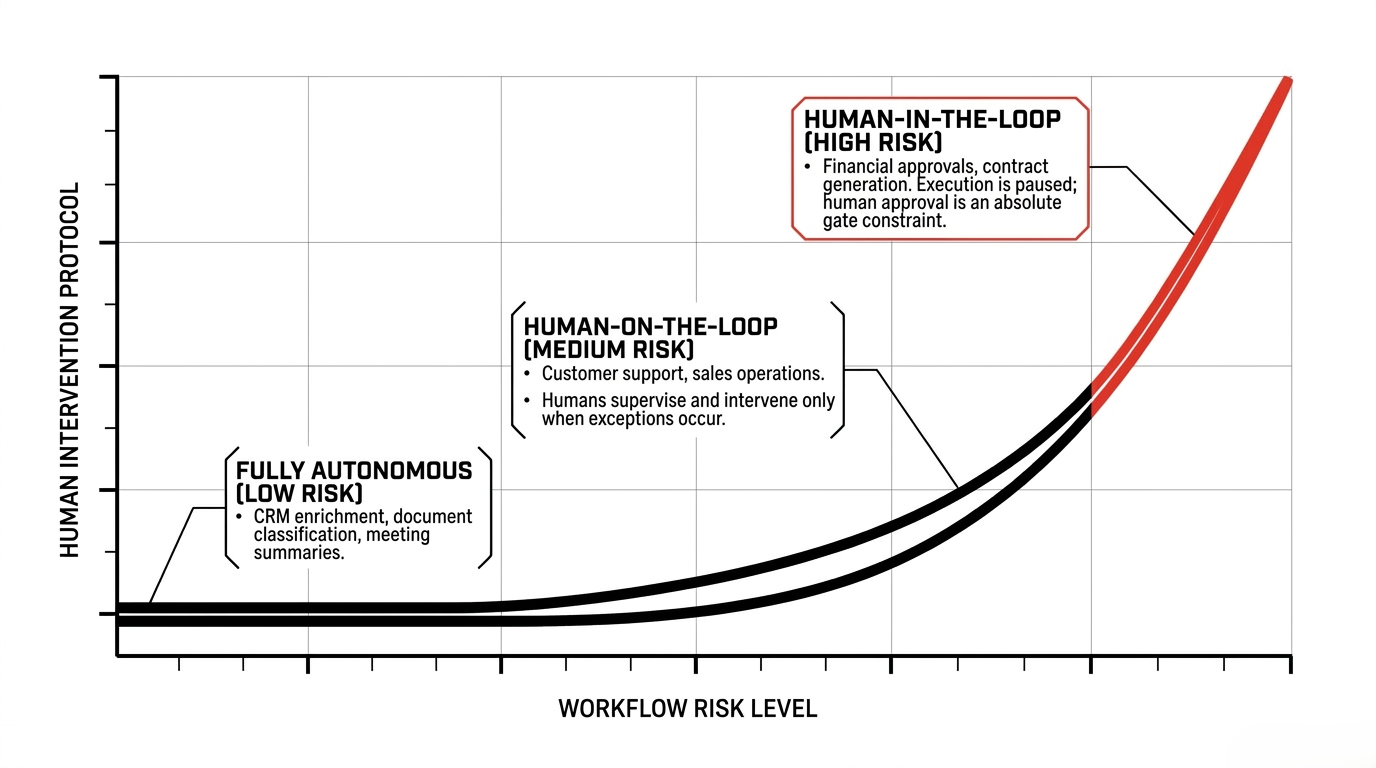
This is a better control model than asking whether “the agent” is autonomous. A single agentic platform may contain workflows across all three modes.
The important engineering requirement is to make the escalation policy explicit. Risk classification should be based on properties such as reversibility, financial impact, data sensitivity, legal effect, external side effects, and confidence. Approval events should also be first-class state transitions that can be audited and replayed.
Human oversight then becomes part of workflow design rather than an emergency patch applied after deployment.
10. Observe Business Outcomes, Not Just Model Activity
Agent observability needs multiple layers because no single metric explains whether the system is healthy.
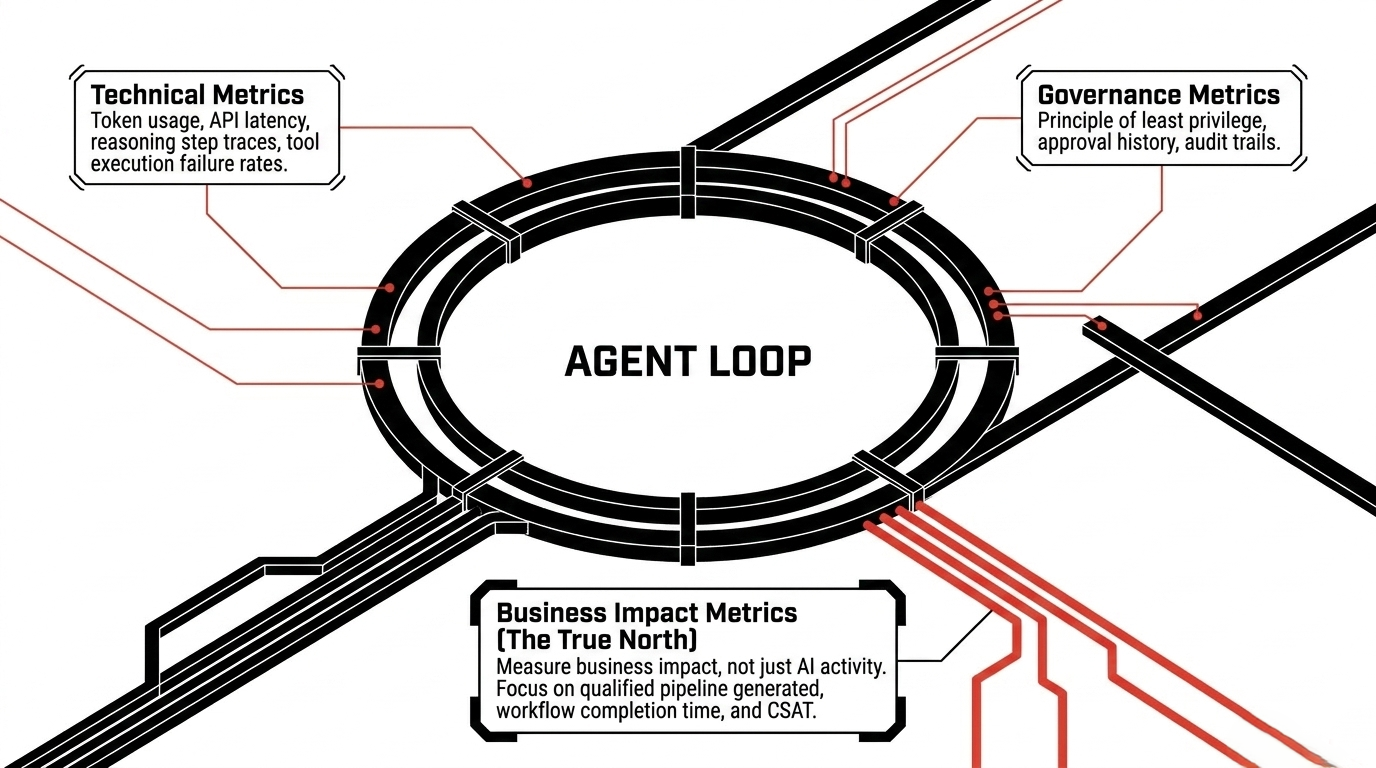
Technical metrics answer whether the system is functioning: token usage, API latency, reasoning traces, and tool execution failures. Governance metrics answer whether the system is operating within policy: least-privilege access, approval history, and audit trails.
But the “true north” metrics are business outcomes. Qualified pipeline generated, workflow completion time, and customer satisfaction are examples from the diagram. The point is to distinguish productive work from raw AI activity.
A system can increase tokens, tool calls, and agent turns while making the business process worse. It can also look technically healthy while violating approval or permission requirements. Production observability must connect all three views.
A useful trace should therefore let an operator move from a business outcome back through the workflow, agent decisions, retrieved context, tool calls, policy checks, and human approvals that produced it.
11. Put Observability and Governance Over the Entire Ecosystem
The final architecture diagram brings the pieces together into an enterprise-scale system.
A central orchestration engine coordinates specialized agents. Those agents connect through tool registries to CRM, ERP, databases, third-party APIs, communication tools, and IoT systems. An observability and governance canopy spans the environment, collecting audit trails, risk analysis, performance metrics, and compliance checks.
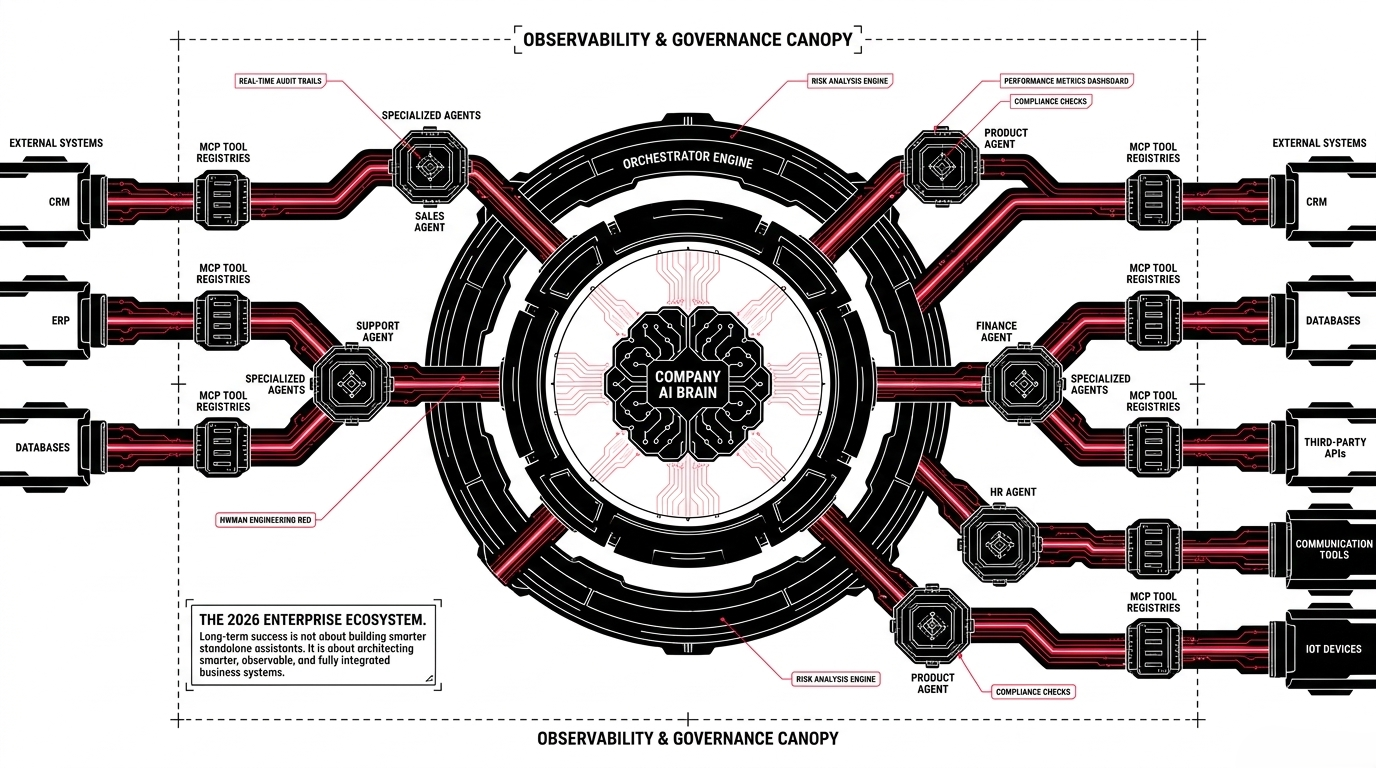
The important word is canopy. Governance is not another agent sitting beside the others. It is a cross-cutting control plane that watches and constrains the full system.
This architecture also changes how “enterprise AI” should be framed. The production objective is not a collection of standalone assistants. It is a coordinated software ecosystem in which agentic components participate in existing business systems under the same disciplines expected of other production services: explicit interfaces, least privilege, logging, policy enforcement, failure isolation, and measurable service outcomes.
Engineering Principles
The architecture ultimately depends on several principles:
-
Specialize around outcomes
Define agents by bounded business responsibility so that prompts, permissions, evaluations, and ownership stay tractable. -
Keep execution deterministic where possible
Let models decide what needs to happen, but let typed tools perform side effects through validated interfaces. -
Treat topology as an optimization variable
ReAct loops, supervisors, and staged workflows have different cost, state, and reliability properties. Choose the structure that matches the task. -
Centralize shared truth and capability discovery
Use governed retrieval for knowledge and registries for tools so agents do not carry unnecessary or inconsistent context. -
Make control proportional to risk
Autonomy, supervision, and mandatory approval should be workflow policies, not one platform-wide setting. -
Measure the system end to end
Technical telemetry, governance evidence, and business outcomes must be traceable across the same execution path.
Final Synthesis
A production-ready agentic platform is best understood as a layered software architecture rather than a collection of clever prompts.
At the bottom are deterministic capabilities: APIs, data stores, enterprise systems, and reusable skills. Above them sit registries and retrieval services that determine which tools and knowledge are relevant. Specialized agents apply reasoning within bounded roles. Orchestration topology coordinates those agents according to task complexity. Human approval policies constrain high-risk actions. Finally, observability and governance span the entire execution path.
The production-ready system combines:
- A deterministic foundation of typed tools, explicit schemas, and controlled side effects.
- A testing layer that evaluates agent decisions, tool contracts, workflow completion, and failure recovery.
- An agent layer composed of specialized roles rather than a single all-purpose super agent.
- Security and governance through least privilege, approvals, auditability, and risk-aware execution.
- An observability layer that connects technical traces to policy evidence and business outcomes.
- A production outcome in which agentic components become composable parts of the enterprise software estate.
The architecture does not eliminate probabilistic behavior. It contains it inside a system that is otherwise designed to be inspectable, governable, and recoverable.
Closing Thought
The most scalable agentic systems will not be the ones with the longest prompts, the largest tool lists, or the most agents.
They will be the ones that make uncertainty explicit, isolate it behind deterministic boundaries, and connect every autonomous action to a measurable business purpose.
Build the architecture that makes the agent understandable before building the agent that looks intelligent.