
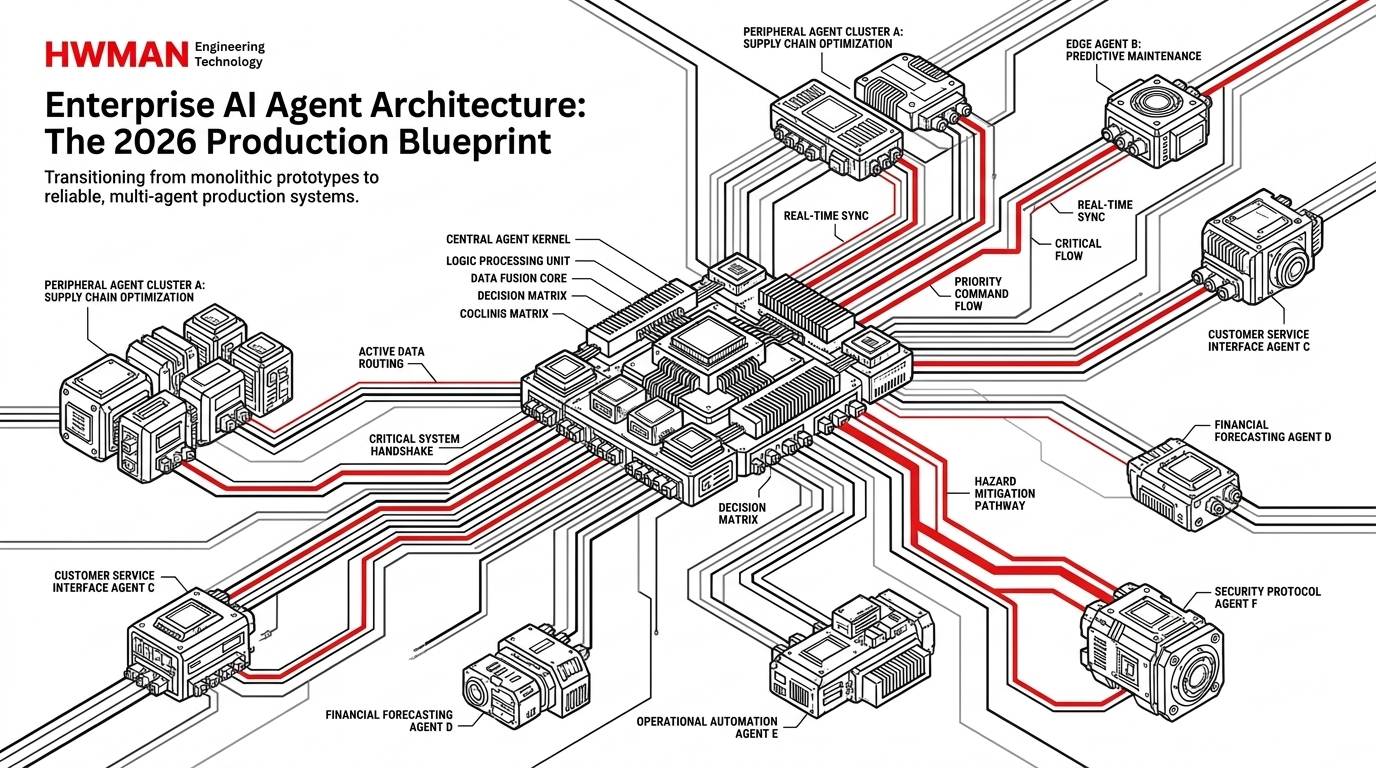
Enterprise AI Agent Architecture: The 2026 Production Blueprint
The difficult part of enterprise AI is not getting an agent to work once. It is designing an operating model that keeps working when the system gains more tools, more data sources, more users, more security boundaries, and more business-critical decisions.
The architecture in this blueprint treats agentic AI as a distributed production system rather than a single prompt wrapped around a large language model. Specialized agents sit around a central orchestration layer, deterministic tools execute bounded actions, knowledge is centralized, permissions are scoped, and high-risk operations are governed explicitly.
The core thesis is architectural: reliability comes from separation of concerns. Reasoning, orchestration, tool execution, context management, security, evaluation, and optimization should be designed as distinct layers with clear contracts between them.
1. Replace the Monolith with Specialized Micro-Agents
A monolithic agent is attractive during prototyping because one model can be connected to many business systems at once. The same design becomes fragile in production. The blueprint highlights several failure modes: simultaneous requests compete for shared resources, latency spikes propagate across unrelated domains, context from one task can contaminate another, and the entire system can inherit a single point of failure.
The proposed alternative is a set of specialized agents connected through an enterprise orchestration bus. Prospecting, CRM, and knowledge tasks become isolated execution domains, each with its own tools and knowledge boundary. That isolation reduces the blast radius of failures and allows teams to update or maintain one capability without rebuilding the entire agent system.
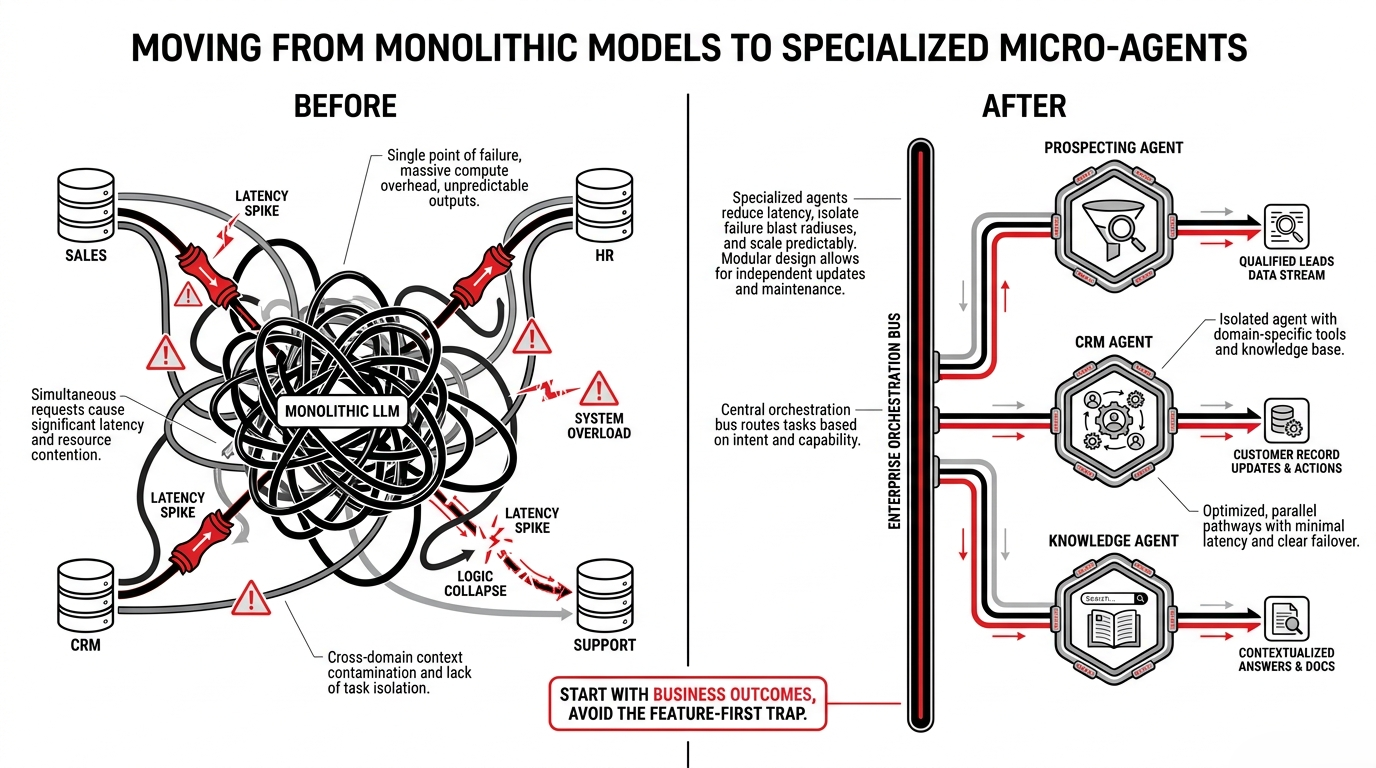
The important change is not merely that there are more agents. It is that responsibility becomes explicit. The orchestrator decides where work should go, while domain agents handle narrower tasks with more predictable inputs, outputs, and operational behavior.
This also changes how teams should prioritize architecture. The visual's instruction to start with business outcomes is a useful guardrail: specialization should follow distinct operational responsibilities, not a desire to create more agent features.
2. Isolate Probabilistic Reasoning from Deterministic Execution
Language models are useful for interpretation, planning, and context-sensitive reasoning, but those properties are probabilistic. Production systems still need deterministic interfaces for actions such as API calls, database operations, workflow transitions, and policy checks.
The blueprint therefore separates three layers: a reasoning layer for LLM logic and planning, a workflow layer for state and orchestration, and a tool layer for deterministic execution and external integrations.
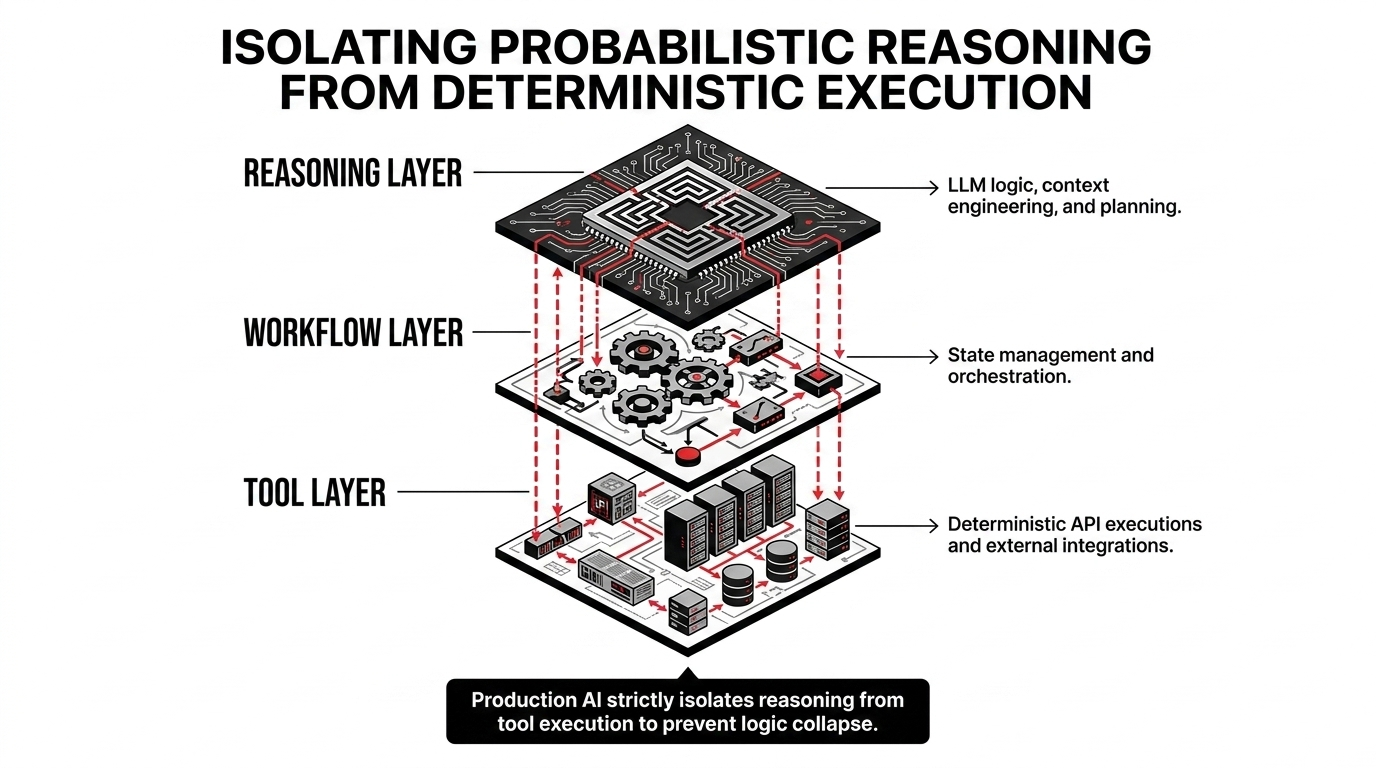
This separation creates an architectural boundary between deciding what should happen and executing what is allowed to happen. The workflow layer becomes the control plane: it stores state, evaluates transitions, routes work, and mediates between open-ended reasoning and bounded operations.
The practical implication is that an LLM should not need to encode every operational rule in prose. Deterministic tools and workflow nodes can carry invariants that must remain stable even when model outputs vary.
3. Choose Agent Behavior Patterns Deliberately
Not every task needs the same reasoning loop. The blueprint presents three behavioral patterns: direct tool use, ReAct-style iterative reasoning, and reflection.
Direct tool use is suited to simple, single-step work. ReAct introduces a loop in which the model alternates between thought, action, and observation. Reflection adds a critic or review pass that recursively improves an output before it is accepted.
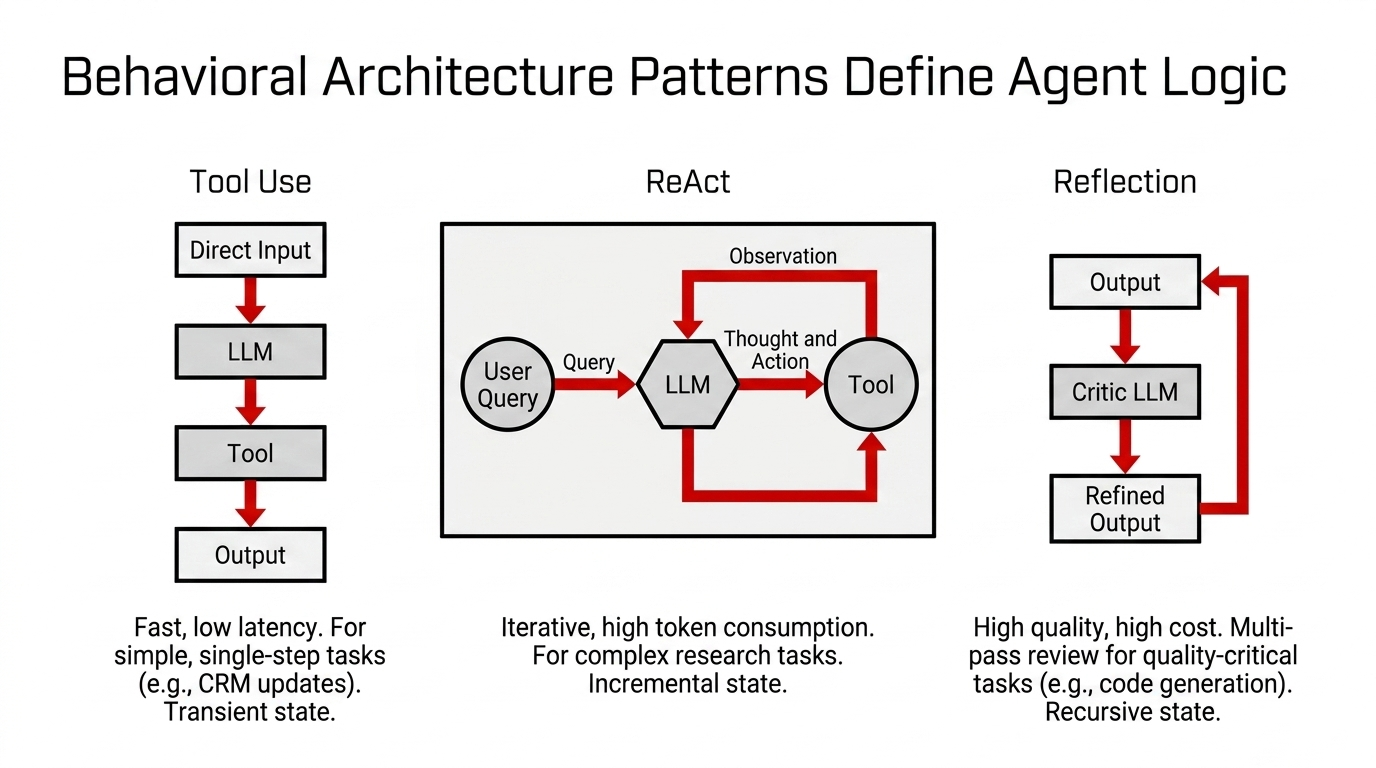
Each pattern carries a different operational profile:
- Tool use minimizes latency and keeps state transient.
- ReAct supports complex research and incremental state, but consumes more tokens and introduces more opportunities for branching behavior.
- Reflection can improve quality for high-stakes outputs, but adds cost and recursive state.
The production question is therefore not "Which pattern is best?" but "Which pattern matches the task's failure tolerance, cost envelope, and verification requirements?" Behavior should be selected per workflow rather than hard-coded across the entire platform.
4. Topology Determines Coordination and Failure Scope
Once multiple agents exist, coordination topology becomes a first-class design decision. The blueprint contrasts sequential chains, parallel fan-out/fan-in, centralized orchestration, and hierarchical supervision.
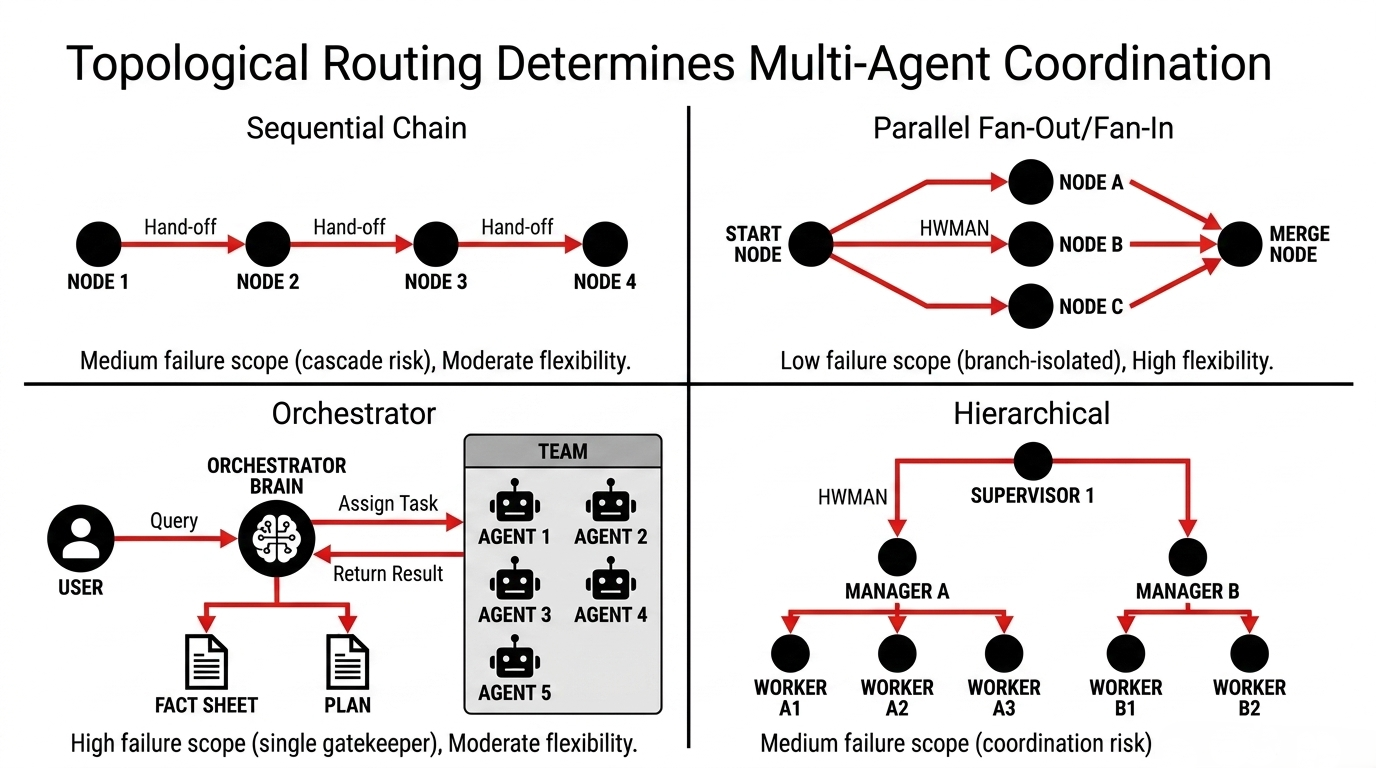
A sequential chain is straightforward but can accumulate cascade risk because later nodes depend on upstream results. Parallel fan-out isolates branches and can reduce latency where tasks are independent, but it requires a merge strategy. A centralized orchestrator offers clear delegation and a single control point, while also creating a gatekeeper whose failure can affect the whole workflow. Hierarchical structures distribute supervision across multiple levels, but coordination complexity increases.
The engineering takeaway is that topology encodes both performance and risk. Teams should decide where they want serialization, where they want parallelism, where they need arbitration, and where a supervisory boundary is worth the added complexity.
5. Framework Choice Should Follow Architectural Needs
The blueprint compares three production frameworks through the capabilities they emphasize. LangGraph is presented as graph-based and stateful, with explicit control and checkpointing. CrewAI is presented as role-based and hierarchical, emphasizing ease of use and built-in tools. AutoGen is presented as conversational and debate-oriented, with emergent logic and code execution.
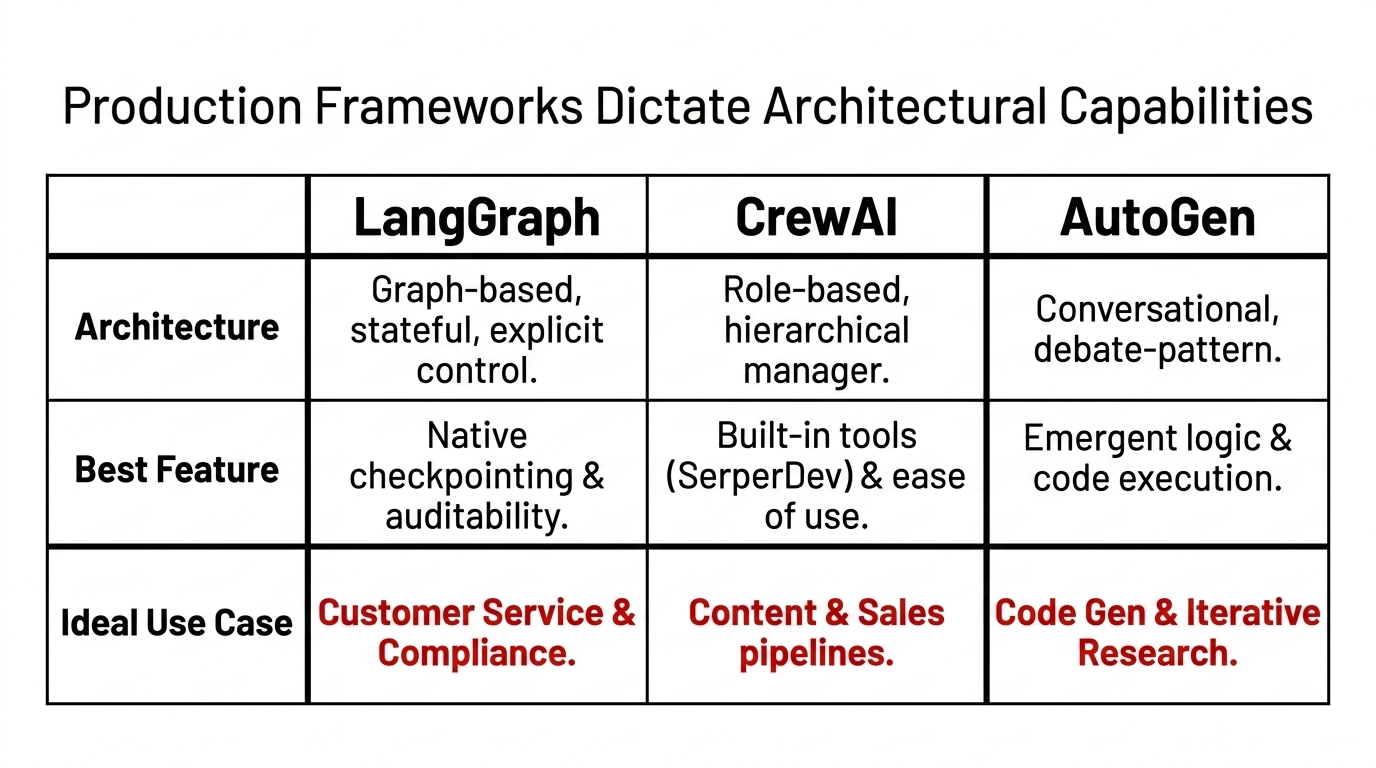
The comparison is useful because it reframes framework selection as an architectural decision rather than a popularity contest. A team prioritizing auditable state transitions may value a graph-native model. A team building role-driven content or sales workflows may prefer an opinionated hierarchical abstraction. A team exploring iterative code generation or research may value conversational coordination.
The broader principle is to choose the framework that makes the desired control model explicit. If the framework fights the system's operational requirements, the team will eventually reimplement orchestration, state management, or governance around it.
6. Build a Shared Enterprise Knowledge Brain
Multi-agent systems become difficult to govern when every agent owns a separate retrieval stack. The blueprint replaces isolated RAG applications with a centralized "Company AI Brain" that exposes vector embeddings, semantic search, metadata filtering, and persistent knowledge.
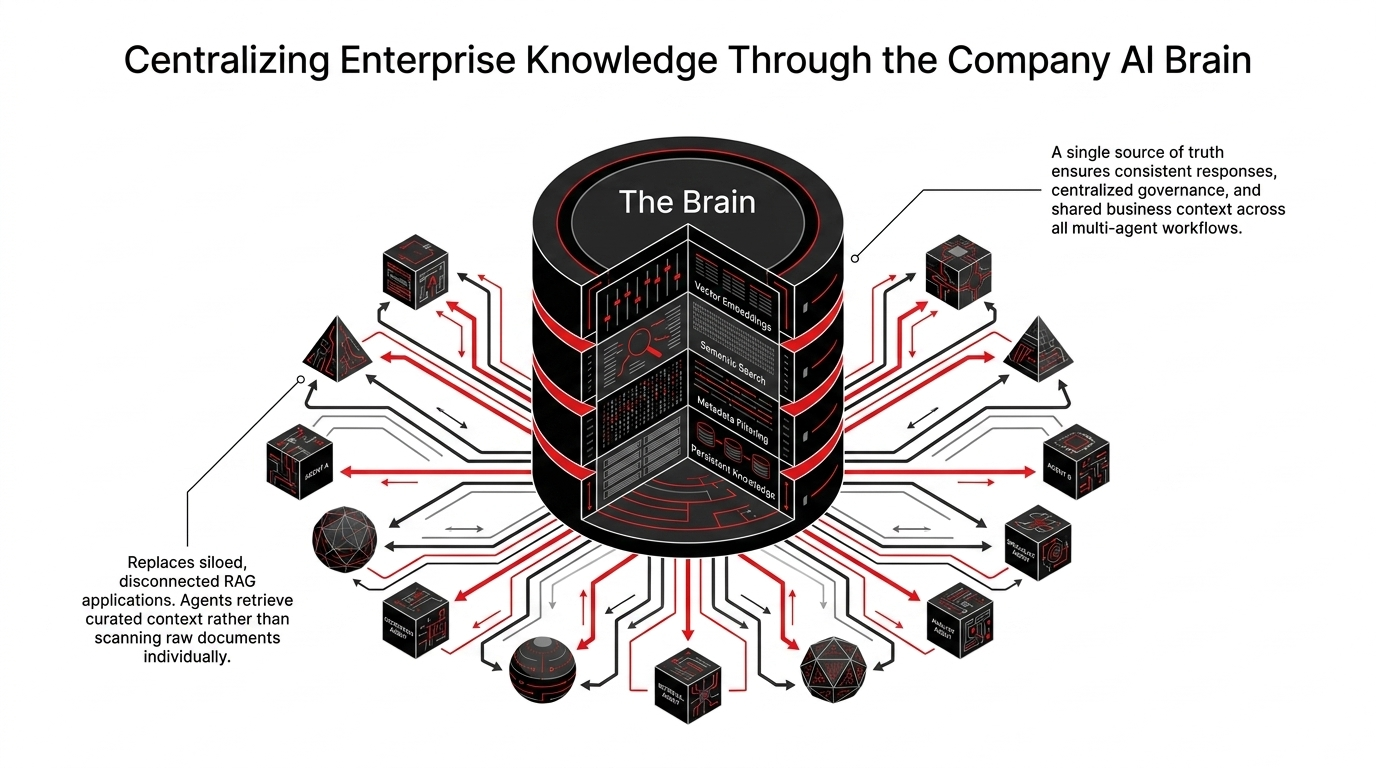
The architecture treats shared knowledge as infrastructure. Agents retrieve curated context from a common source rather than independently scanning raw documents. This supports consistent responses, common governance, and reuse of business context across workflows.
Centralization does not mean that every agent should see everything. The knowledge layer still needs filtering, policy, and access boundaries. Its value comes from creating one governed substrate on top of which specialized views can be assembled for different agents.
7. Use Progressive Tool Discovery Instead of Loading Everything into Context
An enterprise may expose hundreds or thousands of APIs, but putting every tool description into every prompt is not scalable. The blueprint uses the Model Context Protocol (MCP) as a discovery mechanism between an agent, an adapter hub or registry, and a large catalog of enterprise capabilities.
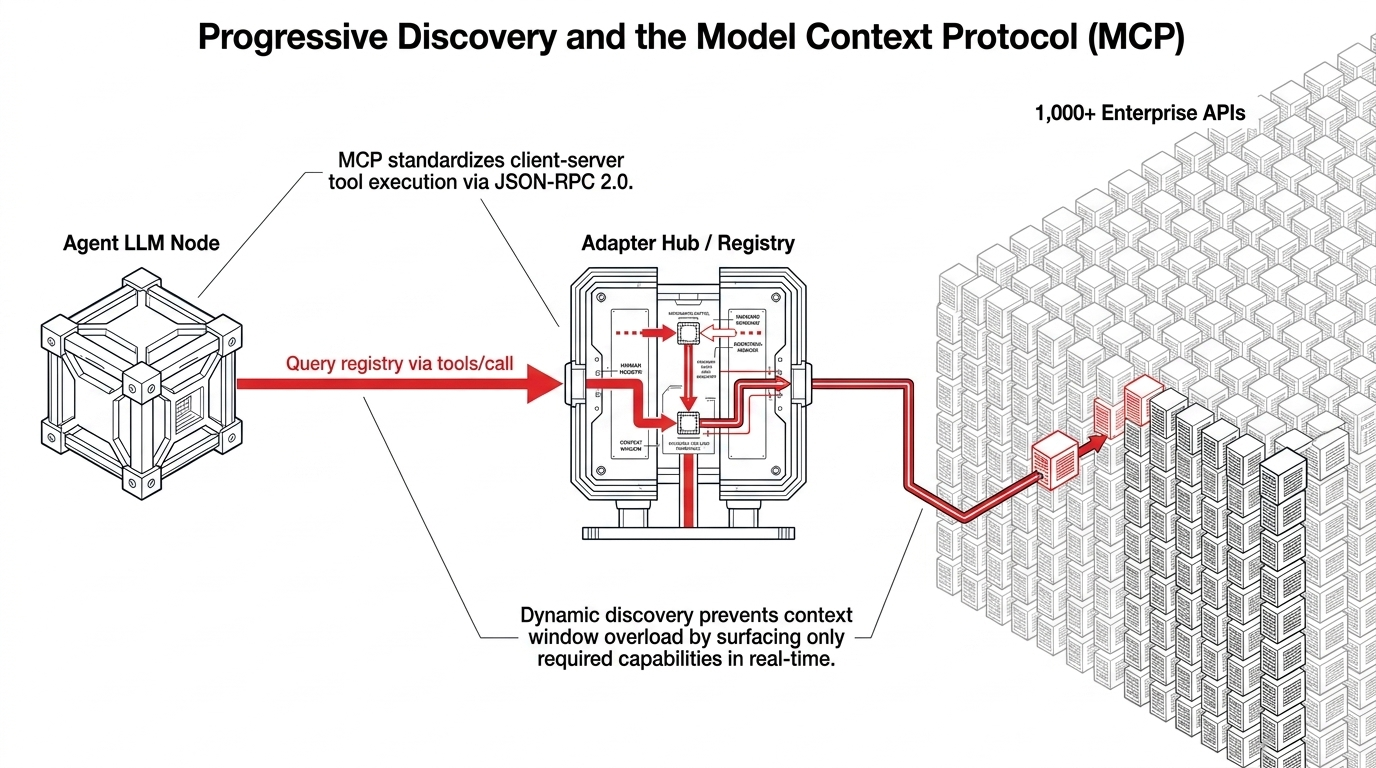
The agent queries the registry and surfaces only the capabilities required for the current task. This is a form of progressive discovery: the context window contains a relevant subset of tools instead of the entire integration estate.
The architecture improves modularity in two ways. First, the registry decouples agent reasoning from direct knowledge of every backend integration. Second, the standardized client-server interface creates a consistent way for agents to discover and invoke tools without baking each integration into the agent itself.
8. Standardize Skills as Composable Modules
Tool discovery only works reliably if capabilities are packaged consistently. The blueprint proposes a standardized skill architecture with three core artifacts: SKILL.md for manifest and metadata, models.py for typed input/output schemas, and handler.py for deterministic execution logic.
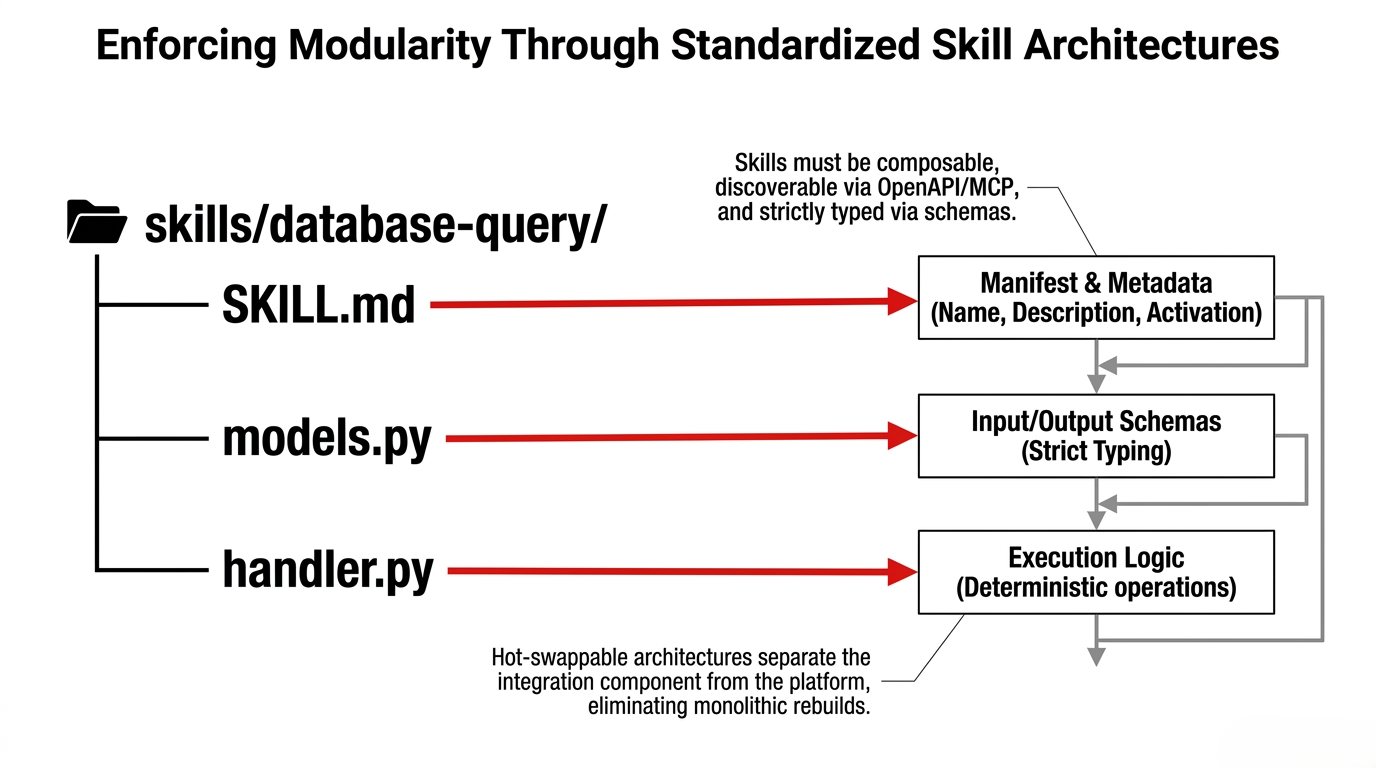
This structure separates capability description, contract, and implementation. The manifest explains what a skill is and when it should activate. Schemas define what data may cross the boundary. The handler performs the actual operation.
That separation makes capabilities hot-swappable. A platform can discover or replace an integration without rebuilding the entire agent runtime, while strict typing reduces ambiguity at the boundary between probabilistic reasoning and deterministic execution.
9. Control Context Growth as a Production Resource
Long-running reasoning loops naturally accumulate observations, tool results, and intermediate state. If every interaction is appended indefinitely, context grows until the system pays a latency and cost penalty and may eventually degrade in reasoning quality.
The blueprint contrasts a ReAct-style accumulation pattern with a more modular pattern that selectively drops obsolete observations.
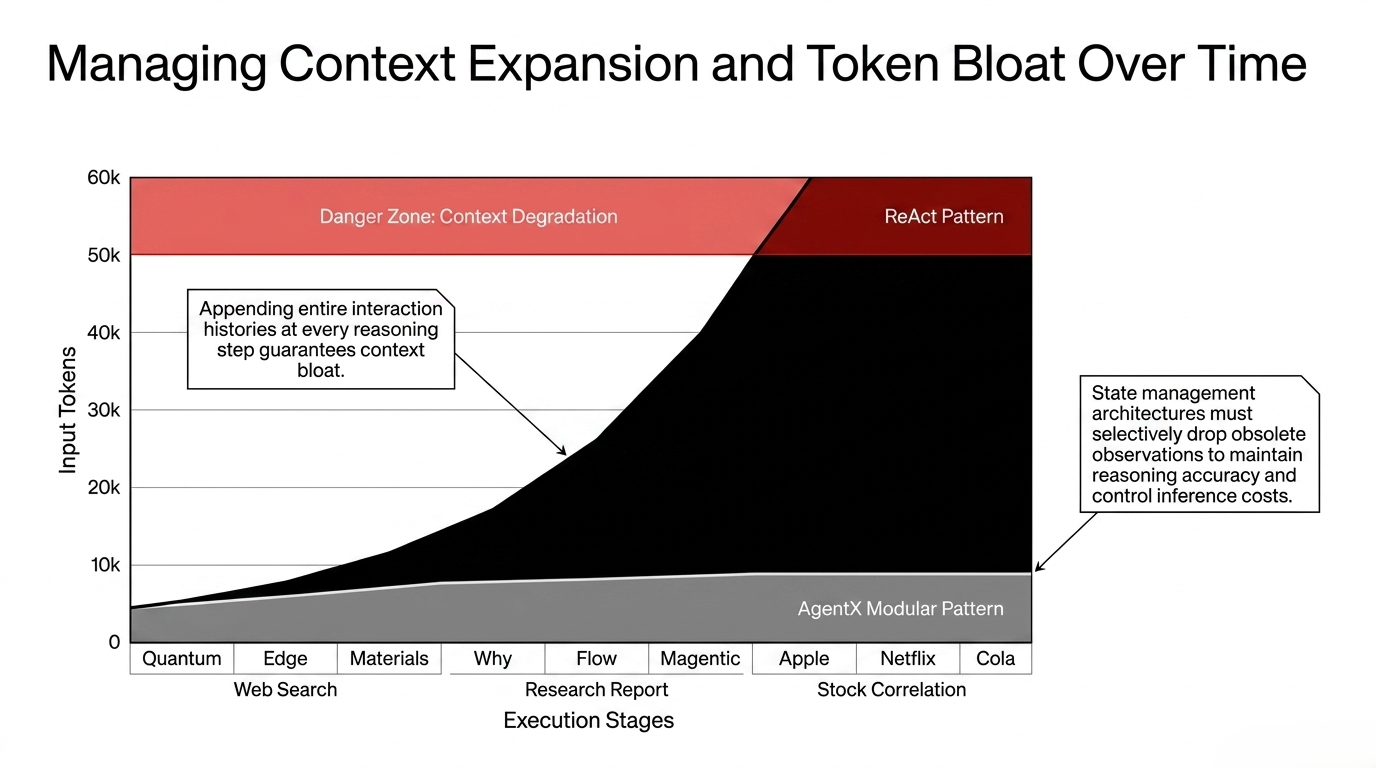
The lesson is that memory should be managed, not merely retained. Production state architectures need rules for summarization, retention, eviction, and rehydration. Some facts should persist; transient observations should expire; derived state may need to be compressed into a smaller representation.
Context management is therefore part of reliability engineering. Token growth affects cost, latency, and model behavior, so the context window must be treated as a bounded operational resource.
10. Put Humans at Explicit Approval Boundaries
Autonomy is not binary. The blueprint distinguishes human-in-the-loop controls, which pause execution for explicit approval, from human-on-the-loop controls, which monitor ongoing work and intervene on exceptions.
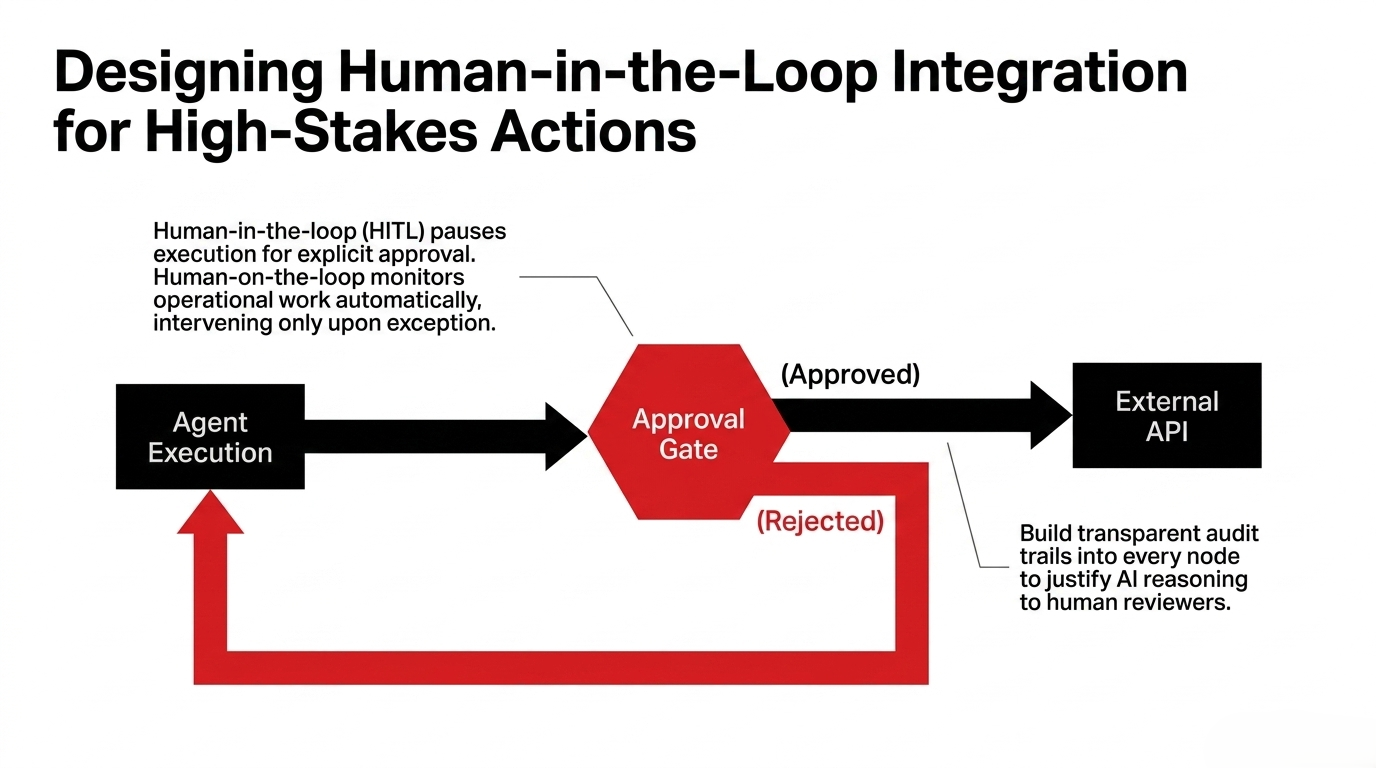
An approval gate sits between agent execution and an external API. Approved actions continue; rejected actions return to the workflow. The visual also emphasizes transparent audit trails so that reviewers can understand why an action was proposed.
This design turns human oversight into a workflow primitive instead of an informal process outside the system. High-stakes operations can require confirmation, while lower-risk work can continue automatically under monitoring. The control can be applied selectively based on action type, data sensitivity, or business impact.
11. Apply Concentric Security and Least Privilege
Security must surround the agent rather than be added after the workflow is designed. The blueprint illustrates concentric governance layers: agent logic sits at the center, surrounded by identity and authorization controls, scoped OAuth permissions, sandboxed execution, and protected enterprise systems.
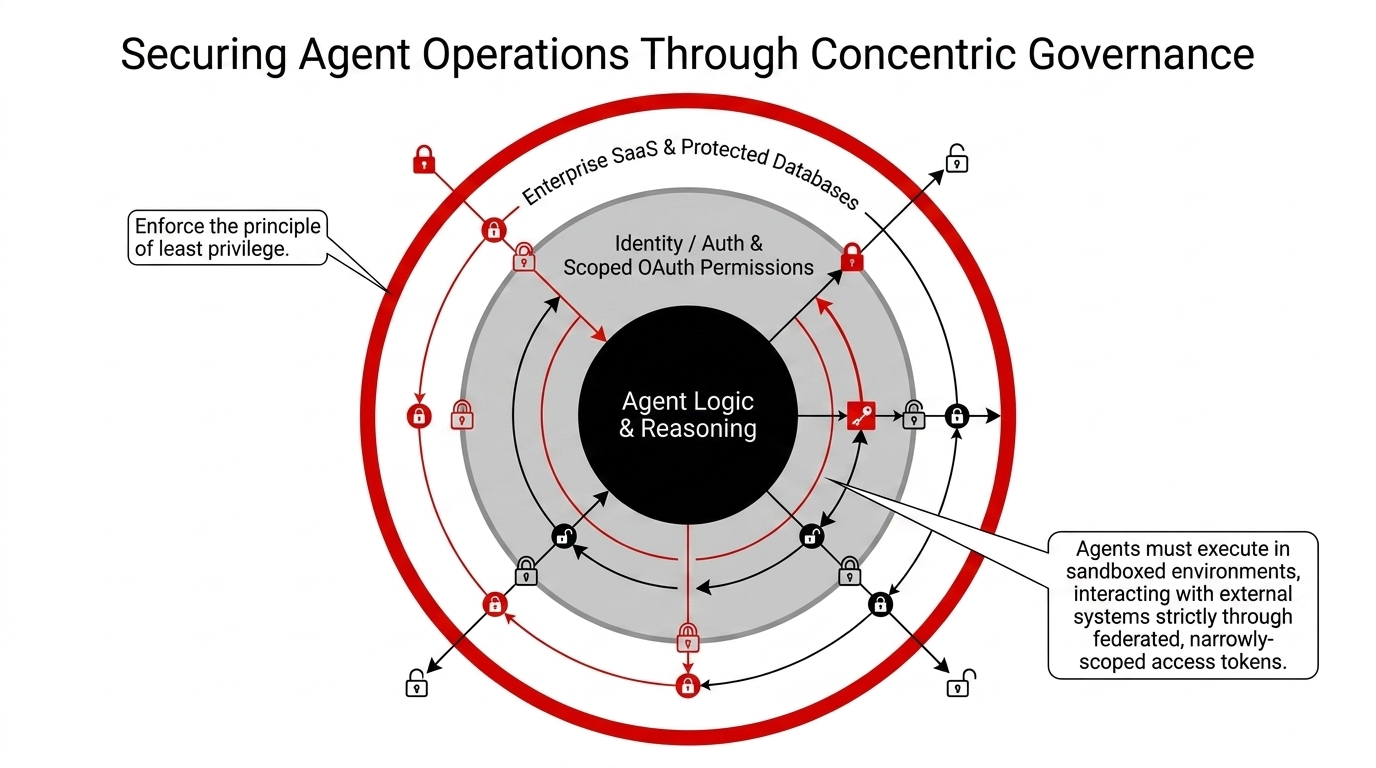
The design follows the principle of least privilege. An agent should receive narrowly scoped credentials for the specific action it needs, and external interactions should pass through controlled, federated interfaces.
This matters because the model is not the security boundary. Prompts can be ambiguous and reasoning can vary. The enforceable boundary belongs in identity systems, permission scopes, tool contracts, sandboxing, and policy gates that remain deterministic regardless of what the model proposes.
12. Evaluate Probabilistic Systems with Probabilistic QA
Traditional software testing often uses binary assertions: a known input either matches the expected output or it does not. The blueprint argues that LLM outputs require a broader evaluation model because responses can vary with temperature, prompts, context, and model state.
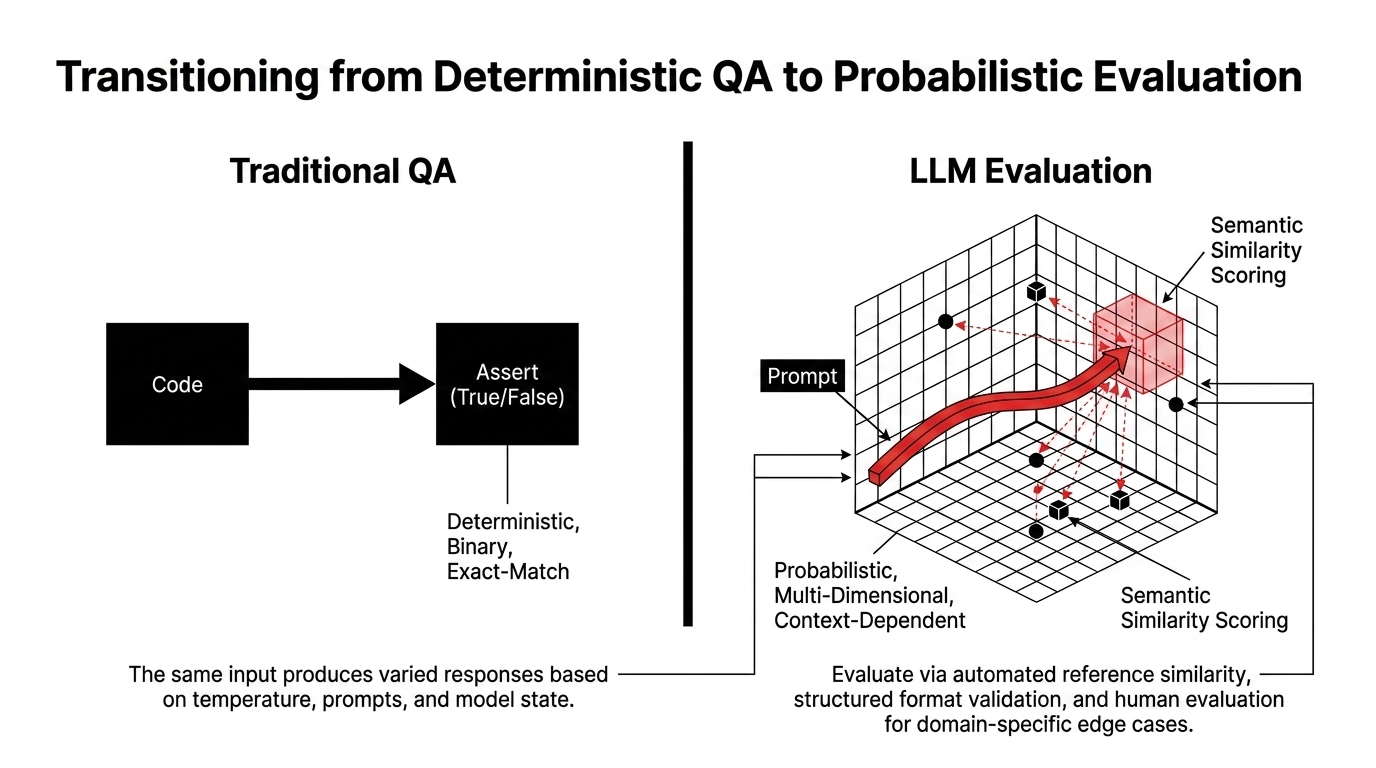
The proposed evaluation approach combines multiple dimensions: reference similarity, semantic scoring, structured format validation, and human review for domain-specific edge cases. The goal is not to abandon deterministic tests, but to apply them where they make sense and augment them where exact-match assertions are too brittle.
A production evaluation suite should therefore separate concerns. Schema compliance, tool-call validity, policy enforcement, and workflow transitions can be tested deterministically. Natural-language usefulness or semantic correctness may require scored evaluation, reference sets, or human judgment.
13. Treat Deployment as the Start of the Optimization Loop
The blueprint closes the operational lifecycle with a continuous optimization loop: collect explicit and implicit feedback, monitor performance, identify weaknesses, refine prompts or weights, update knowledge, test, and deploy again.
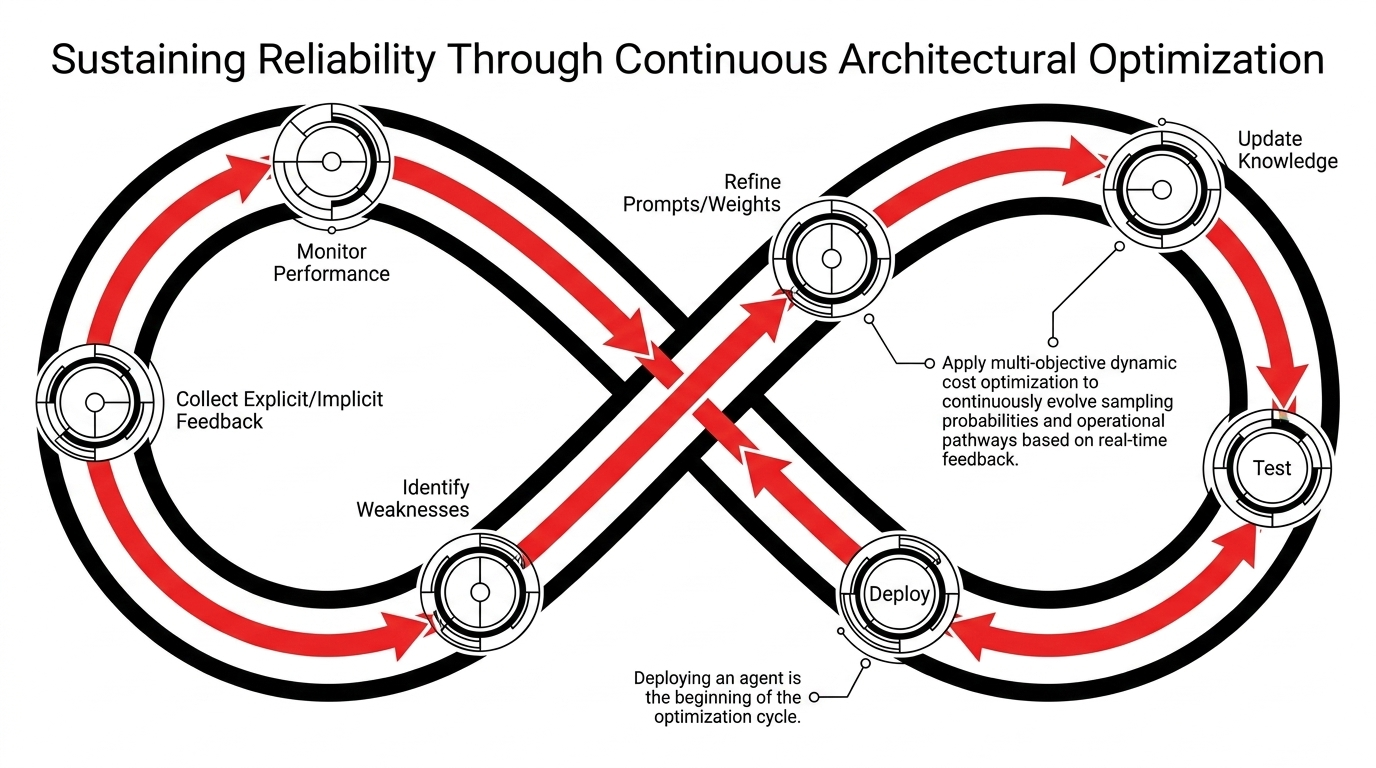
The important idea is that deployment is not the final phase. It is the beginning of a feedback cycle in which real behavior informs the next architecture revision. Operational data can reveal weak prompts, incomplete knowledge, poor routing choices, or costly reasoning patterns.
This loop should be multi-objective. Reliability, latency, cost, user experience, and policy compliance can all pull the system in different directions. Production optimization therefore requires measurement and controlled iteration rather than a one-time model selection decision.
Engineering Principles
The architecture ultimately depends on several principles:
-
Separate reasoning from execution
Use LLMs for interpretation and planning, but place enforceable operations behind deterministic workflows and tools. -
Specialize by responsibility
Break large agent surfaces into bounded domains with explicit interfaces, ownership, and failure scopes. -
Centralize shared infrastructure, not all behavior
Common knowledge, policy, identity, observability, and registries should be reusable across agents while workflow logic remains task-specific. -
Make state and control visible
Routing, checkpoints, approvals, tool calls, and evaluations should be inspectable so failures can be traced and corrected. -
Design for continuous change
Tool catalogs, knowledge, prompts, workflows, permissions, and evaluation criteria will evolve. The architecture should allow individual components to change without forcing monolithic rebuilds.
Final Synthesis
The complete blueprint combines the earlier ideas into one enterprise orchestration model. A central knowledge and policy repository provides governed context. A multi-agent orchestrator delegates work dynamically. Security gates validate flows and enforce policy. A standardized tooling layer exposes modular capabilities through a registry. Access control and audit surround the pathways through which agents interact with enterprise systems.
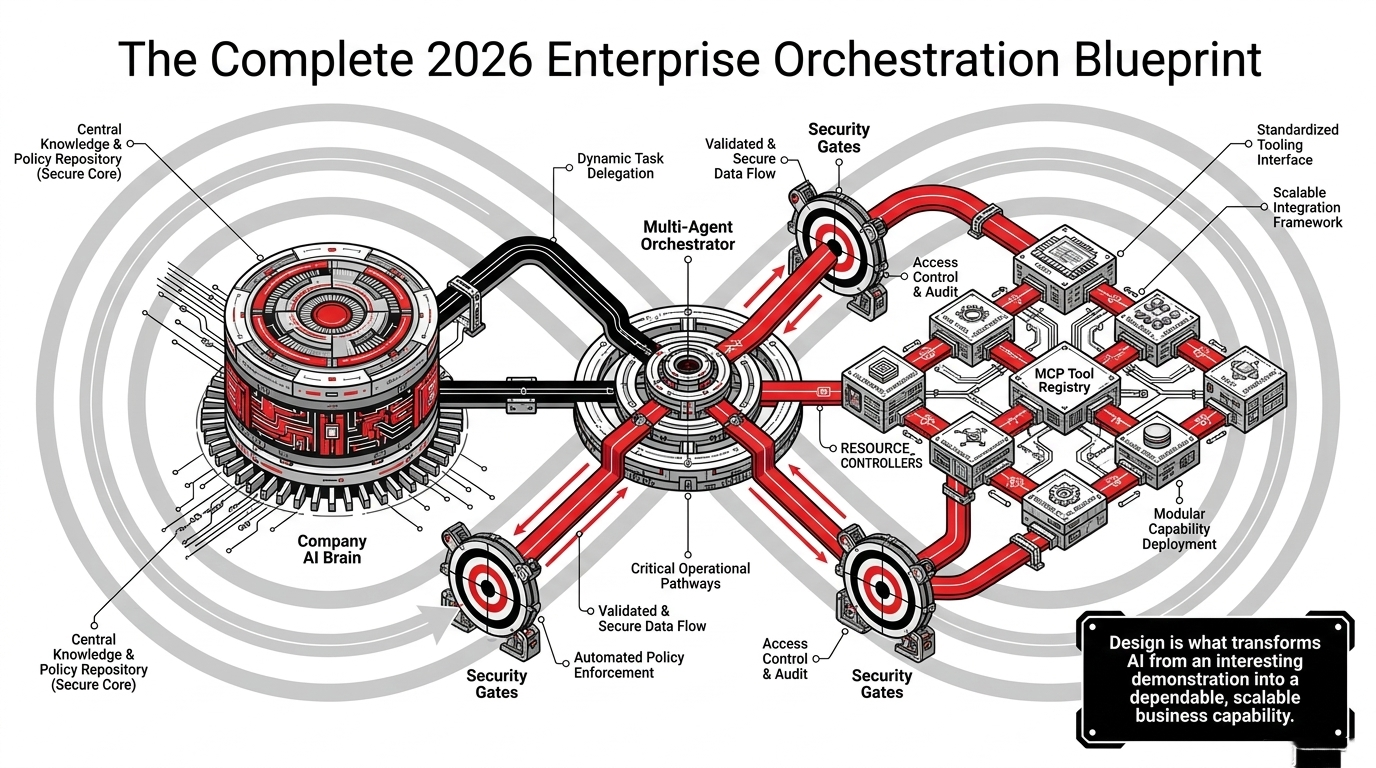
The architecture is intentionally layered. The "Company AI Brain" acts as the secure source of shared context and policy. The orchestrator coordinates specialized agents without requiring them to know every system directly. Security gates enforce boundaries on critical operational paths. The MCP tool registry exposes capabilities through standardized interfaces, allowing modular integrations to be discovered and invoked as needed.
The production-ready system combines:
- A deterministic foundation for tool execution, workflow control, policy checks, and state transitions
- A testing layer that combines exact validation with semantic and human evaluation
- An agent layer composed of specialized reasoning components selected for specific tasks
- Security and governance through scoped permissions, sandboxing, approval gates, and auditability
- Observability and optimization through feedback, monitoring, evaluation, and iterative refinement
- A production outcome in which agent behavior becomes a dependable business capability rather than an isolated demonstration
Closing Thought
Enterprise agent systems become reliable when intelligence is not concentrated in one model, but distributed across an architecture that constrains, observes, and improves every important decision boundary.
The model provides reasoning; the architecture provides production reliability.