
From Prompt to Production: Architecting Agentic Systems in 2026
Agents are no longer prompts. They are engineered systems.
That distinction is the architectural starting point. A capable model can produce a good answer in a demo, yet a production agent must do much more: retrieve the right context, connect to tools and other agents, preserve state, control side effects, recover from failure, route uncertain decisions to humans, and prove that behavior has not regressed after a change.
The engineering problem therefore shifts from prompt design to system design around the model. The source material organizes that system into four interacting concerns: context, connectivity, orchestration, and validation. Together they form the scaffolding that turns model capability into operational reliability.
The thesis is simple: production-grade agents emerge when the model is surrounded by explicit interfaces, lifecycle controls, testable contracts, and feedback loops.
1. From Prompt Engineering to Production Architecture
A prompt is an instruction. A production agent is a runtime.
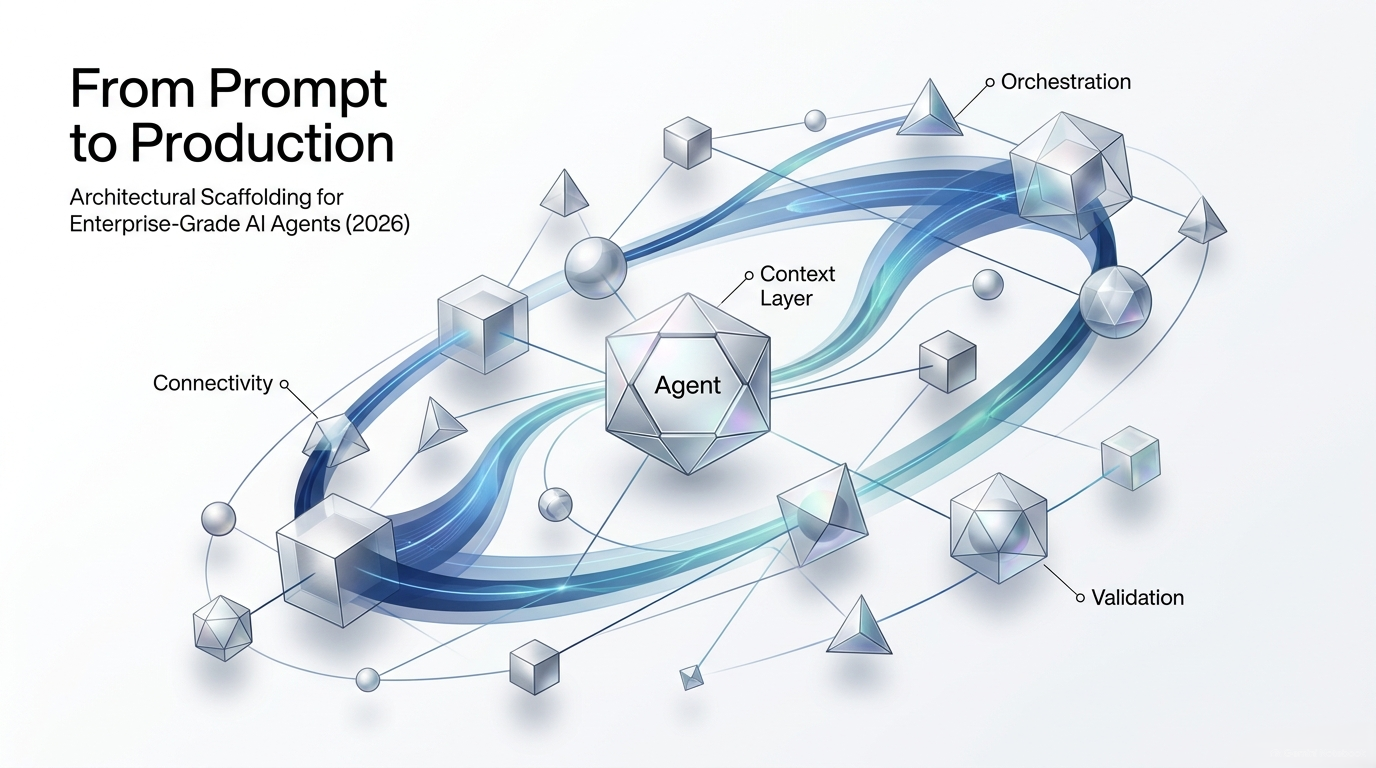
The architecture shown below places the agent at the center of a network of services rather than treating it as a self-contained intelligence. Four labels define the external responsibilities: Context Layer, Connectivity, Orchestration, and Validation.
The important change is ownership. The model may decide what to do next, but the surrounding system owns the mechanics that make the decision safe and useful. Context must be assembled before the model reasons. Connectivity determines what the agent can reach. Orchestration determines how work is sequenced, delegated, retried, or paused. Validation determines whether behavior is acceptable.
This separation also creates engineering leverage. Each layer can evolve independently, be instrumented independently, and fail independently. It becomes possible to ask concrete questions: Was the wrong document retrieved? Did a tool contract change? Was a human approval gate bypassed? Did an orchestration loop terminate too early? Those are system questions, not prompt questions.
2. The Production Stack: Four Layers with Different Failure Modes
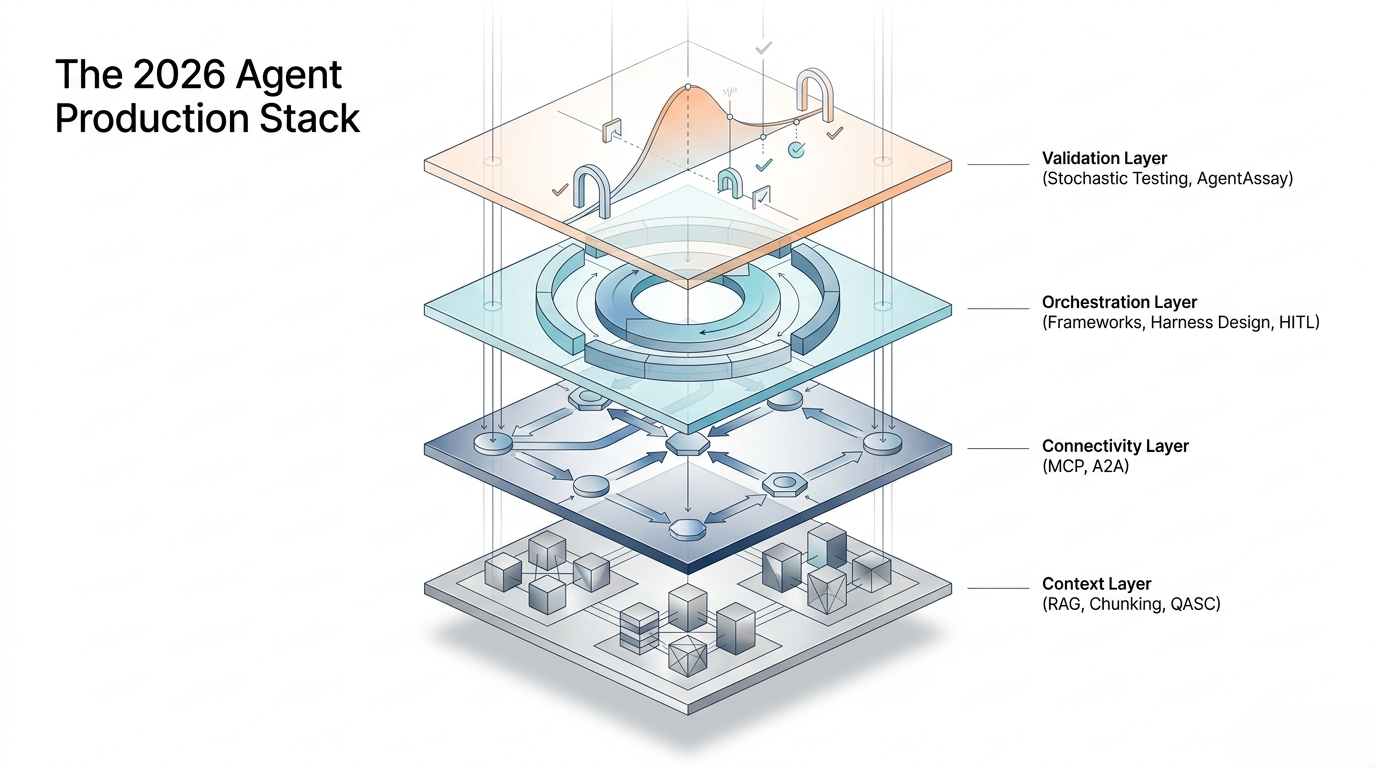
The source material decomposes the 2026 agent stack into four layers:
- Context Layer — RAG, chunking, and QASC.
- Connectivity Layer — MCP and A2A.
- Orchestration Layer — frameworks, harness design, and human-in-the-loop controls.
- Validation Layer — stochastic testing and behavioral regression analysis.
This layered view matters because the same symptom can originate in different places. A poor answer may come from weak retrieval, an incorrect tool call, an orchestration mistake, or model variability. Without architectural boundaries, all four problems collapse into “the agent was wrong.”
A production stack should make the origin of failure observable. Context components should expose what they retrieved and why. Connectivity components should record tool and peer-agent requests. Orchestration should emit state transitions and gate decisions. Validation should evaluate not only the final text but also the execution path that produced it.
The result is not deterministic software, but it can still be structured software.
3. Context Starts with Chunking, Not with the Model
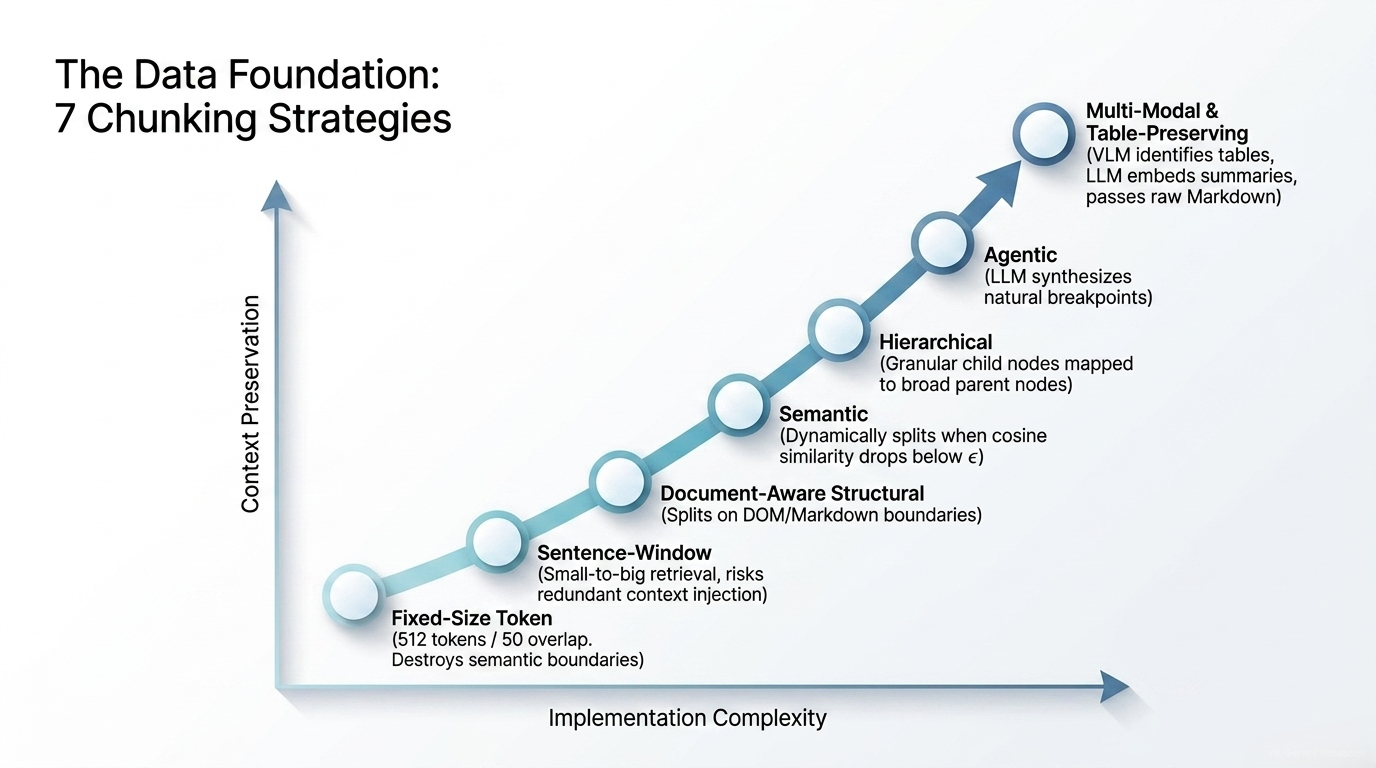
Retrieval quality is constrained by how the knowledge base is segmented before the agent sees it. The source material presents seven chunking strategies on a spectrum from lower implementation complexity to stronger context preservation.
At the simplest end, fixed-size token chunking is easy to implement but can destroy semantic boundaries. Sentence-window retrieval adds local context but can introduce redundant text. Document-aware structural chunking respects DOM or Markdown boundaries. Semantic chunking splits when embedding similarity indicates a topic shift. Hierarchical chunking maps granular child nodes to broader parent nodes. Agentic chunking uses an LLM to synthesize natural breakpoints. Finally, multi-modal and table-preserving approaches attempt to retain document structure that pure text chunking would otherwise flatten.
The engineering implication is not that the most complex strategy always wins. Better preservation increases implementation, indexing, and evaluation complexity. The correct strategy depends on the document types, query patterns, latency budget, and how much structural information the downstream agent needs.
A useful production rule is to make chunking measurable. Evaluate retrieval relevance, completeness, and downstream answer quality on the actual query distribution instead of choosing a chunking method by convention.
4. Query-Adaptive Chunking: Retrieval as a Runtime Decision
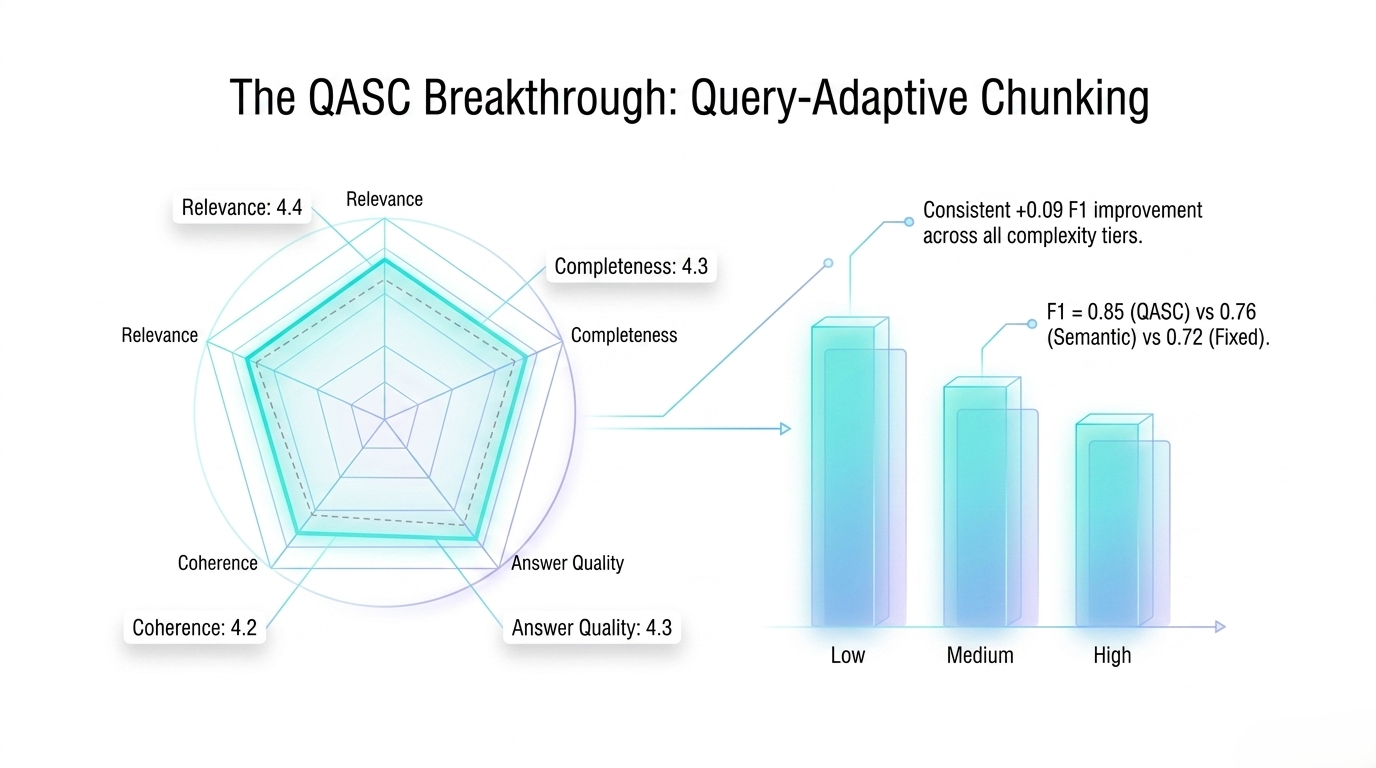
The QASC slide advances the context layer one step further: chunking can become query-adaptive rather than fixed at ingestion time.
The visual reports relevance, completeness, coherence, and answer-quality scores above four on a five-point-looking radar scale, and it depicts a consistent +0.09 F1 improvement across low, medium, and high complexity tiers. It also labels one comparison as F1 = 0.85 for QASC versus 0.76 for semantic and 0.72 for fixed-size chunking.
Those numbers are claims contained in the source slide; no benchmark methodology, dataset, confidence interval, or external citation is provided in the uploaded material. They are therefore best read as the presentation's evidence for the design idea, not as a universal performance guarantee.
Architecturally, the idea is valuable even without the exact numbers. A query can carry information about the granularity of context it needs. A narrow lookup may benefit from compact, high-precision evidence. A synthesis query may need broader parent context or multiple related sections. Making retrieval adaptive to the query turns context assembly into an active component of reasoning rather than a static pre-processing step.
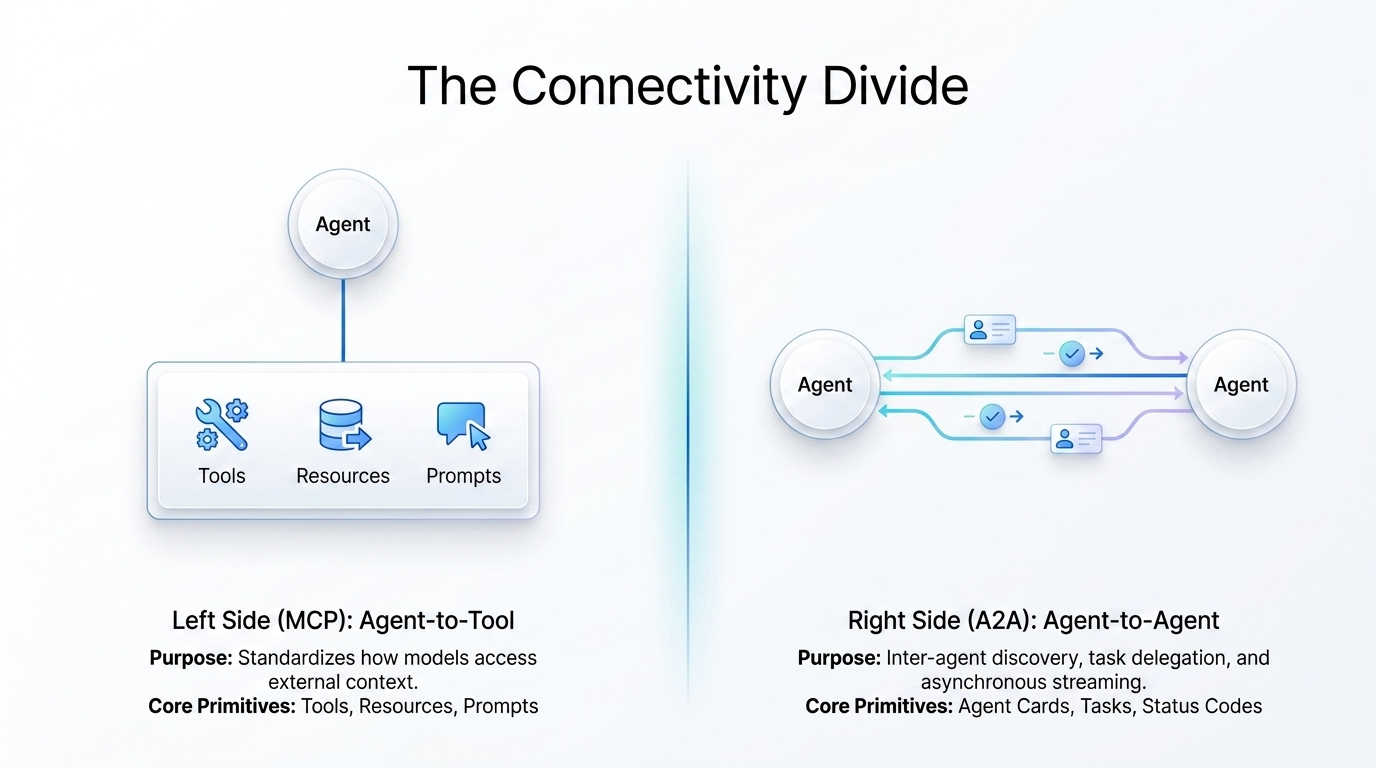
5. The Connectivity Divide: Agent-to-Tool and Agent-to-Agent
Once an agent has context, it must interact with the outside world. The source material separates that problem into two distinct connectivity surfaces.
On the left, Model Context Protocol (MCP) standardizes agent access to external tools, resources, and prompts. The purpose is agent-to-tool connectivity: giving a model a consistent way to discover capabilities, read structured context, and invoke actions.
On the right, A2A addresses agent-to-agent communication. The slide highlights inter-agent discovery, task delegation, asynchronous streaming, and primitives such as agent cards, tasks, and status codes.
These are different integration problems and should remain different contracts. Tool access is usually capability-oriented: “Can I perform this action or read this resource?” Agent-to-agent interaction is coordination-oriented: “Which peer can take this work, what state is it in, and how do results stream back?”
Keeping those interfaces separate reduces coupling. A tool server does not need to become a peer agent, and a peer agent does not need to expose every internal capability as a low-level tool.
6. MCP as a Controlled Capability Boundary
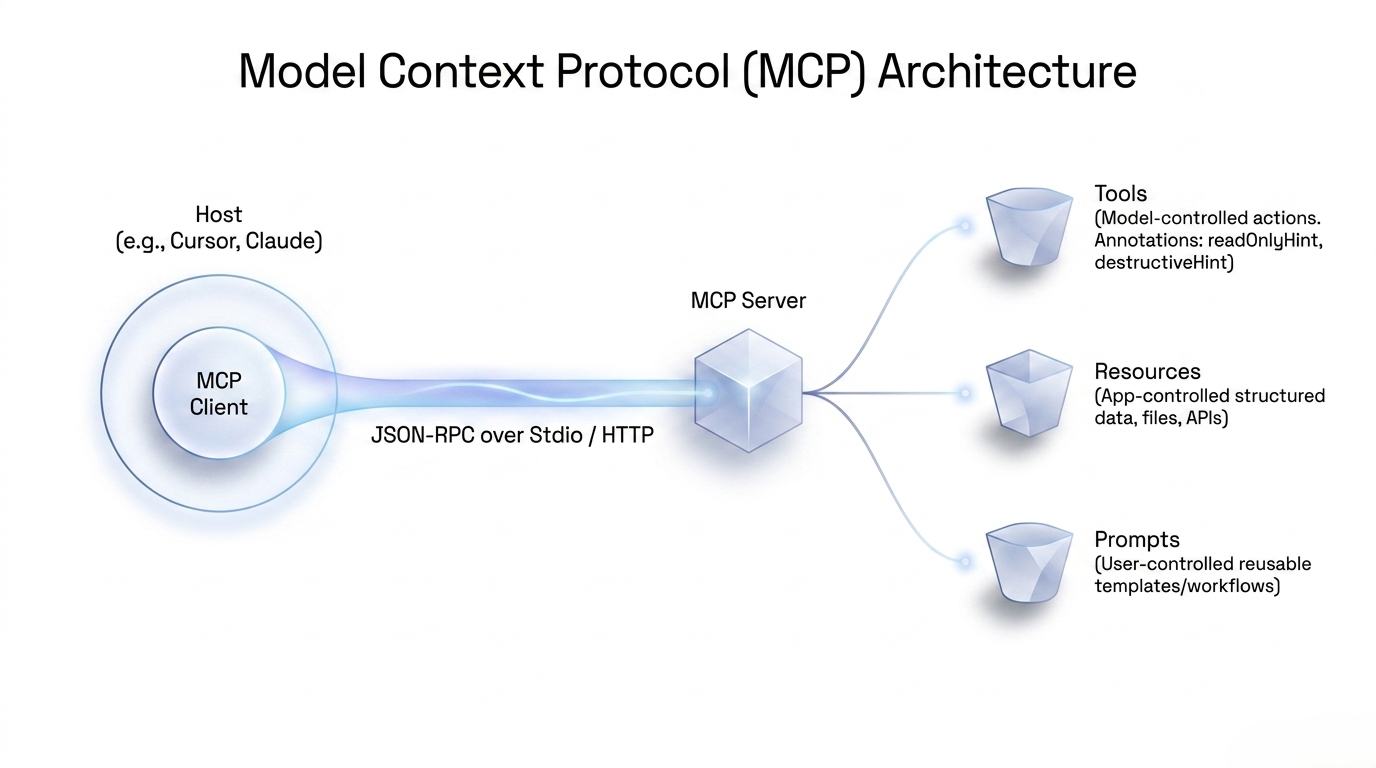
The MCP architecture slide makes the agent-to-tool path concrete. A host such as an IDE or assistant contains an MCP client. The client communicates with an MCP server using JSON-RPC over stdio or HTTP. The server exposes tools, resources, and prompts.
The three categories imply different control semantics:
- Tools are model-controlled actions. The slide also shows annotations such as
readOnlyHintanddestructiveHint, which can help a host or harness reason about risk. - Resources are application-controlled structured data, files, or APIs.
- Prompts are reusable templates or workflows initiated under user control.
The production value of MCP is not merely interoperability. It creates a policy boundary around capability access. The harness can inspect which tool is being requested, apply sandboxing or approval requirements, constrain arguments, and record the call for later analysis.
That makes connectivity part of governance. A model should not possess ambient authority simply because it can generate the name of an action.
7. Orchestration Frameworks Are Trade-Offs, Not Rankings
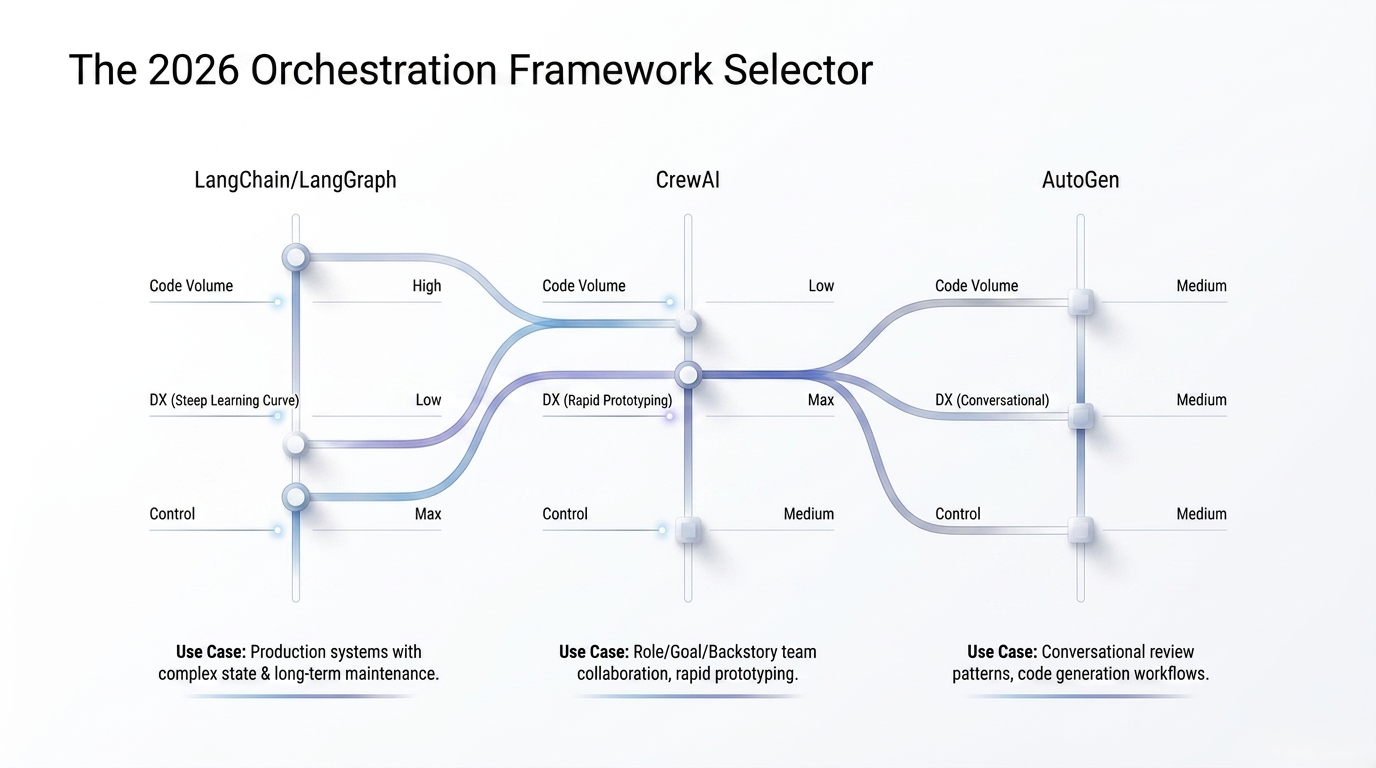
The orchestration selector compares LangChain/LangGraph, CrewAI, and AutoGen across code volume, developer experience, and control.
The slide positions LangChain/LangGraph as a fit for production systems with complex state and long-term maintenance, CrewAI for role/goal/backstory collaboration and rapid prototyping, and AutoGen for conversational review patterns and code-generation workflows.
The chart should be interpreted as a design heuristic, not a definitive benchmark. Framework choice depends on the shape of the workflow:
- Systems with explicit state transitions, retries, checkpoints, and long-lived execution benefit from orchestration that makes state inspectable.
- Team-style role decomposition benefits from abstractions that make agent responsibilities easy to express.
- Conversational multi-agent workflows benefit from frameworks optimized for message exchange and iterative review.
The deeper principle is to avoid letting the framework become the architecture. Model calls, tool contracts, state, policy gates, and evaluation criteria should remain separable enough that the orchestration layer can be replaced without rewriting the entire system.
8. The Harness Is the Runtime Safety Envelope
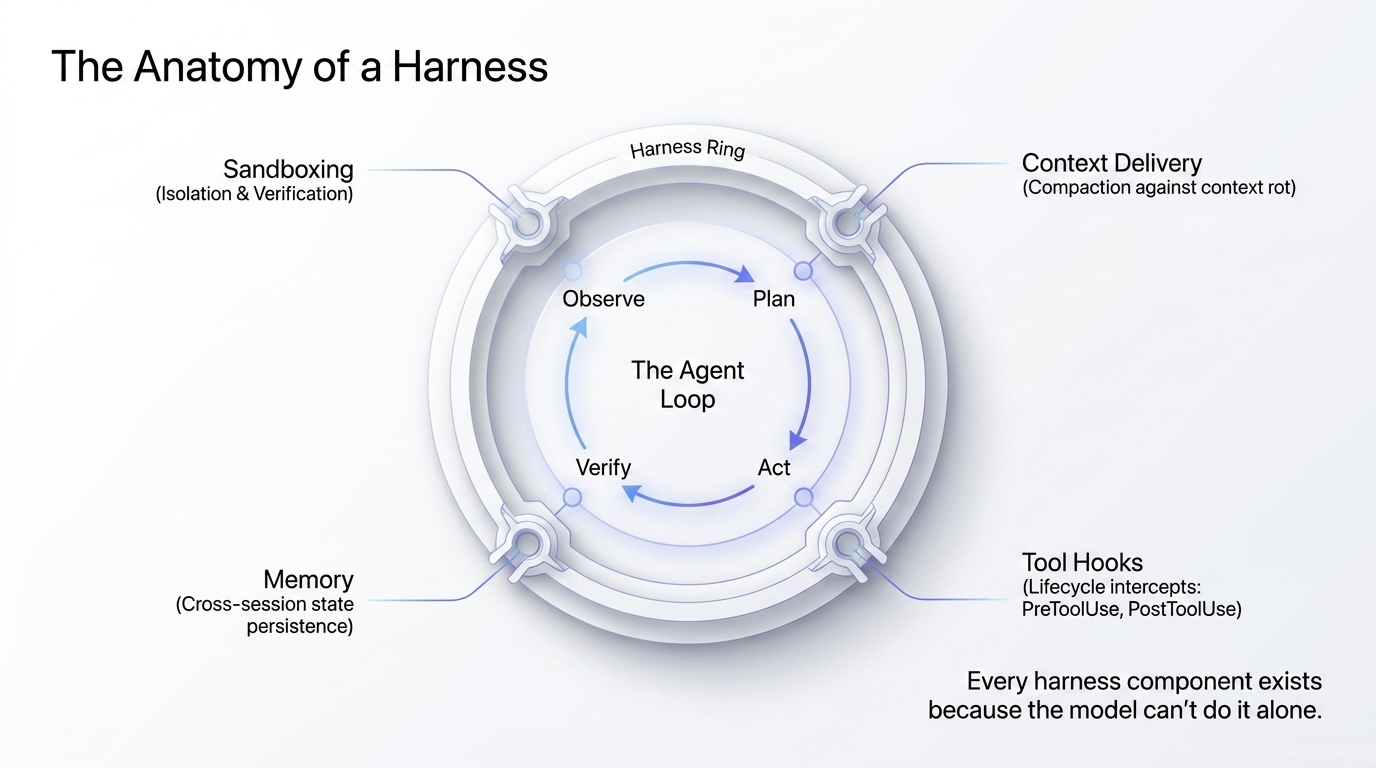
The source material calls out a structure that is often missing from agent demos: the harness.
At the center is the agent loop: Observe → Plan → Act → Verify. Around it sits a harness ring with four responsibilities:
- Sandboxing for isolation and verification.
- Context delivery with compaction to resist context rot.
- Memory for cross-session state persistence.
- Tool hooks for lifecycle interception before and after tool use.
Every one of those responsibilities exists because the model cannot reliably provide it by itself. The model can propose an action, but the harness decides where it runs. The model can reason about prior state, but the harness decides what state is persisted and how it is retrieved. The model can request a tool, but hooks can inspect, rewrite, reject, or log the request.
This is the point where an “agent” becomes an engineered runtime rather than a loop around an LLM API.
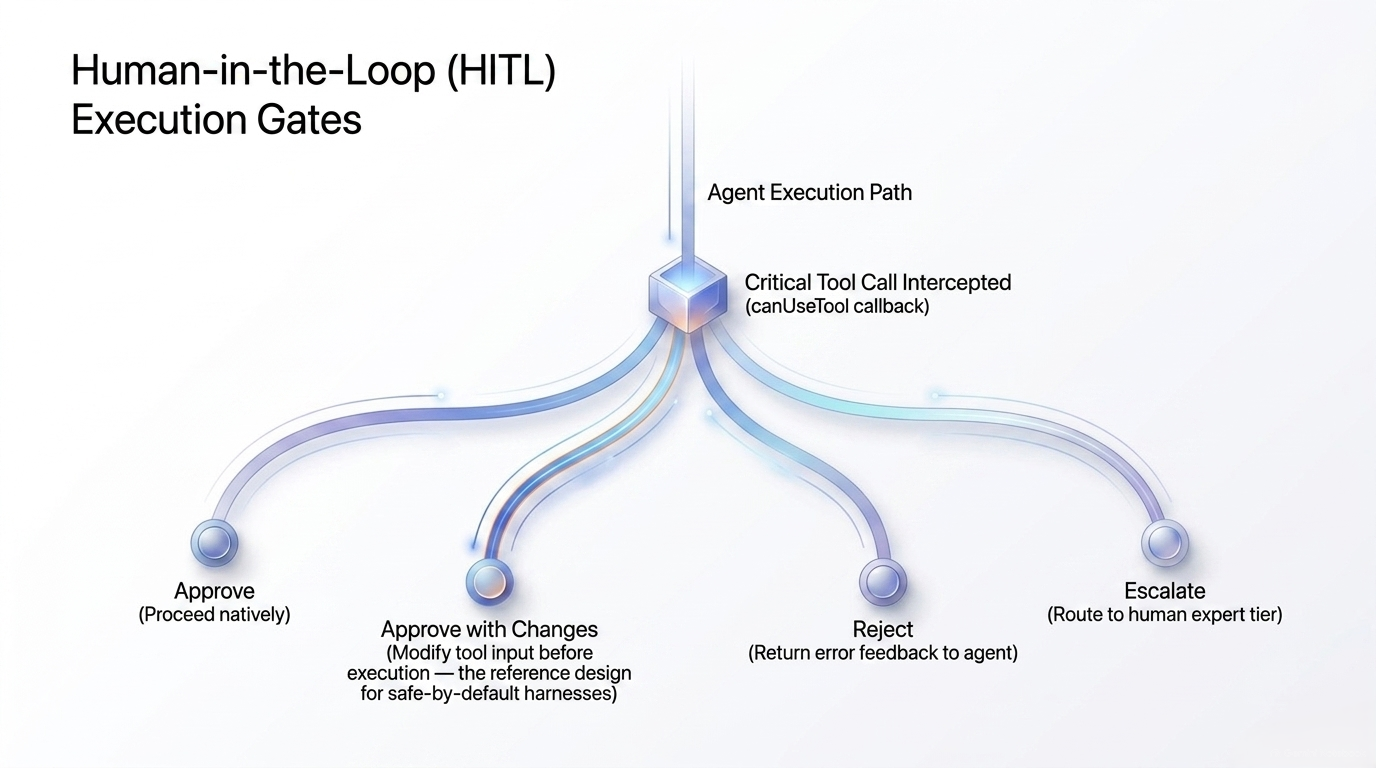
9. Human-in-the-Loop Gates Should Be Explicit Execution States
Human review is most useful when it is encoded as a state transition rather than bolted on as an emergency process.
The HITL slide shows a critical tool call intercepted before execution, producing four possible outcomes:
- Approve — proceed natively.
- Approve with changes — modify the tool input before execution.
- Reject — return error feedback to the agent.
- Escalate — route to a higher human-expert tier.
This is a strong control pattern because it preserves the agent's workflow while making authority explicit. The agent can continue to plan, but selected actions cross a policy boundary that requires human judgment.
“Approve with changes” is especially important. Production review is not always binary. A human may agree with the intent but narrow the scope, correct an argument, remove sensitive data, or constrain a side effect. A good harness should allow that correction to flow back into the execution trace so the agent can reason from the actual approved action rather than from its original proposal.
10. Testing Agents Requires More Than Binary Assertions
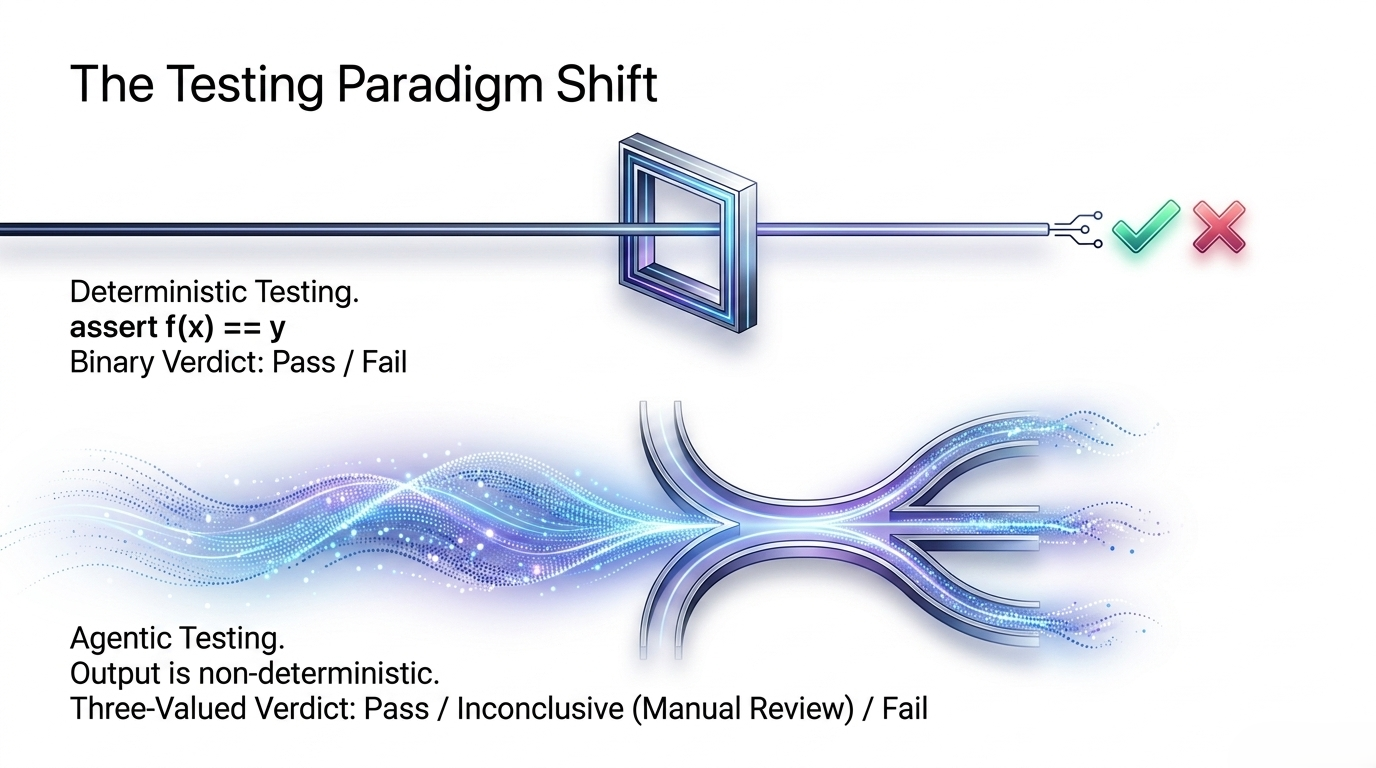
Traditional software testing expects deterministic functions: for a fixed input, assert that the output equals an expected value.
The source material argues that agentic systems require a different verdict model because outputs are non-deterministic.
Instead of only pass/fail, the slide proposes pass / inconclusive (manual review) / fail. That third state matters. For probabilistic outputs, forcing every ambiguous case into a binary verdict can create false positives, false negatives, or brittle test suites that reward exact wording instead of correct behavior.
A production evaluator should therefore test multiple dimensions:
- Was the task completed?
- Were required facts or constraints preserved?
- Were disallowed tools or actions avoided?
- Did the agent recover from errors appropriately?
- Was the execution efficient enough for the use case?
- Is the result uncertain enough to require manual review?
The test target moves from exact text to behavior under constraints.
11. Behavioral Fingerprinting for Regression Detection
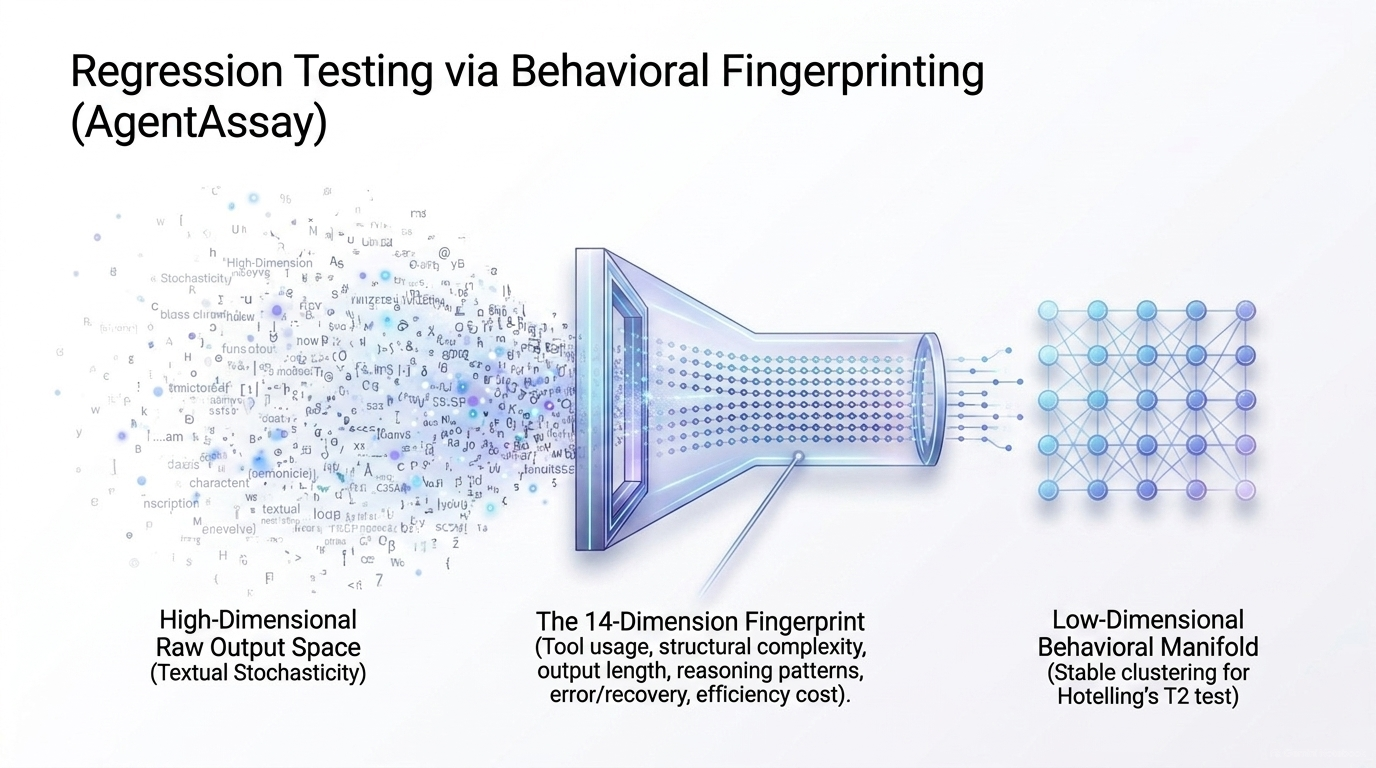
The AgentAssay slide proposes a way to make stochastic behavior more testable: transform high-dimensional raw outputs into a compact behavioral fingerprint.
The depicted fingerprint has 14 dimensions and includes features such as tool usage, structural complexity, output length, reasoning patterns, error/recovery behavior, and efficiency cost. Those features are then mapped into a lower-dimensional behavioral manifold, where stable clustering can be monitored statistically; the slide references Hotelling's T² test.
The practical idea is to detect a regression even when the exact text changes. If a new model version suddenly calls more tools, produces longer plans, recovers from errors less often, or shifts into a different behavioral cluster, the system can flag the change before it reaches users.
This also expands observability. Logs stop being a pile of transcripts and become measurable execution features. The critical engineering requirement is to choose features that correlate with behavior that actually matters. A mathematically stable cluster is not useful if it is stable around the wrong behavior.
12. Autonomous QA as a Closed Feedback Loop
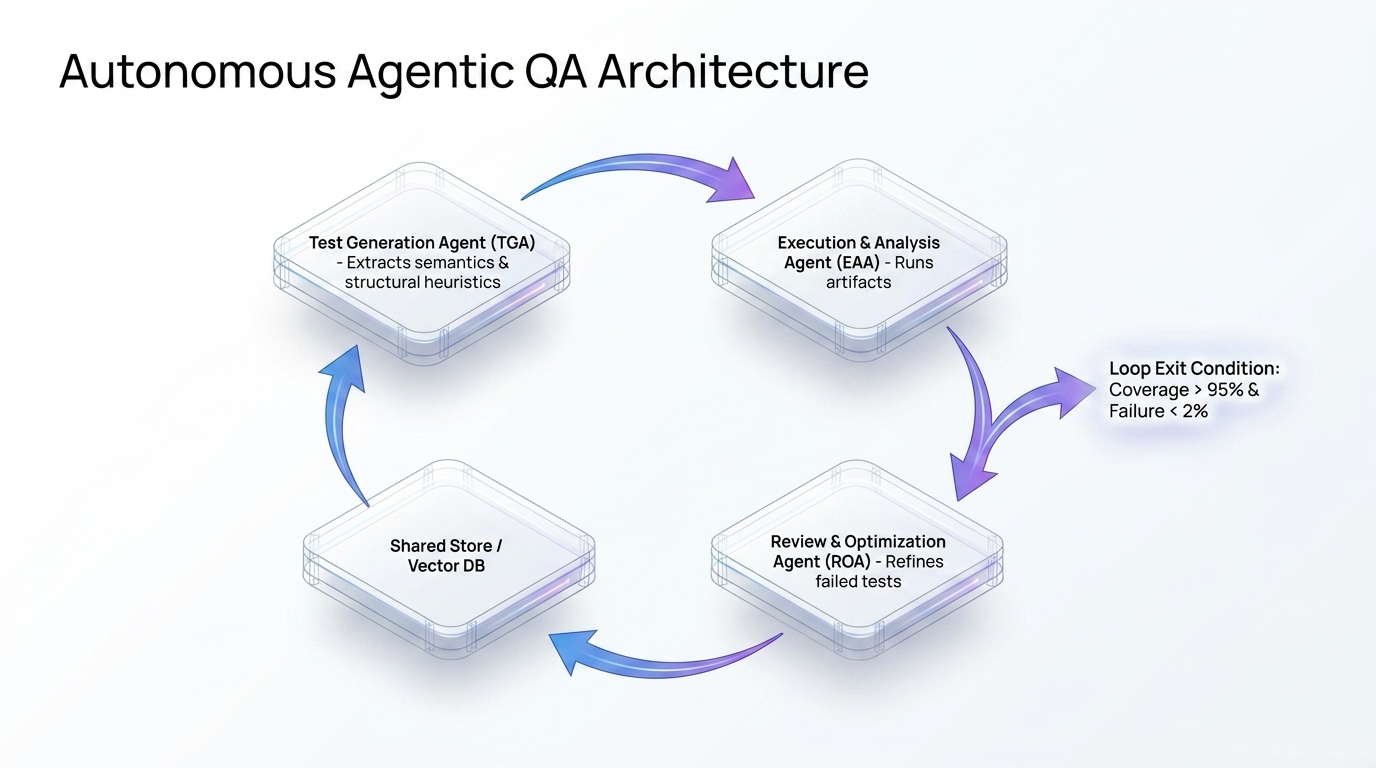
The autonomous QA architecture turns testing into a multi-agent control loop.
The slide shows four components:
- A Test Generation Agent (TGA) that extracts semantics and structural heuristics.
- An Execution & Analysis Agent (EAA) that runs artifacts.
- A Review & Optimization Agent (ROA) that refines failed tests.
- A Shared Store / Vector DB that retains artifacts and state across the loop.
The depicted exit condition is coverage greater than 95% and failure below 2%. Those thresholds are specific to the slide and are not justified elsewhere in the uploaded material, so they should be treated as example release criteria rather than universal targets.
The architecture itself is the stronger idea: generation, execution, review, and persistence form a closed loop. A QA system can continuously refine tests based on observed failures instead of depending entirely on engineers to author and repair every test case manually.
The danger is circular validation. If the same class of model generates the tests, interprets the results, and proposes the fix, correlated blind spots can survive the loop. Independent evaluators, deterministic checks, human sampling, or diversity across models and methods can reduce that risk.
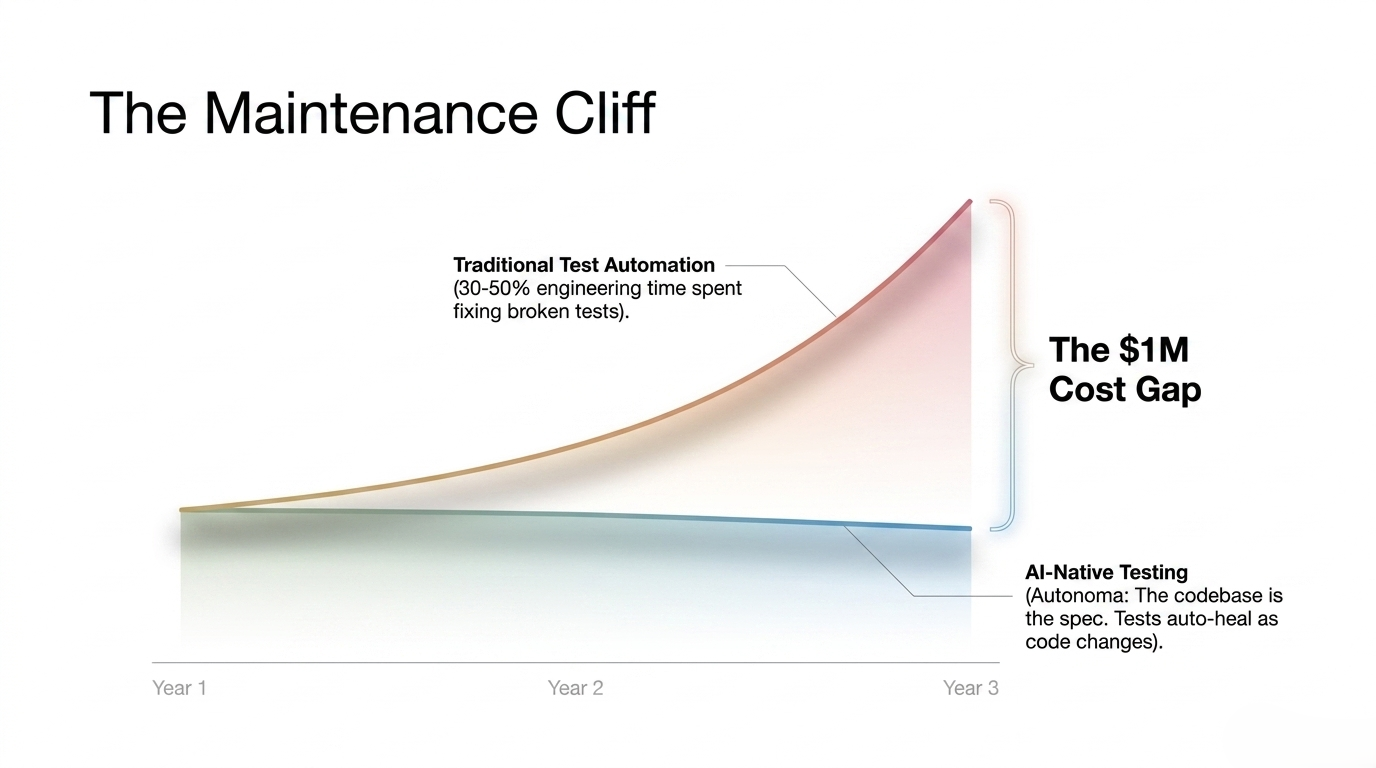
13. The Maintenance Cliff Is an Architecture Problem
The maintenance slide argues that traditional test automation becomes expensive as the system changes, while AI-native approaches aim to keep maintenance flatter.
The visual labels traditional automation as consuming 30–50% of engineering time fixing broken tests and highlights a "$1M Cost Gap" over three years. It contrasts that with an AI-native testing approach labeled Autonoma, described as treating the codebase as the specification and allowing tests to auto-heal as code changes.
The uploaded material does not provide sources or assumptions for the percentage or dollar figure. They should therefore be read as illustrative claims in the presentation, not independently verified benchmarks.
The underlying engineering concern is valid without the headline number: if test maintenance grows faster than product complexity, validation eventually becomes a delivery bottleneck. The response should not be “less testing,” but testing systems that can adapt while preserving intent. Auto-healing is only safe when the system can distinguish legitimate product evolution from a regression that the test should continue to catch.
Engineering Principles
The architecture ultimately depends on several principles:
-
Treat context as a first-class subsystem
Retrieval, chunking, hierarchy, and query adaptation should be evaluated as production components with their own quality metrics. -
Separate connectivity contracts by purpose
Agent-to-tool connectivity and agent-to-agent coordination solve different problems. Keep capability access, delegation, and status semantics explicit. -
Put the model inside a harness
Sandboxing, memory, context delivery, lifecycle hooks, and state transitions should be implemented outside the model and be independently testable. -
Make authority visible
Tool annotations, execution gates, and human approval should encode what the agent may do, not merely what it can ask to do. -
Test behavior, not only text
Stochastic systems need multi-dimensional evaluation, inconclusive states, execution-path checks, and regression detection across behavioral features. -
Design observability into the execution path
Capture context selection, tool calls, state transitions, approvals, retries, and behavioral fingerprints so production incidents can be traced to a subsystem. -
Optimize for maintainability, not demo velocity
Frameworks, tests, and agent roles should reduce long-term coupling. A fast prototype is valuable only if its abstractions can survive change.
Final Synthesis
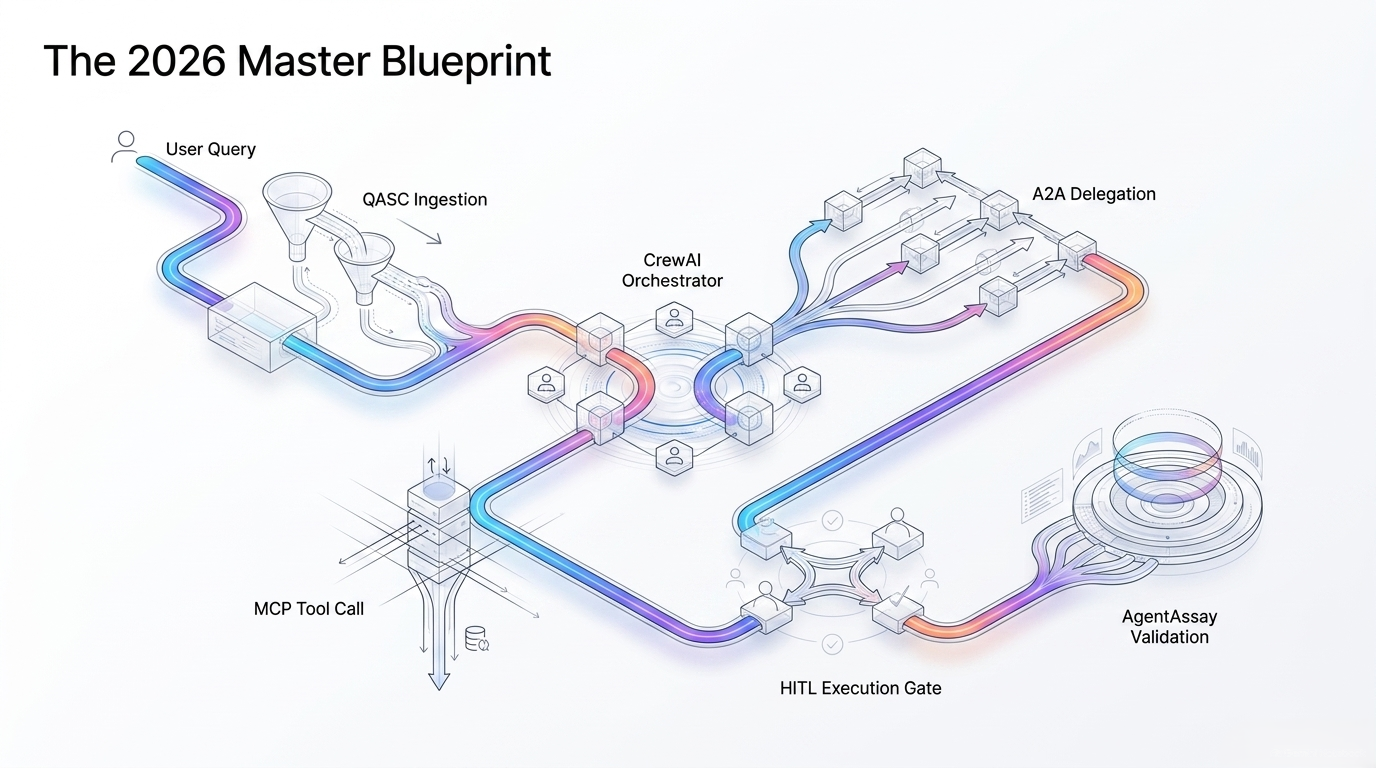
The master blueprint connects the layers into one production flow.
A user query enters through QASC ingestion, where the context layer adapts retrieval to the request. The flow reaches a CrewAI orchestrator, which coordinates work and fans tasks out through A2A delegation. When agents need external capabilities, the system routes through an MCP tool call boundary. Risk-sensitive actions pass through a HITL execution gate. The final behavior is evaluated through AgentAssay validation.
The important part is not the specific brand or framework at each label. It is the sequence of responsibilities:
- Deterministic foundation: explicit state, interfaces, tool contracts, and execution boundaries.
- Testing layer: stochastic evaluation, behavioral fingerprints, and closed-loop QA.
- Agent/AI layer: reasoning, planning, delegation, and adaptive context use.
- Security and governance: sandboxing, tool-risk annotations, approval gates, and escalation paths.
- Observability layer: execution traces, retrieval evidence, tool usage, state transitions, and regression features.
- Production outcome: an agent whose behavior can be constrained, inspected, tested, and maintained as the surrounding system changes.
This is the shift from building prompts to building agent platforms. The model remains central, but reliability comes from the architecture around it.
Closing Thought
A production agent should never depend on the model being perfect. It should depend on the system being prepared for the model to be variable.
The mature unit of AI engineering is not the prompt. It is the controlled, observable, testable agent system.