
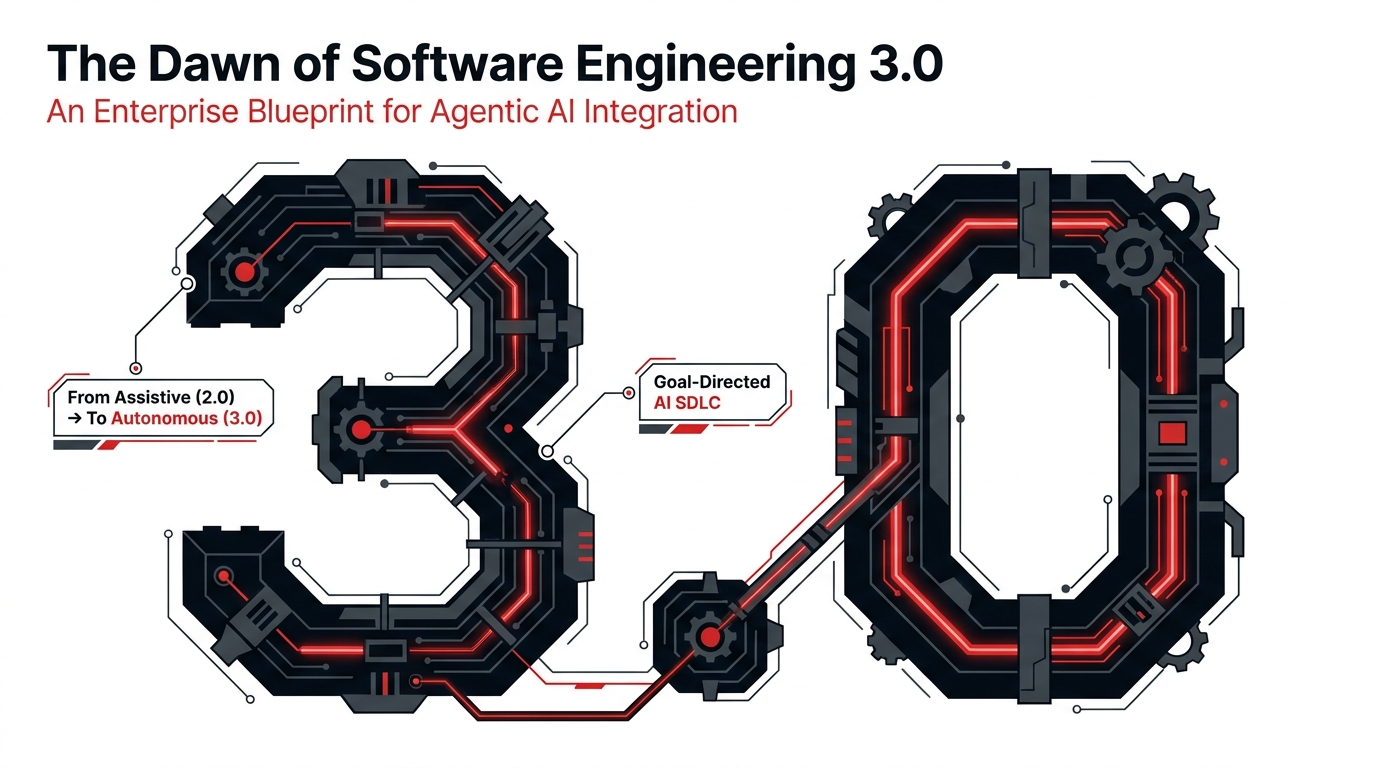
Software Engineering 3.0: An Enterprise Blueprint for Agentic SDLCs
Software engineering is entering a phase in which the unit of leverage is no longer just the individual developer with a better autocomplete model. The larger shift is architectural: software teams are beginning to coordinate autonomous and semi-autonomous agents that can decompose work, inspect systems, change code, provision environments, run tests, interpret failures, and revise their own plans.
That does not make developers irrelevant. It changes where engineering judgment is concentrated. Instead of spending all of their time producing implementation detail, experienced engineers increasingly define goals, boundaries, interfaces, evidence requirements, approval gates, and recovery behavior. The work moves from writing every line to designing the system that can safely delegate lines of work.
The blueprint in these diagrams calls that transition Software Engineering 3.0: a goal-directed, agentic software development lifecycle in which autonomy is earned through architecture, verification, and governance rather than granted as a blanket permission.
1. The Core Triad: Autonomy, Adaptability, and Goal-Directedness
An agentic engineering system becomes meaningfully different from a scripted automation when three properties appear together.
Autonomy means the system can continue operating without requiring a human instruction at every intermediate step. Adaptability means it can evaluate feedback, revise a plan, and correct execution. Goal-directedness means it can translate a high-level outcome into concrete, bounded tasks.
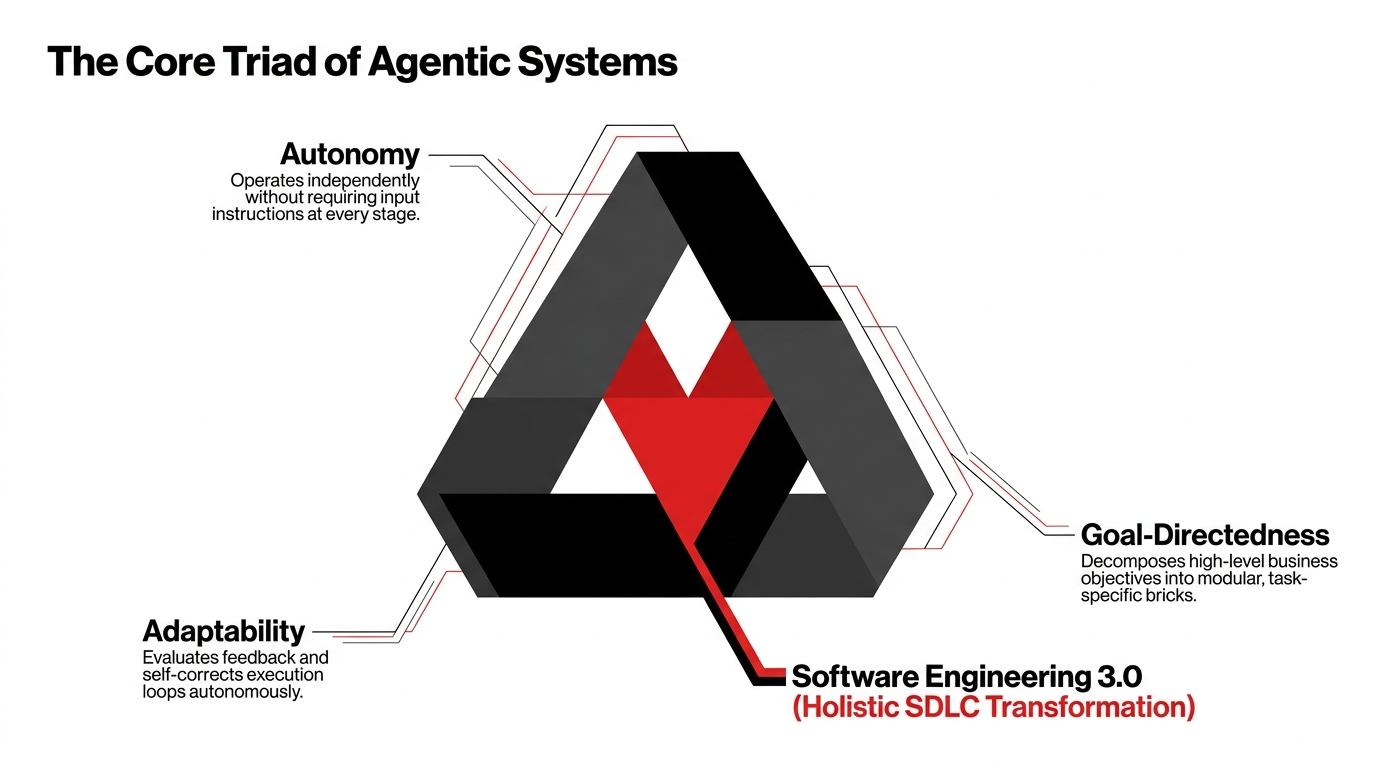
These properties form a useful design test. A tool that only follows a fixed chain may automate work, but it is not strongly agentic. A model that can reason but cannot execute tools is not an engineering worker. An autonomous loop that lacks explicit goals or correction mechanisms can move quickly in the wrong direction.
The engineering implication is that Software Engineering 3.0 is not a single model upgrade. It is a whole-SDLC control system. Models provide reasoning, but production reliability depends on orchestration, state, tool access, verification, and policies that determine when the system may act.
2. Agentic Maturity Is Uneven Across the SDLC
The source material maps higher agentic maturity to coding, testing, DevOps, and maintenance, where execution can often be constrained by machine-checkable artifacts: source code, test outcomes, deployment state, runtime telemetry, and version history.
Requirements, design, and security remain harder. Those stages depend more heavily on ambiguous business intent, formal reasoning, threat interpretation, and the translation of natural language into precise models.
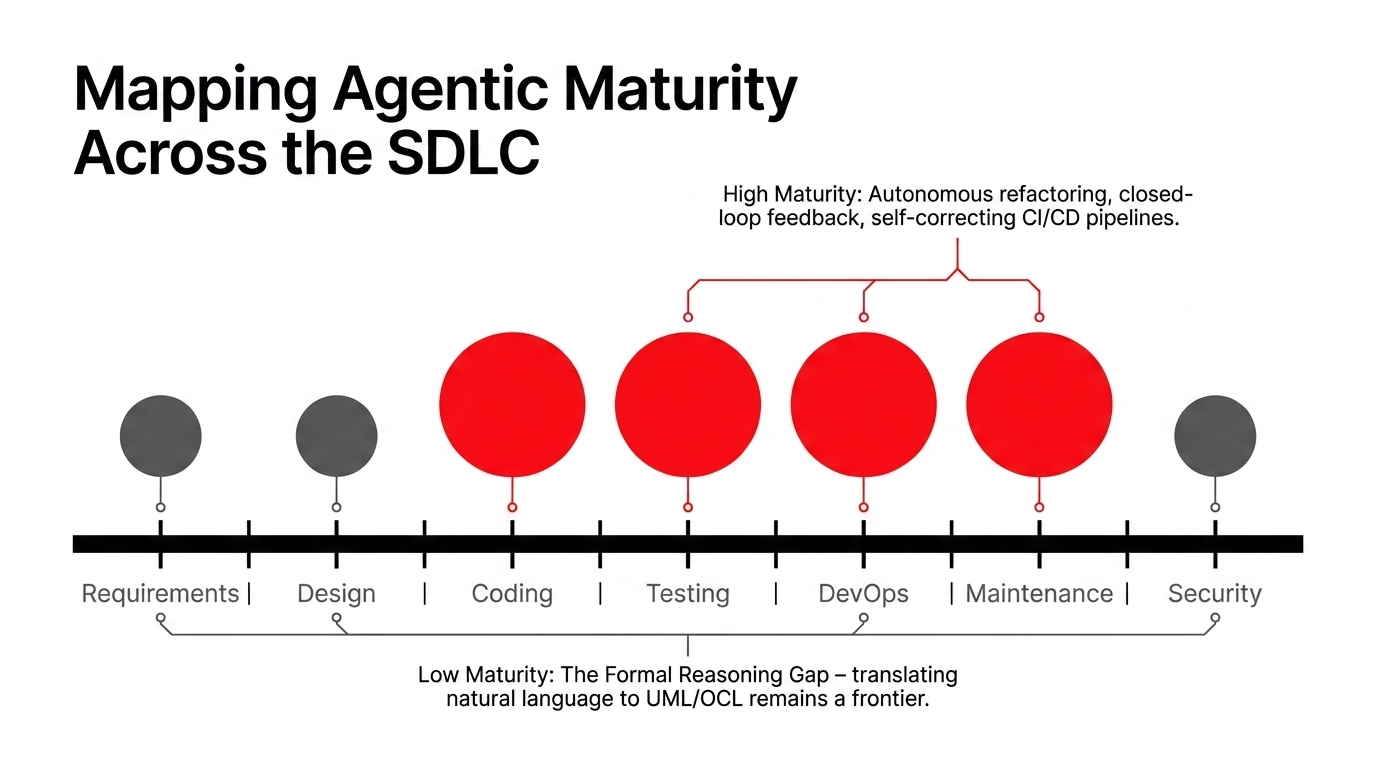
This distinction matters because organizations should not apply one autonomy policy to every activity. A coding agent operating inside a branch with tests, a disposable environment, and a narrow task can be given more freedom than an agent making a security exception or redefining a requirement.
A mature agentic SDLC therefore uses graduated autonomy. The acceptable agency level depends on the task’s reversibility, uncertainty, blast radius, and available evidence.
3. AgentOps Requires a Layered Technology Stack
Agentic delivery systems need more than a foundation model. The reference architecture separates the platform into four technical layers connected by shared memory.
At the bottom, infrastructure provides sandboxed execution through containers, cluster scheduling, and CI/CD. Above it, foundation models perform semantic reasoning. Protocols define tool-agnostic interaction conventions and behavioral contracts. Orchestrators decompose tasks, coordinate agents, and route work.
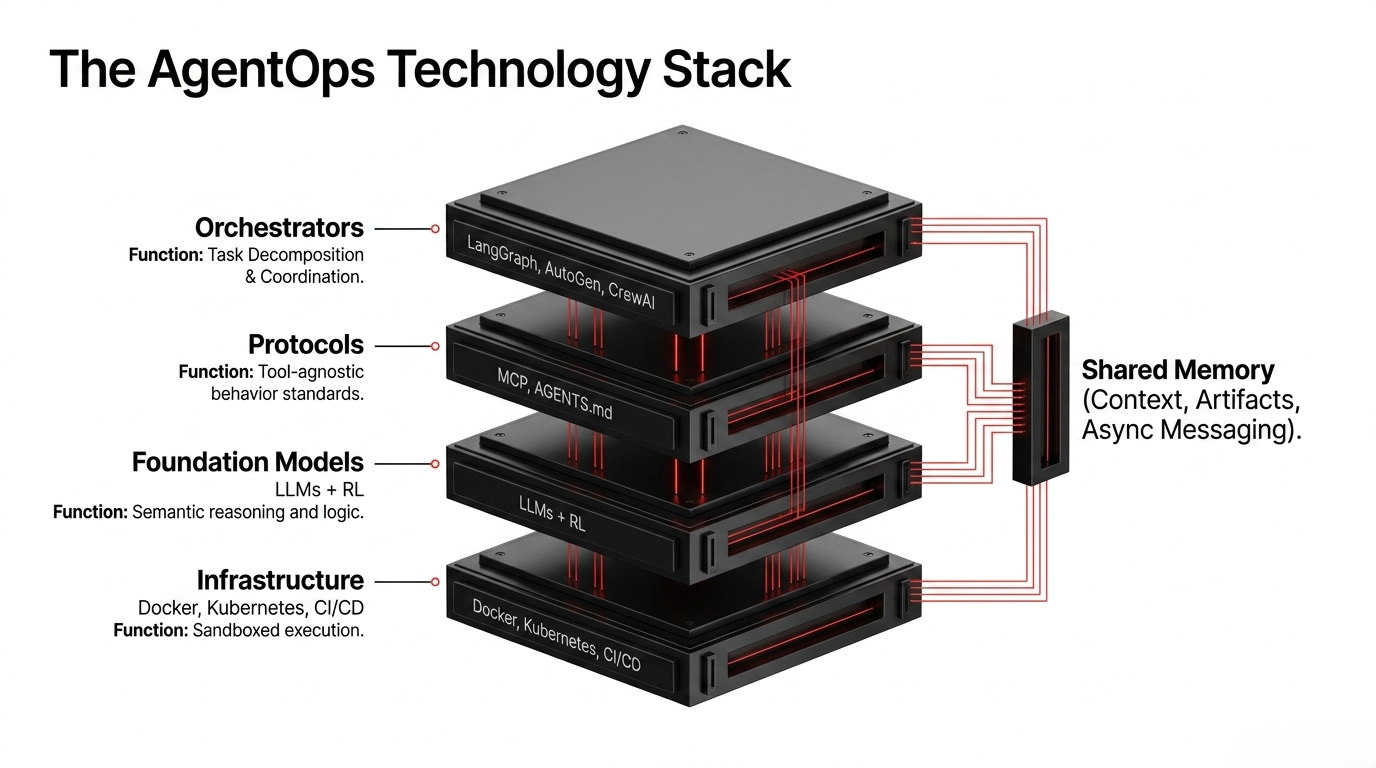
Shared memory sits beside the stack rather than inside a single layer because every participant needs access to durable context: plans, artifacts, messages, evidence, and state transitions. That shared context becomes the working substrate for coordination.
In production, shared memory should be treated as an auditable system of record rather than an unbounded chat transcript. Useful design characteristics include:
- explicit artifact versions and ownership,
- append-only event histories for important decisions,
- bounded context retrieval instead of indiscriminate replay,
- provenance linking generated output back to source evidence,
- retention and access policies appropriate to the code and data being handled.
The practical lesson is simple: models reason; platforms make that reasoning operable.
4. Climb the Architectural Complexity Ladder Deliberately
Not every problem needs a swarm. The architectural ladder in the source material moves from prompt chains to dynamic routing, memory and reflection, multi-agent systems, enterprise integration with approval gates, and finally peer-to-peer swarm coordination.
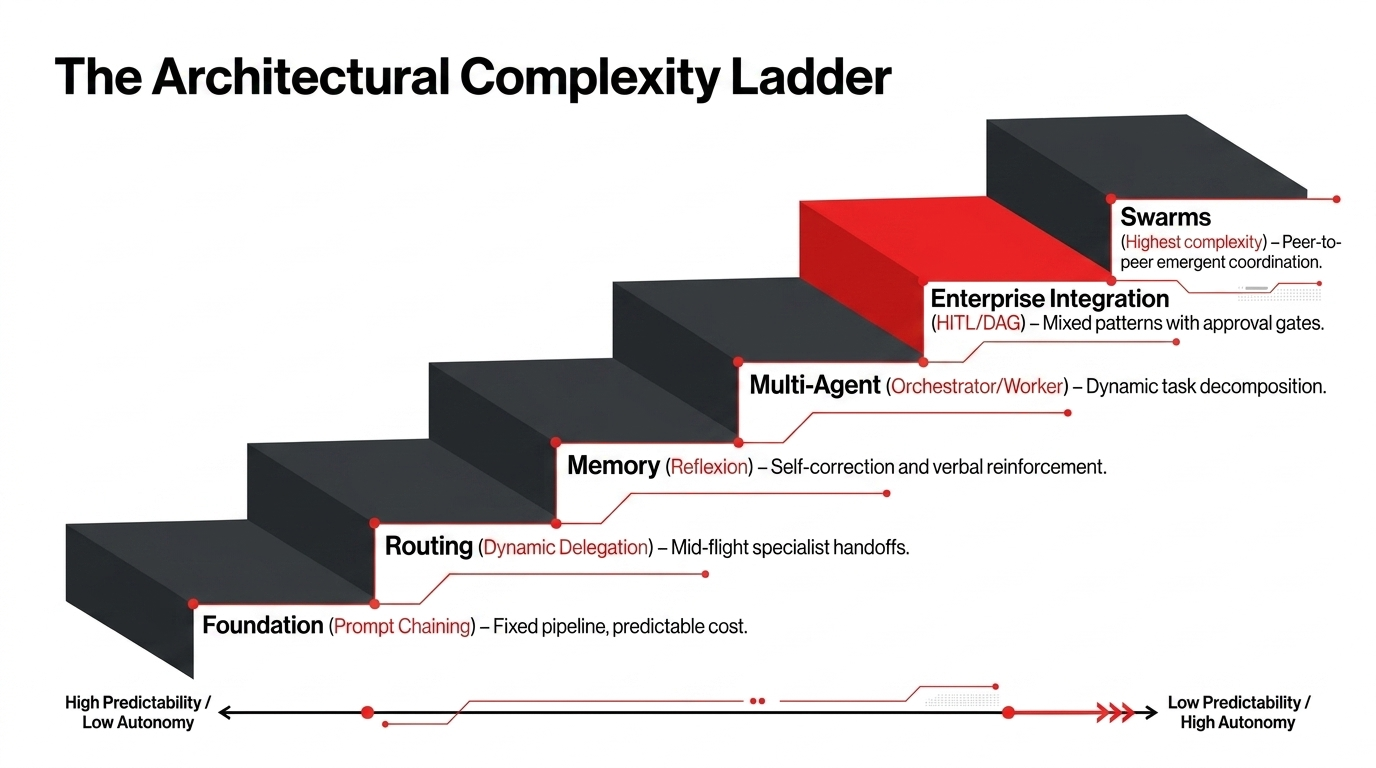
Each step buys flexibility at the cost of predictability. Fixed pipelines are easier to estimate, test, and secure. Dynamic delegation improves specialization but introduces runtime branching. Memory enables self-correction but creates state-management problems. Multi-agent systems improve parallelism while adding coordination overhead. Swarms can be powerful when the work decomposes naturally, but they also create the greatest observability and control burden.
A sensible enterprise rule is to use the least complex architecture that can solve the task reliably. Agentic systems should earn complexity only when a simpler pipeline cannot handle the branching, uncertainty, or parallelism required.
This principle also helps control cost. More agents mean more context, more model calls, more intermediate artifacts, and more opportunities for retries. Complexity is not free simply because the workers are software.
5. Orchestrator-Worker Is the Default Multi-Agent Pattern
The orchestrator-worker pattern provides a practical middle ground between a fixed chain and a fully decentralized swarm. A manager agent maintains a task ledger, detects blockers, assigns work, and decides what should happen next. Specialist workers perform bounded functions such as implementation, testing, documentation, and review.
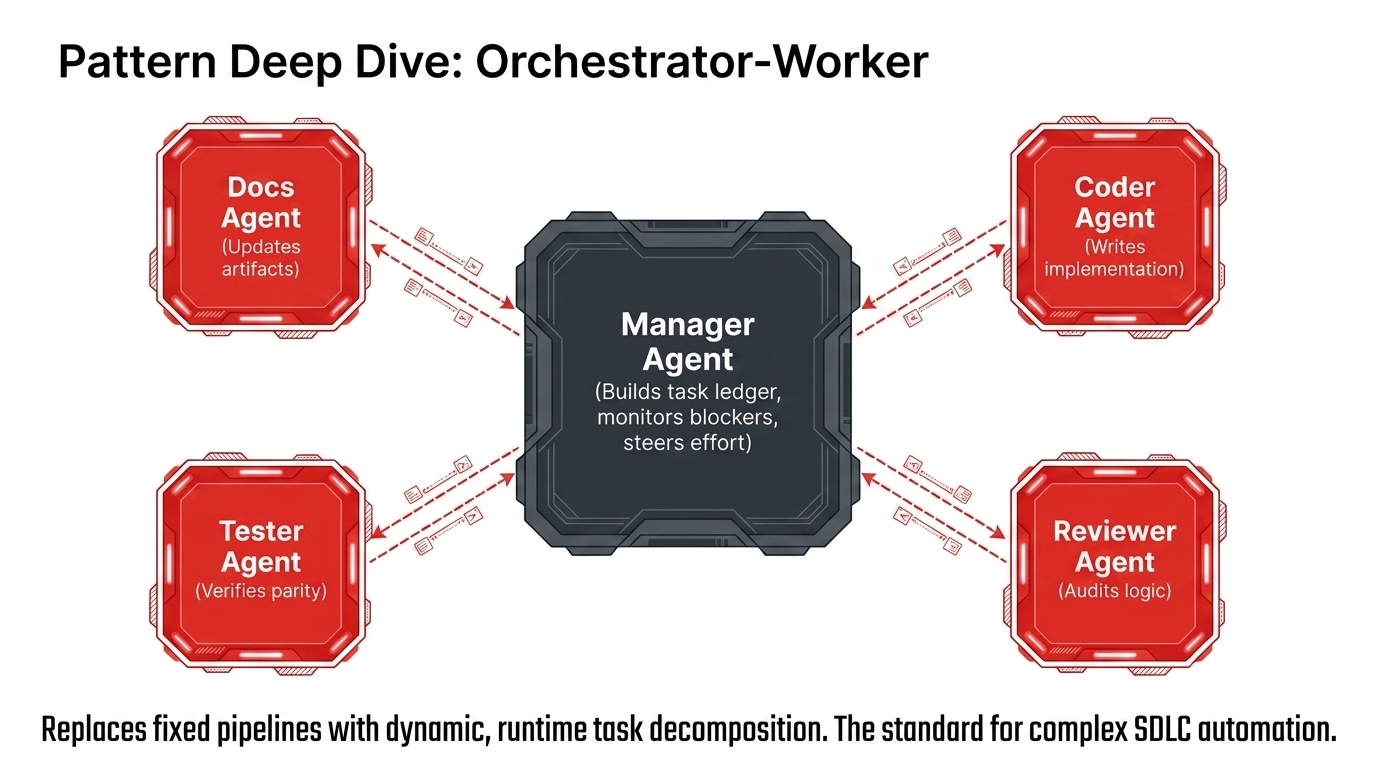
The critical architectural advantage is dynamic task decomposition. The manager can discover that an implementation task is blocked on an undocumented API, create a documentation or discovery subtask, and route the result back into the main plan without forcing the whole workflow to be predefined.
The pattern works best when worker contracts are explicit. Each worker should know:
- what input artifacts it may consume,
- what outputs it must produce,
- what tools it is authorized to use,
- what constitutes completion,
- what evidence must accompany the result,
- when to stop and escalate rather than continue improvising.
This converts delegation from a conversational convention into an engineering interface.
6. Agency Allocation Is a Security Control
The source material places human-driven “Ask Mode” and autonomous “Agent Mode” on a continuum, with a human-in-the-loop control boundary between them. That is a useful way to think about governance: autonomy is not binary.
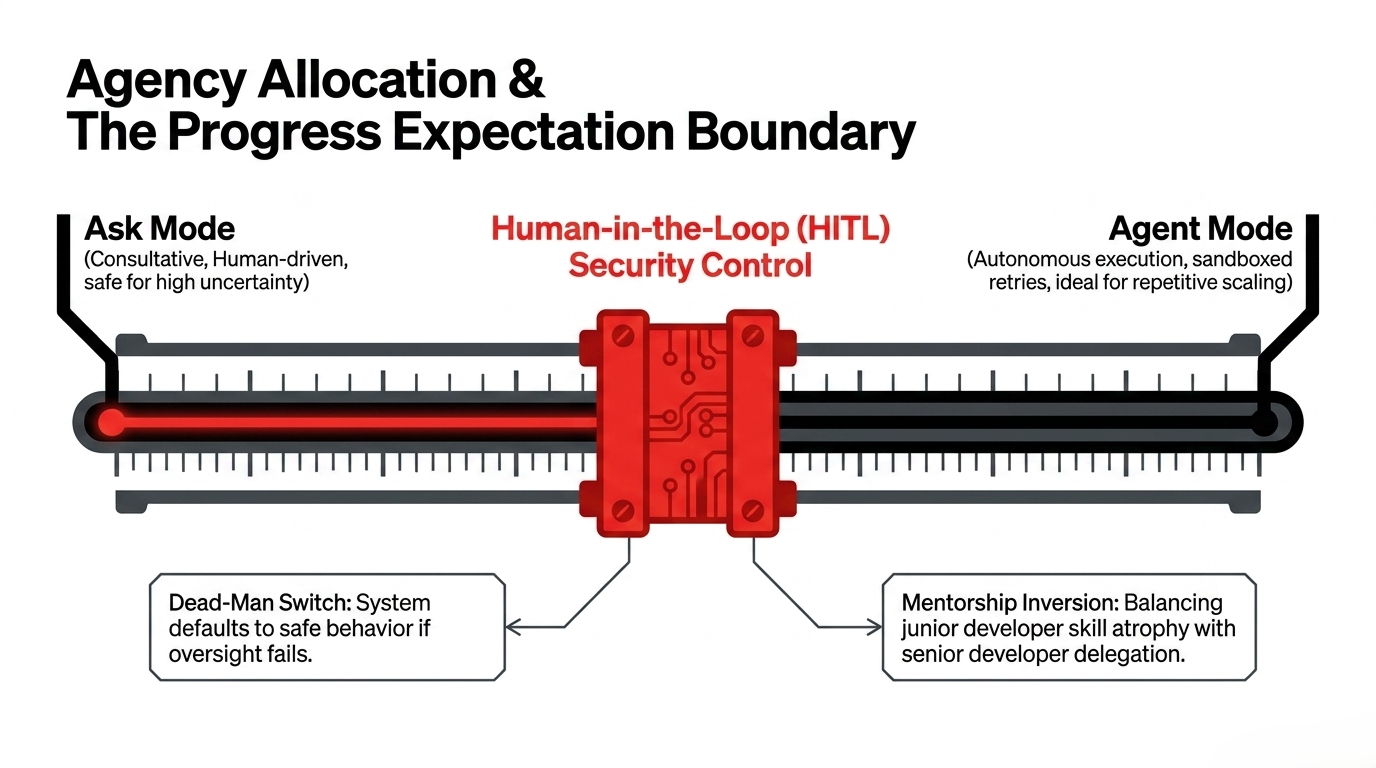
Tasks with high uncertainty, unclear intent, destructive potential, or irreversible consequences should remain closer to consultative operation. Repetitive, reversible tasks inside sandboxed environments can move toward autonomous execution.
Two governance ideas in the diagram deserve special attention. A dead-man switch means the system defaults toward a safe state when oversight or coordination fails. Mentorship inversion captures a human risk: if junior engineers delegate every difficult reasoning task, they may stop developing the judgment required to review agent output, while senior engineers become overloaded with delegation and approval work.
A production policy should therefore define agency by risk class. Examples include automatic execution for formatting or isolated test generation, review-required execution for code changes, and explicit approval for production deployment, credential changes, data migration, or security-sensitive configuration.
7. Legacy Modernization Is a Natural Stress Test
Legacy modernization exposes the hardest part of agentic engineering: the system must reason about software whose intent is distributed across code, database triggers, configuration, scripts, runtime behavior, and undocumented conventions.
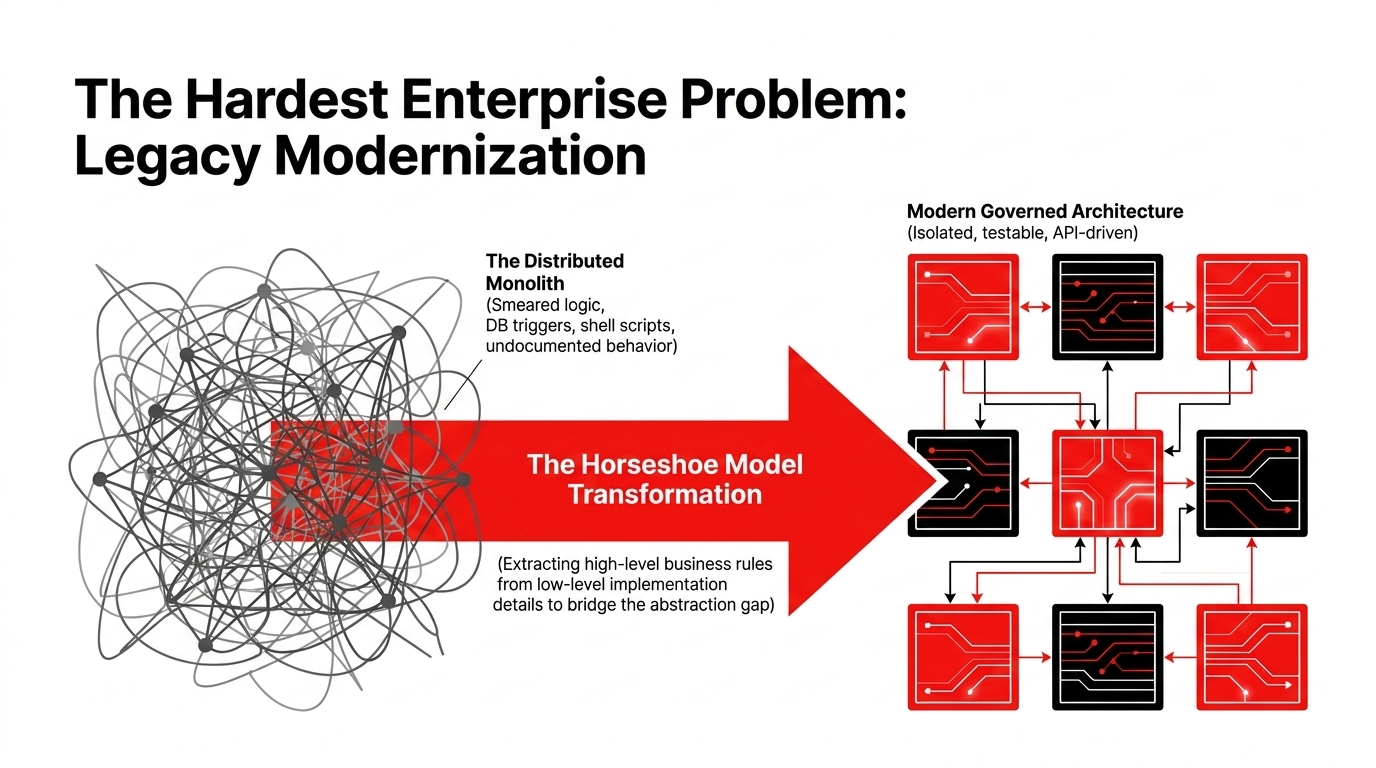
The source material uses a horseshoe-style transformation: move upward from low-level implementation details to recover higher-level business rules, then move downward again into a modern governed architecture.
This is more than code translation. A successful modernization program must preserve behavior while changing implementation structure. That requires recovering operational intent before rewriting the system.
The biggest failure mode is to treat the existing codebase as a complete specification. In real systems, behavior often lives in the interaction between code, data, environment, deployment configuration, and human operating procedures. Agentic modernization works only if discovery is broad enough to capture that distributed truth.
8. Reverse Documentation Engineering Creates the Missing Specification
The “Reversa Flow” diagram makes the key move explicit: use agents to extract knowledge, rules, and architecture from the legacy system, assemble those findings into governed operational specifications, and then use the specifications to guide migration and future evolution.
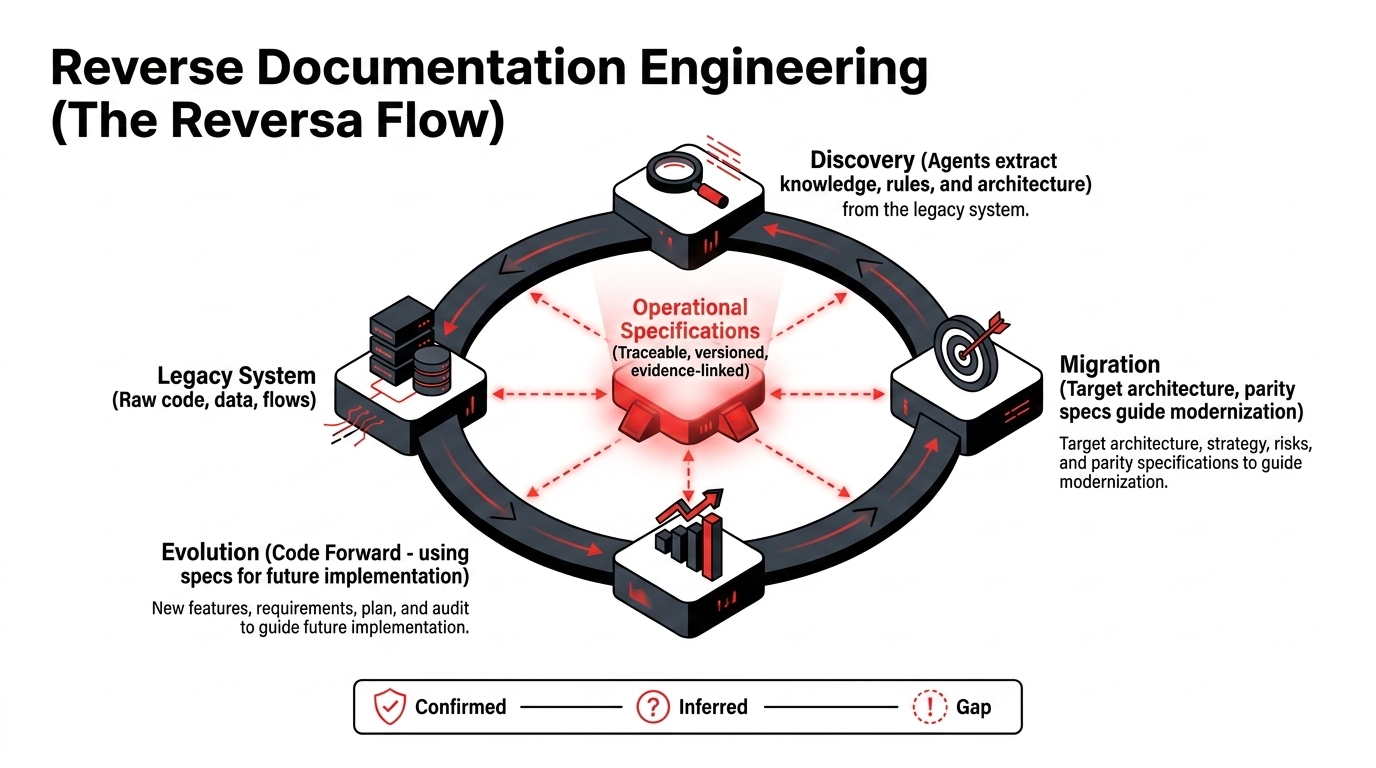
This creates a loop rather than a one-time migration project:
Legacy system → discovery → operational specification → migration → evolution → updated specification.
The central artifact is the operational specification. It should be traceable, versioned, and evidence-linked. That means every important statement about behavior should ideally carry a status such as confirmed, inferred, or gap.
That distinction is especially valuable for agentic systems. Models are good at constructing plausible explanations. Modernization requires knowing whether an explanation is supported by code, runtime evidence, tests, or only inference. Uncertainty should be represented as data, not buried in prose.
9. Translate Code into Governed Specifications Before Rebuilding
The specification funnel in the source material shows a staged reasoning process. An explorer opens candidate architectural paths. A challenger looks for adversarial risks and contradictions. A pre-spec stage defines minimum scope and non-goals. The output is a set of governed engineering artifacts rather than a free-form summary.
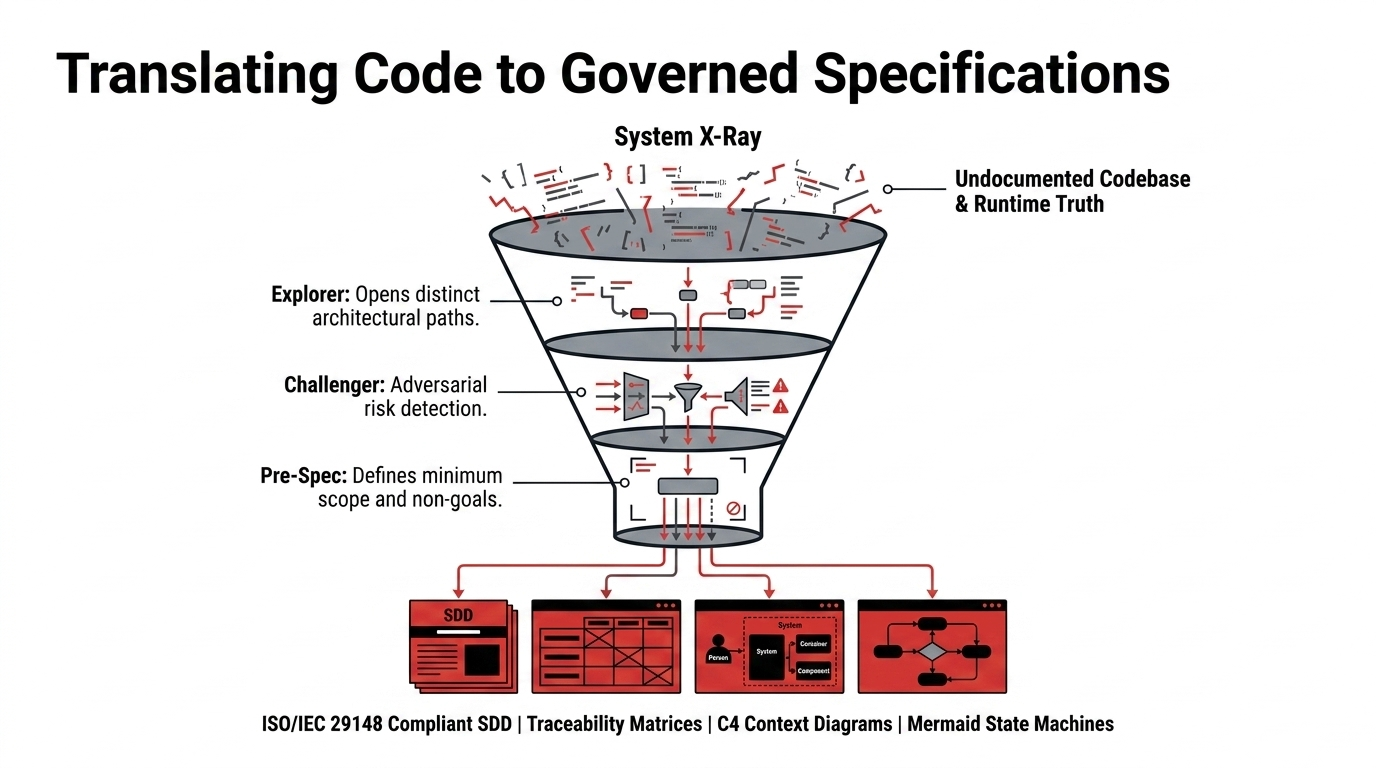
The listed artifact types include software design documentation, traceability matrices, C4 context diagrams, and state-machine descriptions. The broader architectural principle is that modernization should produce machine-usable and reviewable specifications.
That improves several things at once. It reduces context-window pressure because downstream agents can consume only the slice of specification relevant to a task. It gives reviewers stable artifacts to approve. It creates a target for parity testing. And it separates discovery from implementation so the system does not rewrite code while it is still guessing what the code does.
This is one of the strongest production patterns in the blueprint: compress an opaque system into governed intermediate representations before asking agents to transform it.
10. Parallel Migration Works When the Specification Is the Shared Contract
Once the source system has been converted into explicit specifications, migration can be decomposed into parallel tracks. The example uses frontend, backend, and database subagents, each working from the same source specification while receiving only the rules relevant to its track.
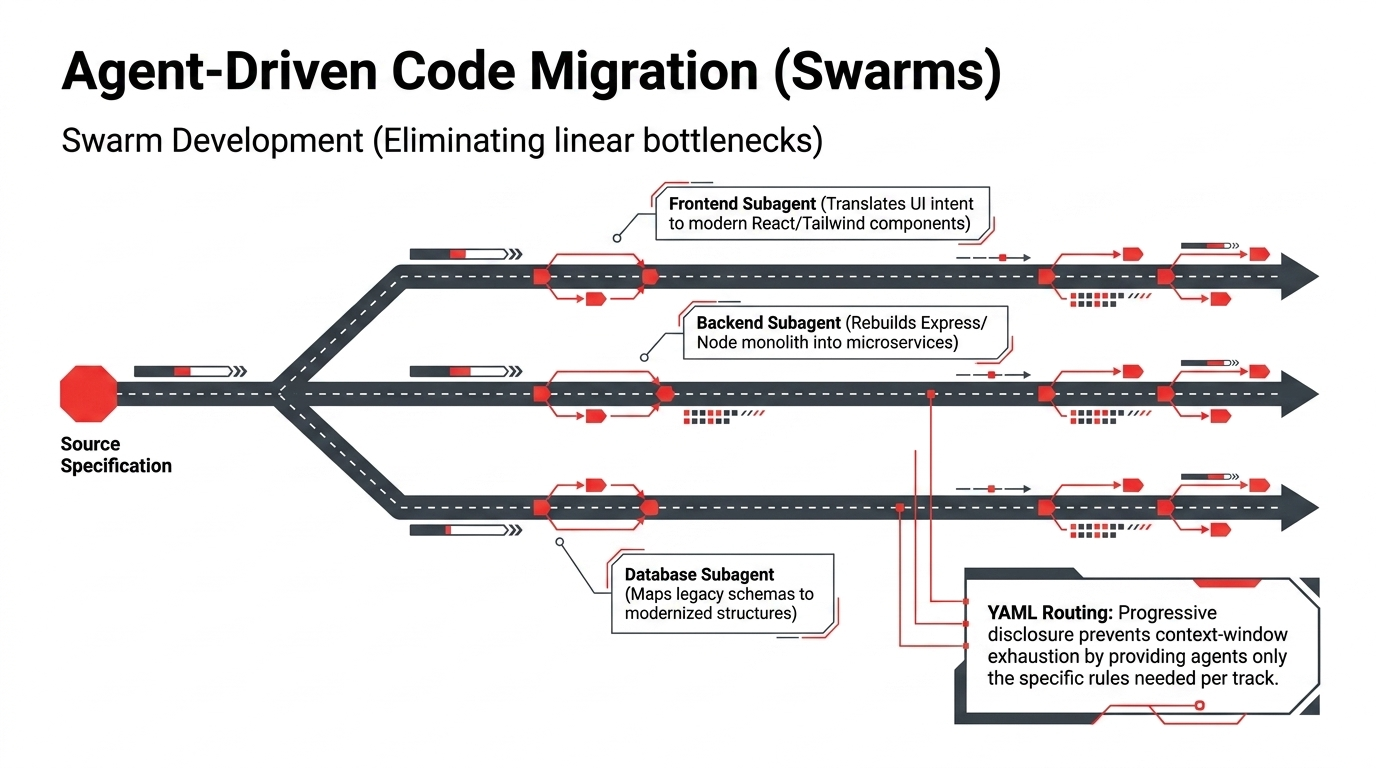
This is where swarms can reduce linear bottlenecks. Different specialists can advance simultaneously as long as boundaries are clear and the outputs rejoin through stable interfaces.
The diagram also introduces progressive disclosure through routing. Instead of placing the entire migration context into every agent prompt, the system supplies the minimum rules needed for the current track. That is important for both quality and cost. Smaller, targeted contexts reduce distraction, lower token use, and make it easier to determine which evidence influenced a decision.
Parallelism should not remove integration discipline. Contracts, schemas, API behavior, migration ordering, and data invariants still need centralized governance. Swarm execution is most useful when the system can parallelize implementation without fragmenting the architecture.
11. Verification Must Put the Environment in the Loop
Agent-generated tests are not automatically trustworthy. The source material therefore introduces an environment agent that constructs an executable build/runtime environment, runs parity checks, captures failures, produces diagnostics, and feeds those signals back to the coding agent.
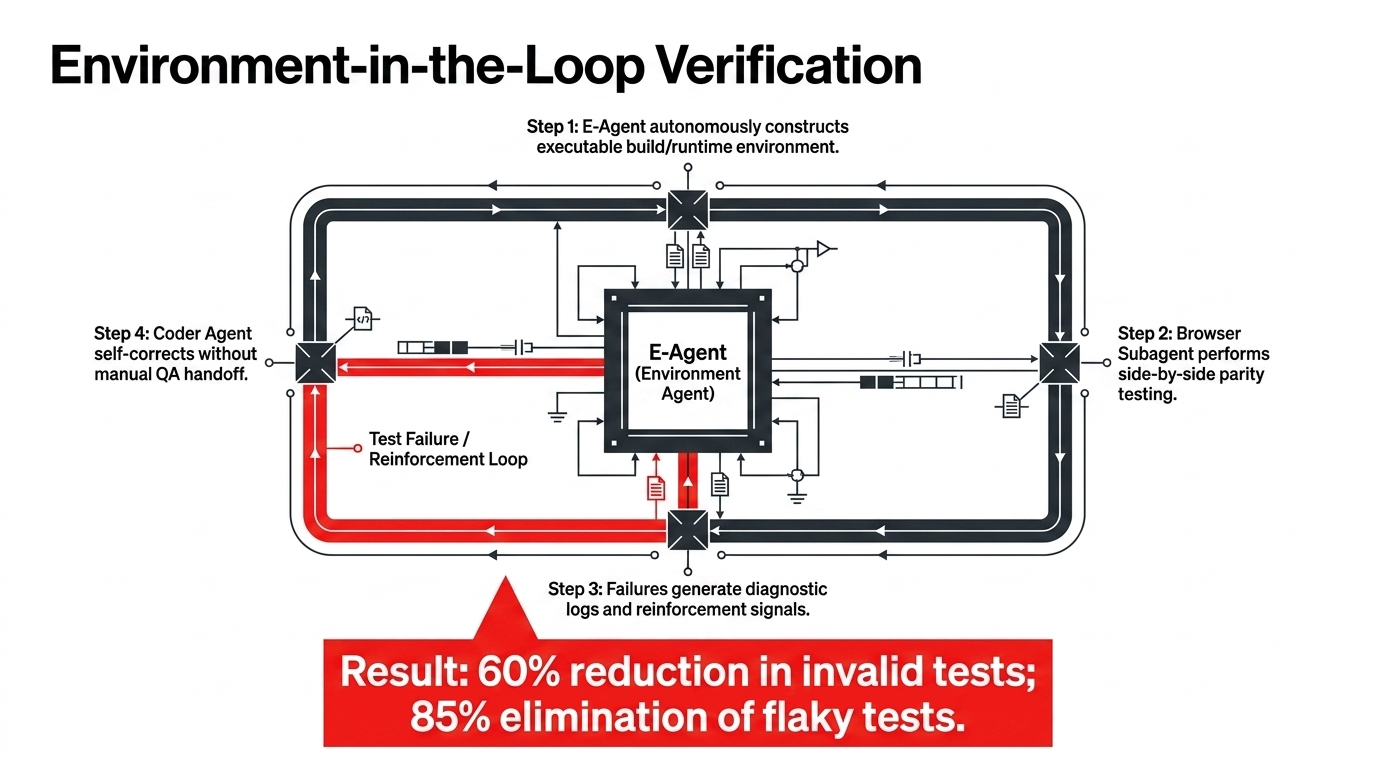
This is a major reliability upgrade over model-only review. The environment becomes an external source of truth. Instead of asking the same model family to generate code and then judge whether it looks correct, the system executes the software and observes behavior.
A robust verification loop should combine multiple evidence channels: unit tests, integration tests, browser or API parity checks, static analysis, type checks, security scanning, performance constraints, and domain-specific invariants. Failures should be converted into structured diagnostics that can be routed back to the responsible agent.
The source visual reports reductions in invalid and flaky tests, but it does not provide the experimental design or measurement methodology. Those numbers should therefore be treated as claims from the presented blueprint, not independently validated benchmarks.
12. The Hard Problems Are Sociotechnical, Not Just Technical
The risk diagram highlights five barriers: accountability, formal reasoning, skill atrophy, token and compute costs, and hallucinations or state breakdown in unfamiliar codebases.
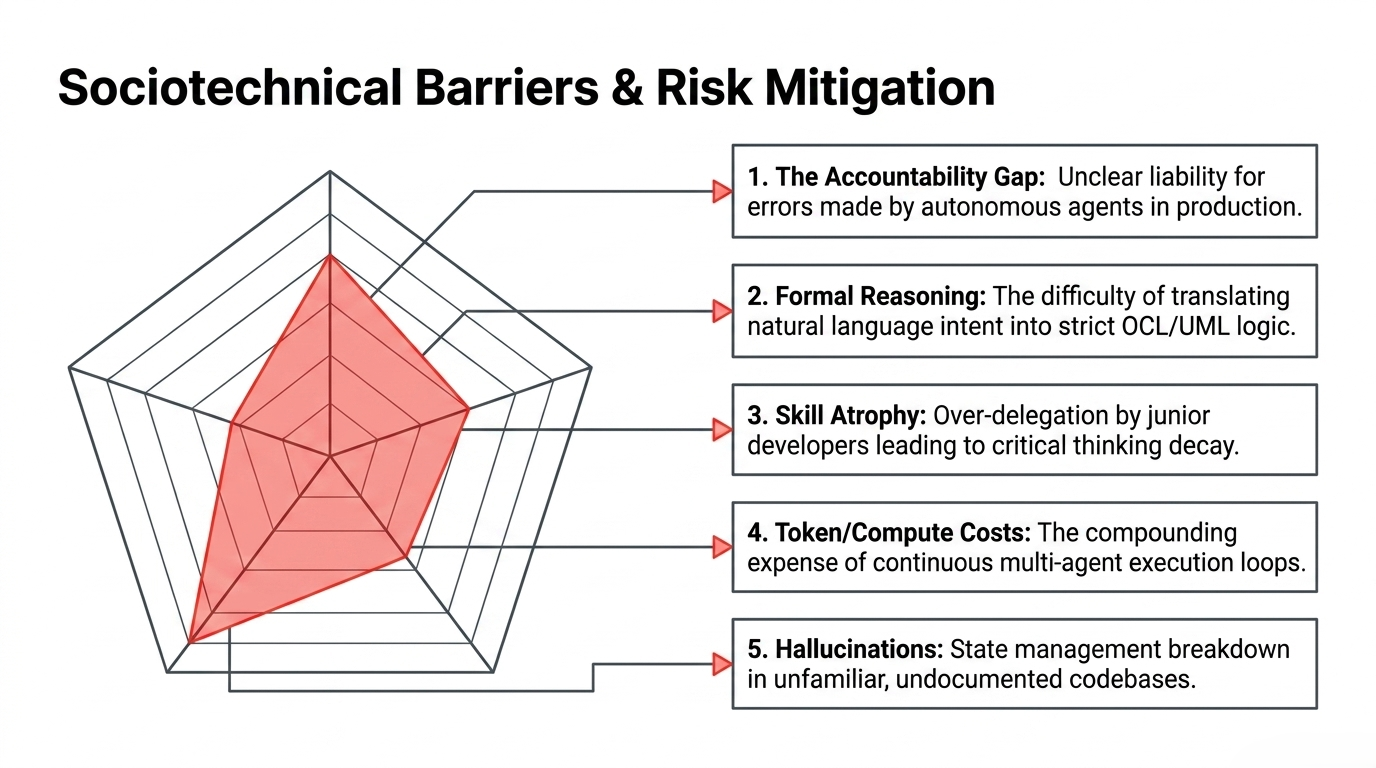
These risks interact. Weak formal reasoning can create ambiguous specifications. Ambiguous specifications increase hallucination risk. More retries increase cost. Excessive reliance on agents can reduce the human expertise needed to detect subtle failures. And when a production incident occurs, unclear responsibility can make remediation slower.
A practical mitigation program should combine technical and organizational controls:
- assign human owners to agent-created production changes,
- require provenance and evidence for critical decisions,
- cap runtime loops and tool budgets,
- preserve manual competency through review and rotation,
- test agents against adversarial or incomplete inputs,
- design fallback behavior for coordination, model, and tool failures.
The important point is that AgentOps is also operating-model design. The system has to define who is responsible, who may approve, who can stop execution, and how humans retain enough context to intervene effectively.
13. Benchmark Claims Need Evidence Discipline
The source material presents several headline performance claims, including reductions in lead time and increases in feature-analysis and deployment speed, along with a vulnerability-recall figure.
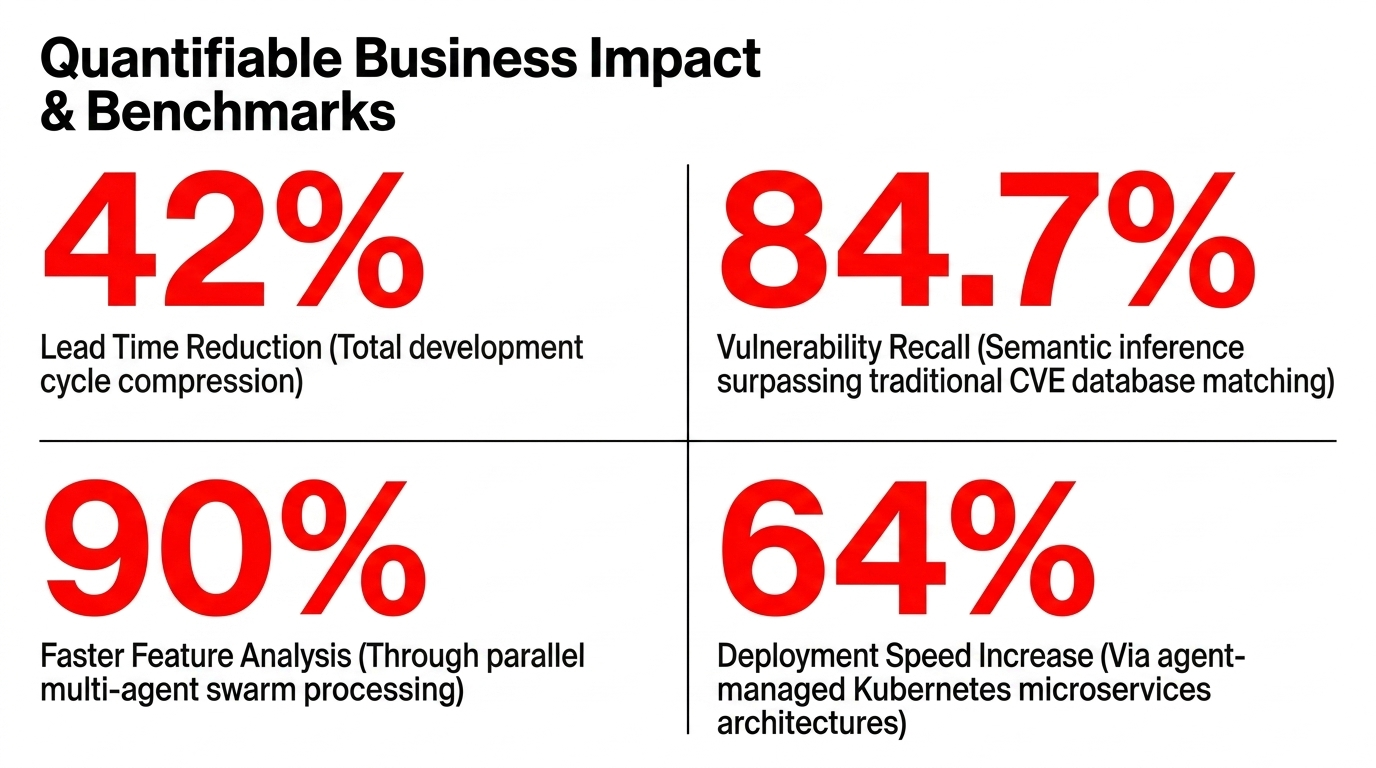
Those values are useful as hypotheses for what an agentic platform should measure, but the diagrams do not include datasets, baselines, sample sizes, confidence intervals, workloads, or evaluation procedures. A publication-ready engineering program should therefore avoid treating them as universal outcomes.
What is transferable is the measurement framework. If an organization adopts this architecture, it should track:
- end-to-end lead time by work type,
- cycle time per agent and per human approval stage,
- first-pass test validity and flaky-test rate,
- change failure rate and rollback frequency,
- defect escape rate and vulnerability detection,
- model/tool cost per completed unit of work,
- human review time and escalation frequency,
- parity confidence for modernization workloads.
Agentic engineering becomes credible when speed metrics are paired with quality, risk, and cost metrics.
14. A Full Legacy-Modernization Swarm Combines Discovery, Synthesis, and Self-Healing
The combined modernization visual brings the architecture together. “System spiders” inspect the legacy estate to recover APIs, UI flows, database behavior, configurations, and hidden business rules. Their output is then handed to a collaborative swarm that separates implementation, environment provisioning, and test validation into distinct roles.
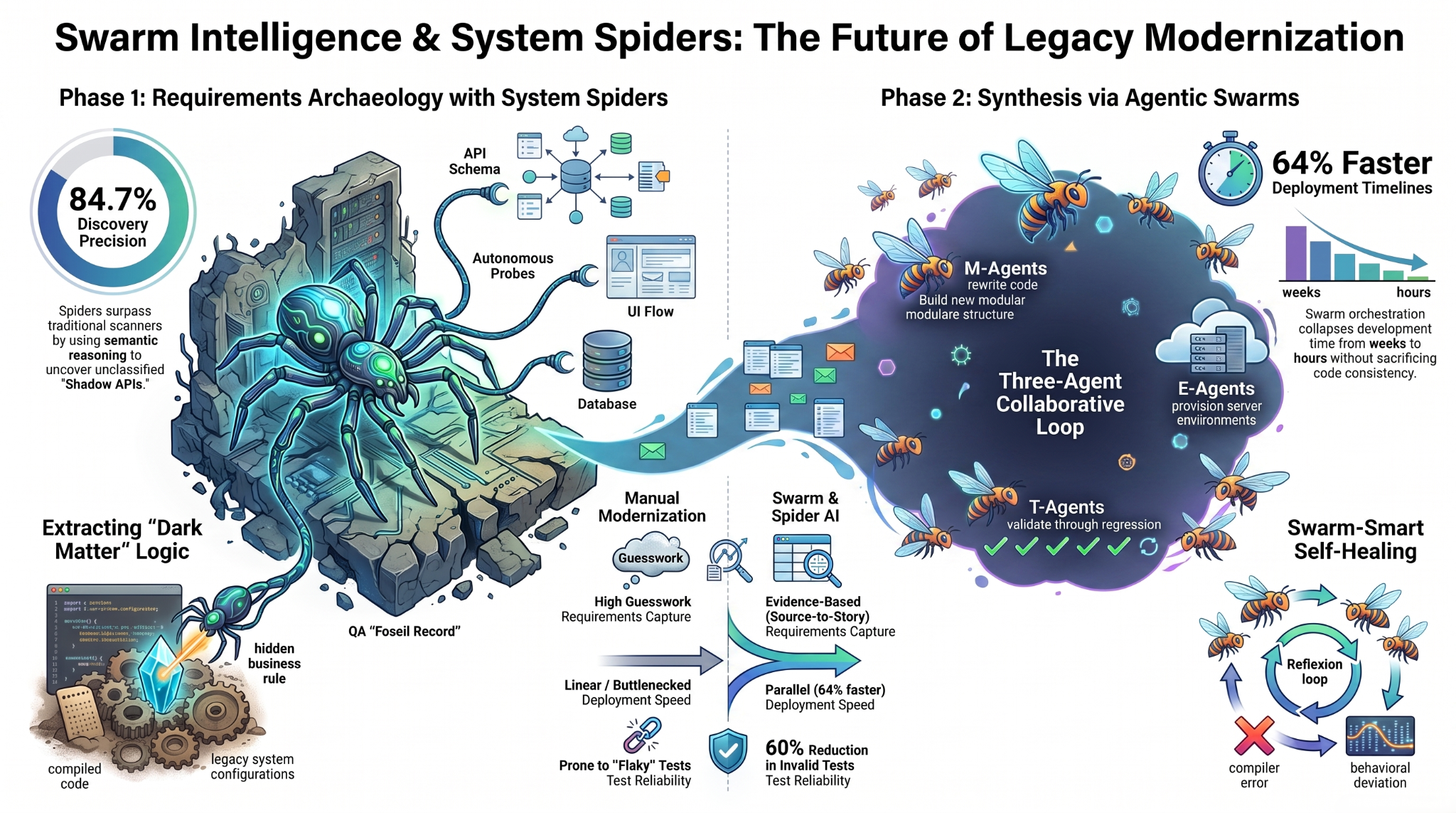
This two-phase structure is important.
Phase 1: requirements archaeology. Agents inspect the system and build evidence-backed specifications from source code and runtime truth.
Phase 2: synthesis. Specialized agents rewrite modules, provision executable environments, validate behavior, and loop on failures.
The strongest architectural idea is separation of concerns. Discovery agents are not asked to modernize while they are still inferring behavior. Coding agents are not allowed to declare their own work correct without environment evidence. Environment agents provide executable truth. Test agents specialize in parity and regression. The orchestrator keeps the workflow coherent.
The visual also presents several quantitative improvements. As with the other benchmark slide, these should be read as source claims rather than established industry baselines unless supporting evaluation data is supplied.
15. The Future State: Developers Orchestrate Delegated Intelligence
The final image states the thesis directly: the transition is not about replacing developers; it is about changing the developer’s role from producing every implementation detail to orchestrating swarms of intelligence.
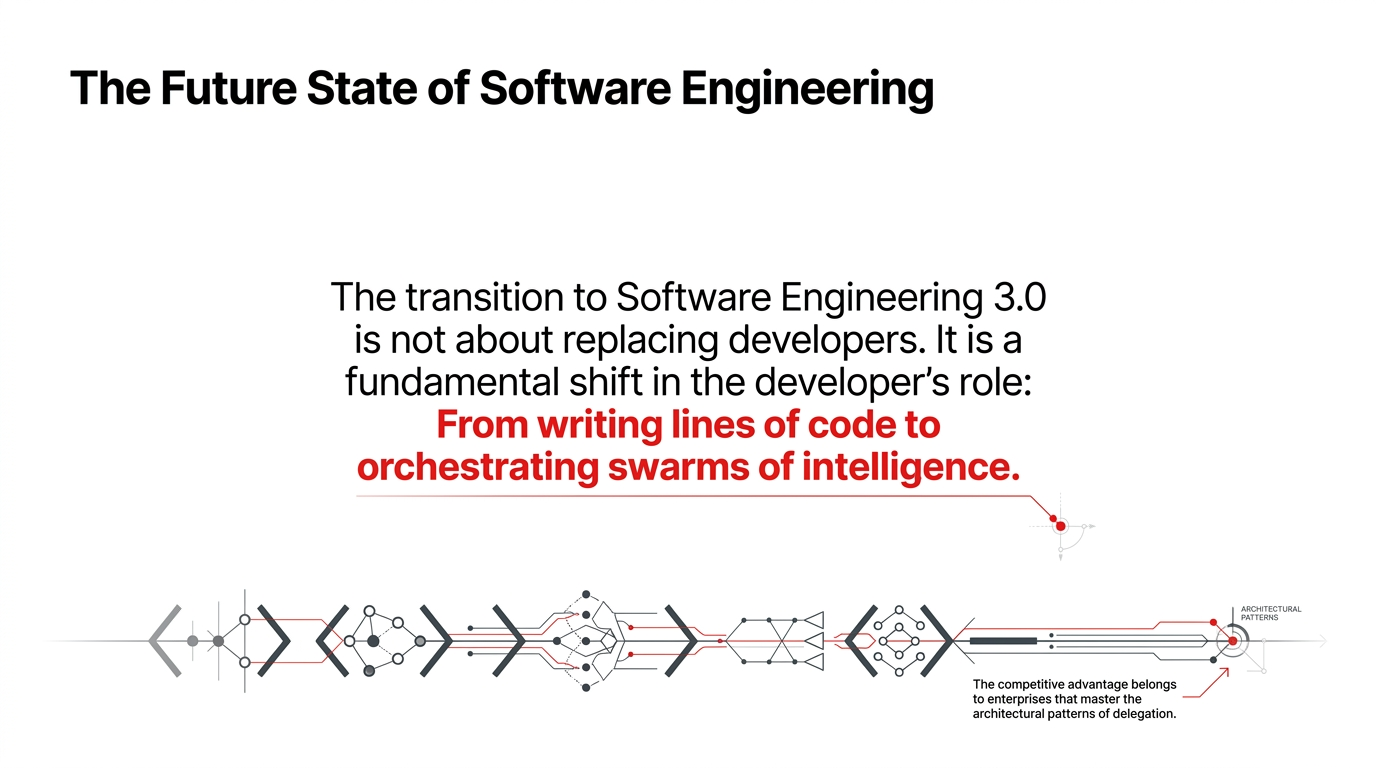
That shift increases the value of architecture. Once agents can write, test, and change code quickly, the competitive bottleneck moves upward into the patterns that govern delegation: task decomposition, agent boundaries, evidence contracts, approval gates, state management, recovery behavior, and observability.
Developers still write code, especially where ambiguity is high or novelty matters. But more of their leverage comes from designing the conditions under which many specialized workers can operate safely in parallel.
Engineering Principles
The architecture ultimately depends on several principles:
-
Earn autonomy through evidence
Increase agency only where execution is observable, reversible, testable, and bounded. -
Separate discovery from transformation
Recover operational truth before rewriting systems whose behavior is poorly documented. -
Use governed intermediate artifacts
Specifications, traceability maps, architecture models, and parity contracts reduce ambiguity between agents. -
Prefer environment truth over model self-assessment
Code should be executed, tested, and observed in realistic environments before the system is allowed to self-correct. -
Choose the simplest coordination pattern that works
Prompt chains, routing, orchestrator-worker systems, and swarms belong on a continuum; higher autonomy should solve a real problem, not serve as an architectural fashion. -
Treat shared memory as production infrastructure
Context, artifacts, decisions, and messages need versioning, access control, and provenance. -
Make human intervention an explicit control path
Approval gates, safe defaults, budget limits, and emergency stop behavior are part of the architecture. -
Measure quality and cost alongside speed
Faster execution is valuable only if reliability, security, maintainability, and economic efficiency remain acceptable.
Final Synthesis
Software Engineering 3.0 is best understood as a delegation architecture for the SDLC. Foundation models supply semantic reasoning, but the production system is created by the layers around them: orchestrators, protocols, shared memory, sandboxed infrastructure, governed specifications, verification environments, approval policies, and telemetry.
The legacy-modernization flow is a particularly strong example because it forces every layer to work together. Discovery agents extract evidence. Specifications encode what is known and what remains uncertain. Orchestrators divide the migration into bounded tasks. Specialist agents implement in parallel. Environment agents create executable truth. Test agents evaluate parity. Human controls govern high-risk transitions. Observability records enough of the process to explain what happened.
The production-ready system combines:
- a deterministic foundation for source control, build systems, deployment pipelines, and policy enforcement,
- a testing layer that validates behavior in executable environments,
- an agent layer that plans, delegates, implements, reviews, and self-corrects,
- security and governance through scoped permissions, approval gates, and safe-stop behavior,
- observability across plans, tool calls, state changes, cost, evidence, and validation results,
- a production outcome in which humans supervise architecture and intent while agents absorb more of the repetitive implementation and verification loop.
Closing Thought
The most important question is not how much code an agent can write. It is how much well-governed responsibility an engineering organization can safely delegate.
The future of software engineering is less about automating keystrokes and more about engineering the architecture of delegation.