
Swarm Intelligence in the SDLC
The transition from coding copilots to agentic software engineering is not mainly about giving an LLM more freedom. It is about building a system that can observe what software actually does, coordinate specialized work, validate every change, and route consequential decisions through explicit governance.
That distinction matters because software delivery is full of state, side effects, undocumented behavior, environmental assumptions, and conflicting evidence. A model can generate plausible code in a single turn, but production engineering requires a loop: understand intent, act in a constrained environment, collect evidence, compare results against expectations, remediate failures, and repeat.
The architecture in this article treats that loop as the foundation of swarm intelligence in the SDLC. Individual agents are useful, but the larger engineering shift comes from connecting agents to runtime environments, shared state, test systems, reverse-documentation workflows, and human accountability.
1. From Autocomplete to Software Engineering 3.0
The source material frames the next stage of software engineering around a core triad: autonomy, adaptability, and goal-directedness. Together, those properties move an AI system beyond passive code completion.
Autonomy means an agent can execute a complex workflow without requiring a new prompt for every step. Adaptability means the workflow can consume feedback from the environment and correct itself. Goal-directedness means high-level objectives can be decomposed into smaller tasks rather than being treated as one monolithic generation request.
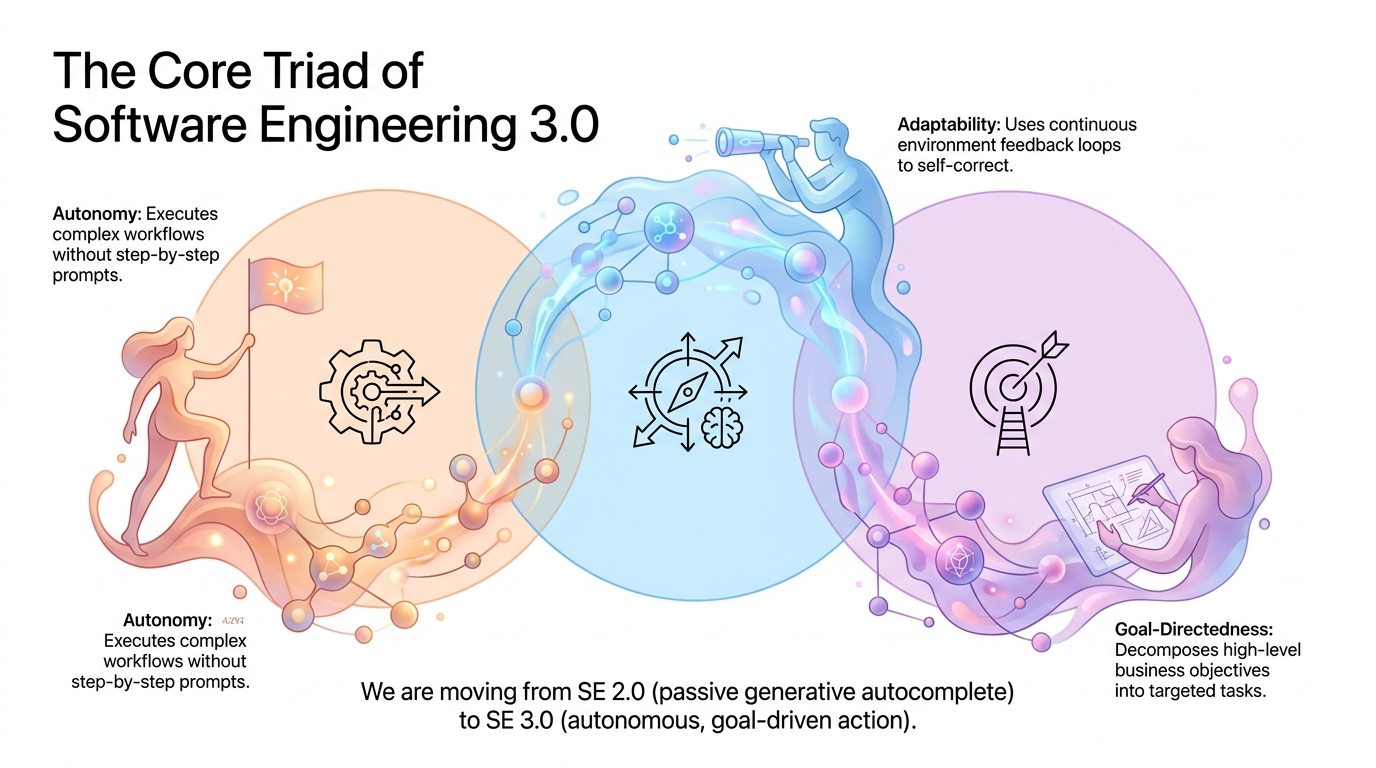
The engineering implication is important: autonomy without feedback becomes uncontrolled execution, while feedback without a goal becomes reactive thrashing. Goal-directed behavior provides a destination; environmental feedback provides evidence; autonomy supplies the ability to traverse the path between them.
This is why an agentic system should be designed less like a chat interface and more like a control system with bounded actuators and measurable state transitions. The model may decide what to try next, but the system around it must determine what it is allowed to touch, what evidence counts as success, and when the loop must stop.
2. Multi-Agent Design Is a Complexity Ladder
Not every problem needs a swarm. The design pattern should grow with the uncertainty, parallelism, and coordination requirements of the task.
The progression shown in the deck starts with a single-agent tool caller, moves to orchestrator-workers for dynamic task decomposition, then to group chat for debate and consensus, and finally to a swarm of peer agents.
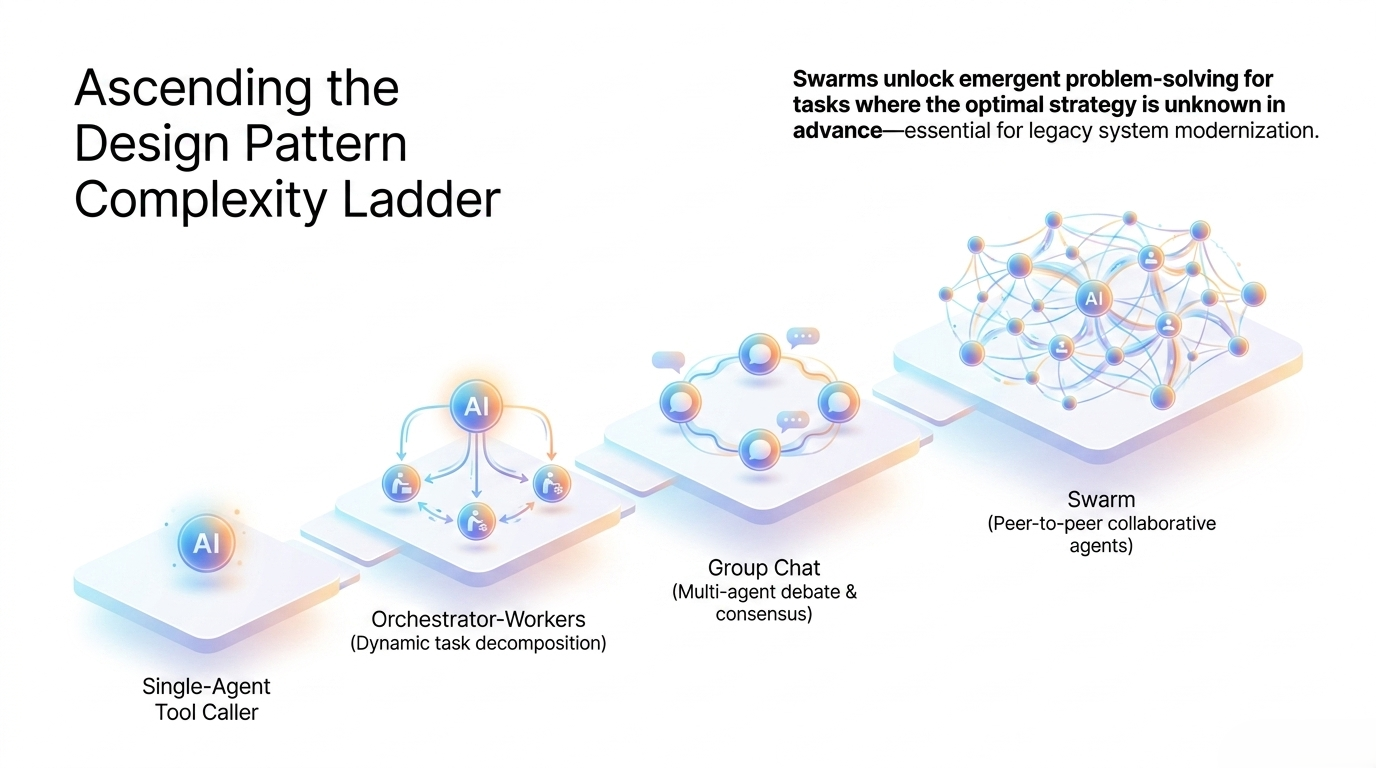
Each step adds coordination power, but it also adds failure modes. A single agent is easier to reason about, while an orchestrator can split work into specialist tasks. Group-chat patterns introduce explicit argument and consensus, which can help when multiple interpretations must be compared. Peer-to-peer swarms go further by allowing useful behavior to emerge without one central planner.
The deck's key claim is that swarms are particularly relevant when the optimal strategy is not known in advance, such as legacy-system modernization. In that setting, the architecture may need to discover hidden behavior, compare conflicting evidence, generate candidate specifications, migrate code, and continuously re-test the result.
A practical rule follows: choose the least complex coordination model that can reliably solve the problem. Swarms are not a default architecture; they are an escalation point for tasks whose search space, ambiguity, or parallelism justifies the additional coordination burden.
3. The Real Modernization Problem Is “Dark Matter” Logic
Legacy modernization is often described as a code-translation problem. The harder problem is that the written documentation and the running system are rarely identical.
The deck calls the hidden behavior “dark matter logic”: business rules encoded in old patches, exception handlers, integration quirks, database behavior, undocumented operator workarounds, and historical compatibility decisions. The wiki may describe what the system is supposed to do, while production behavior contains the rules the organization has actually depended on.
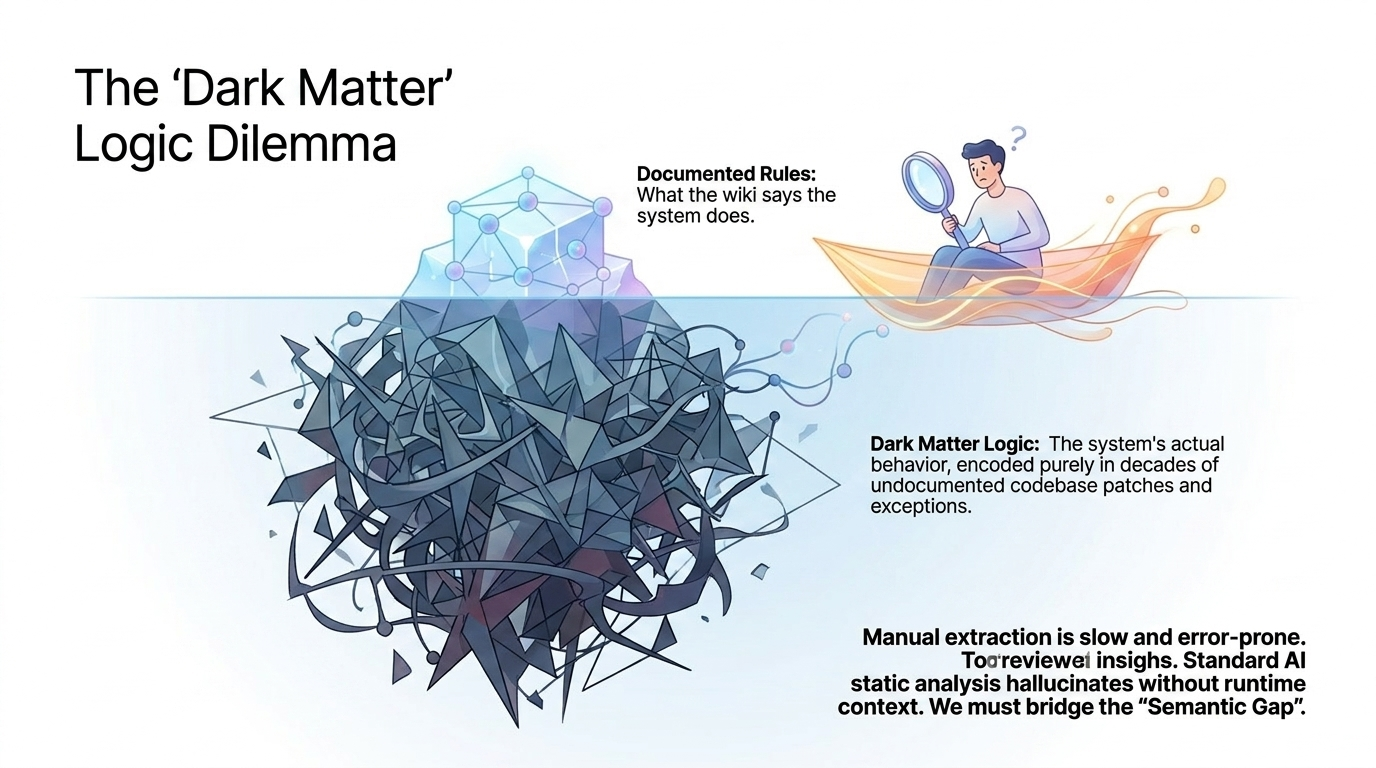
This creates a semantic gap. Static inspection can reveal structure, but it does not automatically tell us which branches execute in practice, which external services shape behavior, or which legacy exceptions are functionally required. Manual extraction is slow and inconsistent, and model-generated interpretation can become ungrounded when it lacks runtime context.
The architectural answer is to treat execution evidence as a first-class input to requirements discovery.
Requirements archaeology through runtime evidence
The deck describes autonomous System Spiders that crawl network traffic, APIs, databases, and application behavior in safe QA environments. Their purpose is to reconstruct runtime call trees and transaction paths without exposing production data.
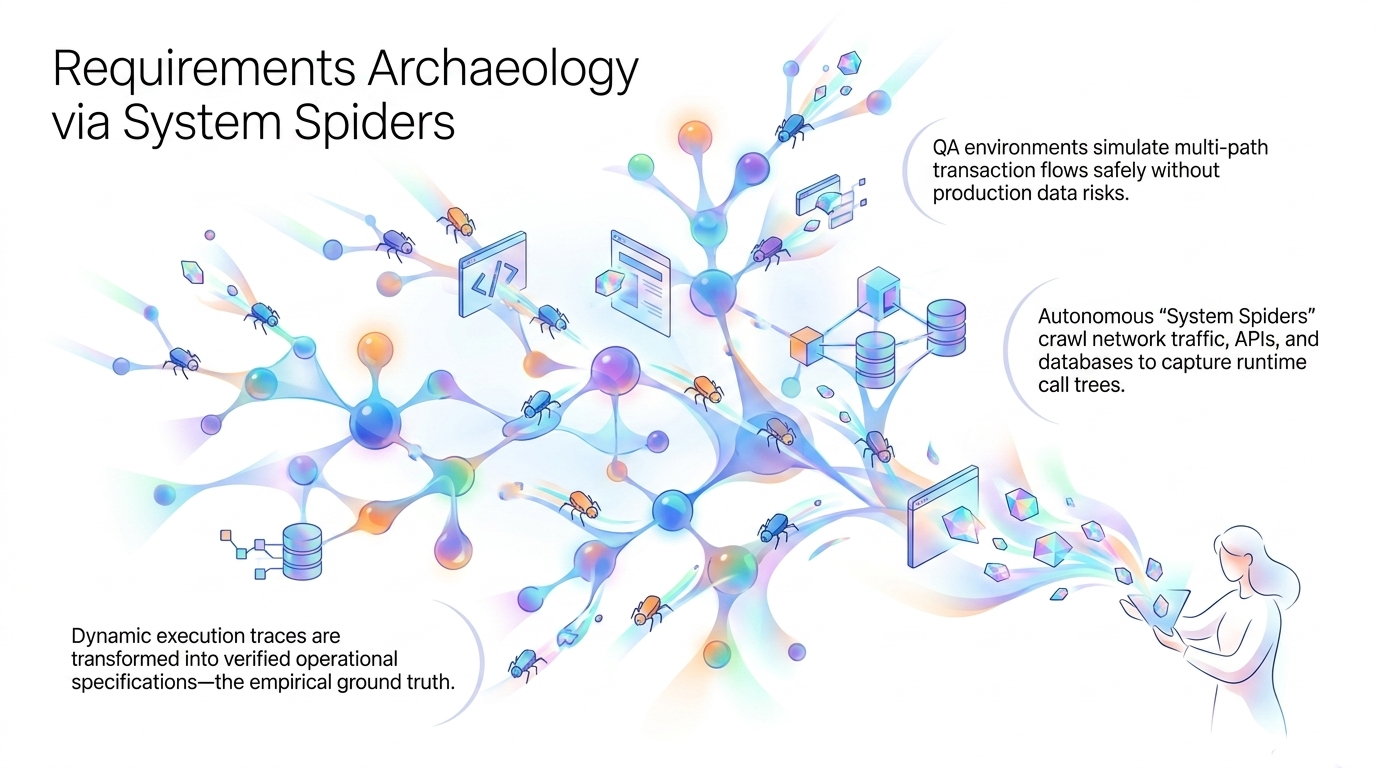
Dynamic traces are then transformed into verified operational specifications. That turns requirements discovery from a purely documentary exercise into empirical archaeology: infer what the system must preserve by observing the behavior that real execution produces.
This approach does not eliminate the need for documentation or domain expertise. It changes the evidence hierarchy. Written requirements remain important, but runtime traces provide a way to test whether the documentation matches operational reality.
For modernization work, that means the first deliverable should often be a validated behavioral model rather than migrated source code.
4. Coordination Needs Shared State, Not Endless Conversation
Multi-agent systems can degrade when every agent talks directly to every other agent. Context becomes duplicated, stale, or contradictory, and communication grows rapidly as the number of participants increases.
The blackboard architecture in the source material addresses this by making agents communicate through a globally shared, typed state store. Agents read from the shared memory, perform specialized work, and write structured results back to it.
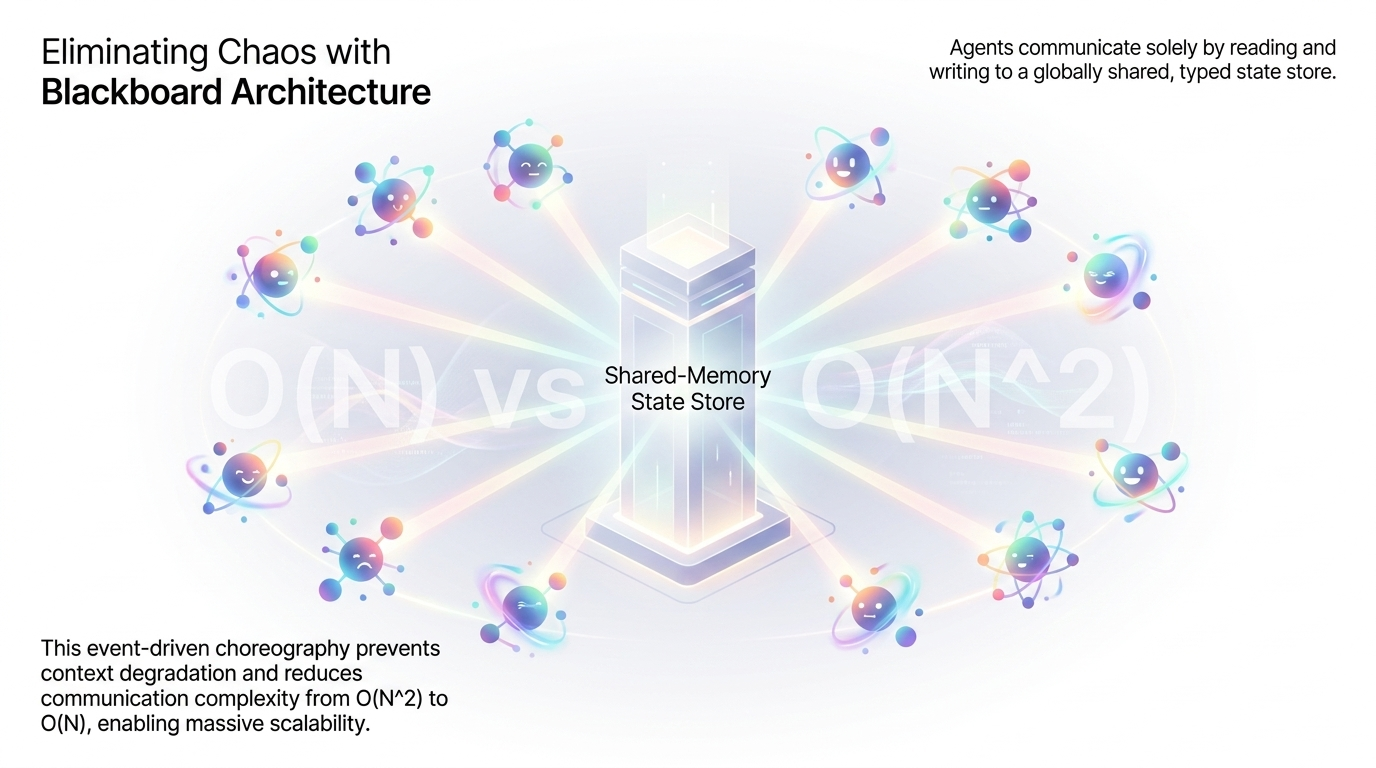
This replaces conversational mesh coordination with event-driven choreography. The slide expresses the scaling difference as moving communication complexity from roughly O(N²) toward O(N) by centralizing coordination through shared state.
The deeper value is not only message reduction. A typed state store establishes a contract. Instead of relying on another agent to interpret a long natural-language thread, each participant can consume explicit state such as:
- discovered requirements and confidence levels,
- current migration targets,
- failing test identifiers,
- execution traces and environment metadata,
- remediation proposals,
- approval status,
- and provenance linking an output to the evidence that produced it.
That structure makes the system easier to inspect and replay. It also creates a natural location for concurrency control, schema validation, audit metadata, and idempotency.
A swarm becomes far more governable when its shared memory is treated as system state, not as a chat transcript.
5. Environment-in-the-Loop Turns Execution into Evidence
An autonomous coding agent is only as trustworthy as the feedback loop around its actions. The Environment-in-the-Loop (EITL) paradigm places execution infrastructure directly inside the agent workflow.
The deck assigns three complementary responsibilities:
- M-Agent (Migration): rewrites legacy code, understands target semantics, and resolves incompatibilities.
- E-Agent (Environment): provisions sandboxes, configures toolchains, compiles code, and captures execution logs.
- T-Agent (Testsuite): generates and maintains regression tests by analyzing specifications and migrated code.
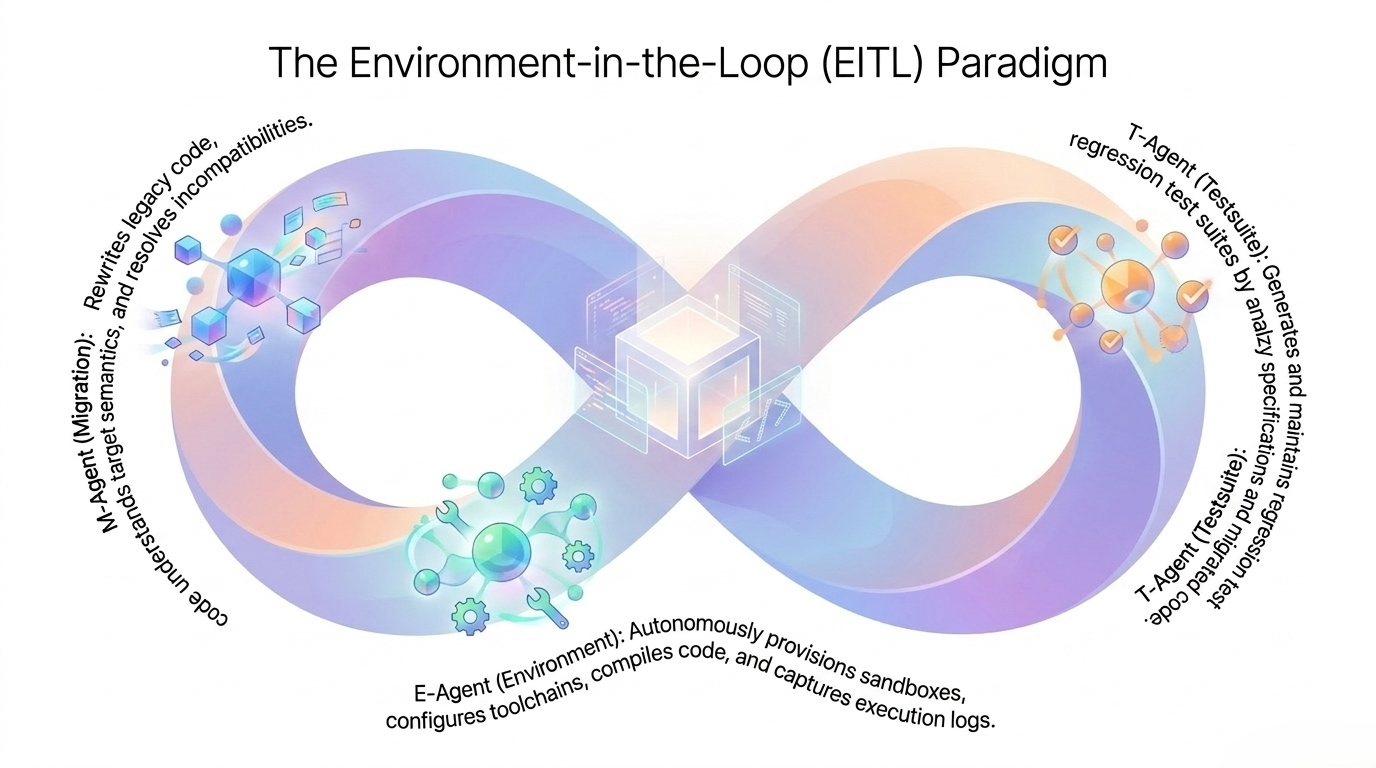
The critical design choice is that the environment is not a passive destination at the end of generation. It is an active participant in reasoning. Compiler errors, dependency failures, runtime exceptions, exit codes, and test results become structured feedback that changes what the agents do next.
That closes a common gap in AI-assisted engineering: a model can produce syntactically plausible code, but the environment determines whether the code is installable, executable, compatible, and behaviorally correct.
QA as a validation synergy
The E-Agent and T-Agent form a particularly useful validation pair. The deck presents the E-Agent as a validation hub that parses runtime errors and compiler stack traces into structured JSON. The T-Agent acts as the QA driver, using that real-time failure data to expand assertion coverage and refine expectations.
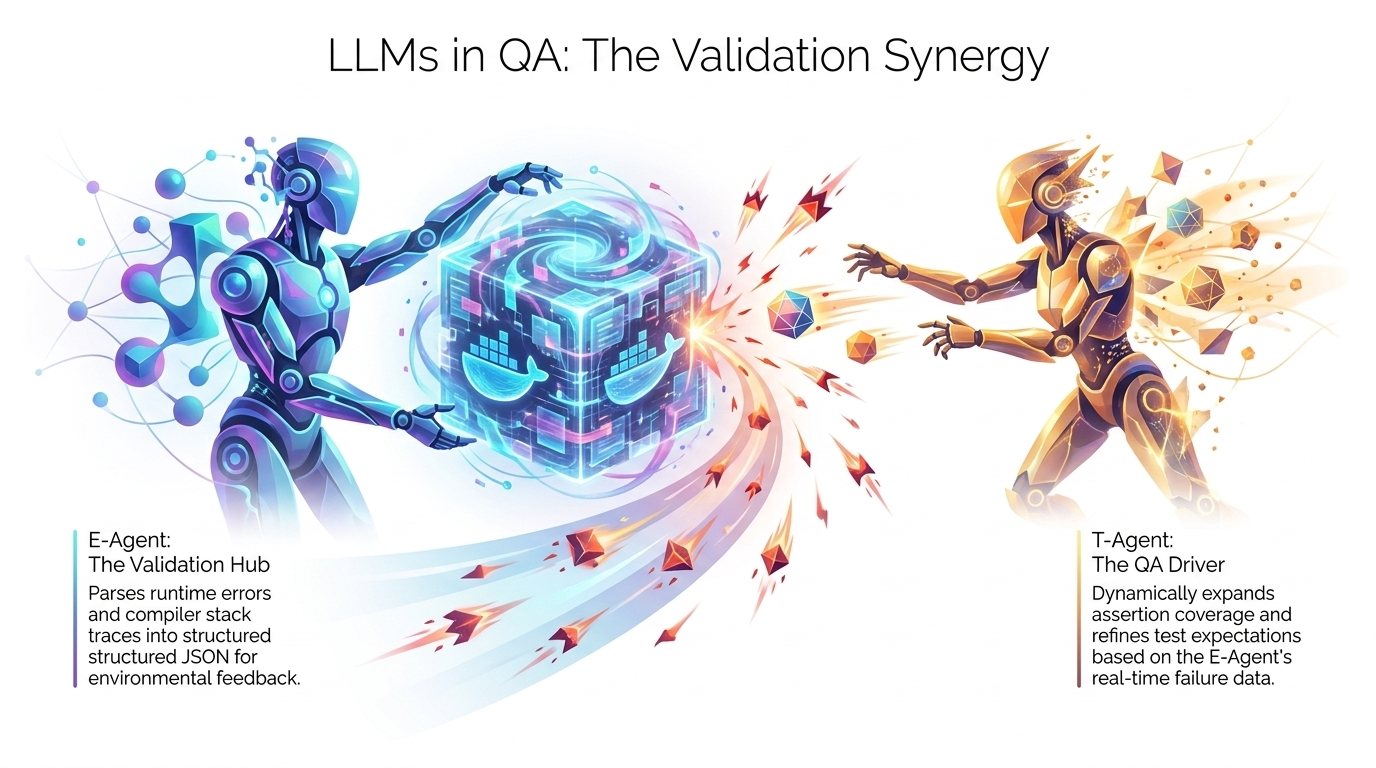
This separation is architecturally healthy. The component that executes the system should not be identical to the component that defines all success criteria. By feeding structured environmental evidence into a test-focused agent, the architecture creates a feedback path between what happened and what should be checked next.
Closed-loop reflexion and self-healing
The deck organizes remediation into three phases.
- Diagnostic extraction. Execution failures are mapped to specific code locations, missing packages, or configuration problems.
- Targeted remediation. The E-Agent repairs sandbox configuration while the M-Agent patches semantic logic defects.
- Iterative verification. The patched system is redeployed and re-tested until the validation condition is clean.
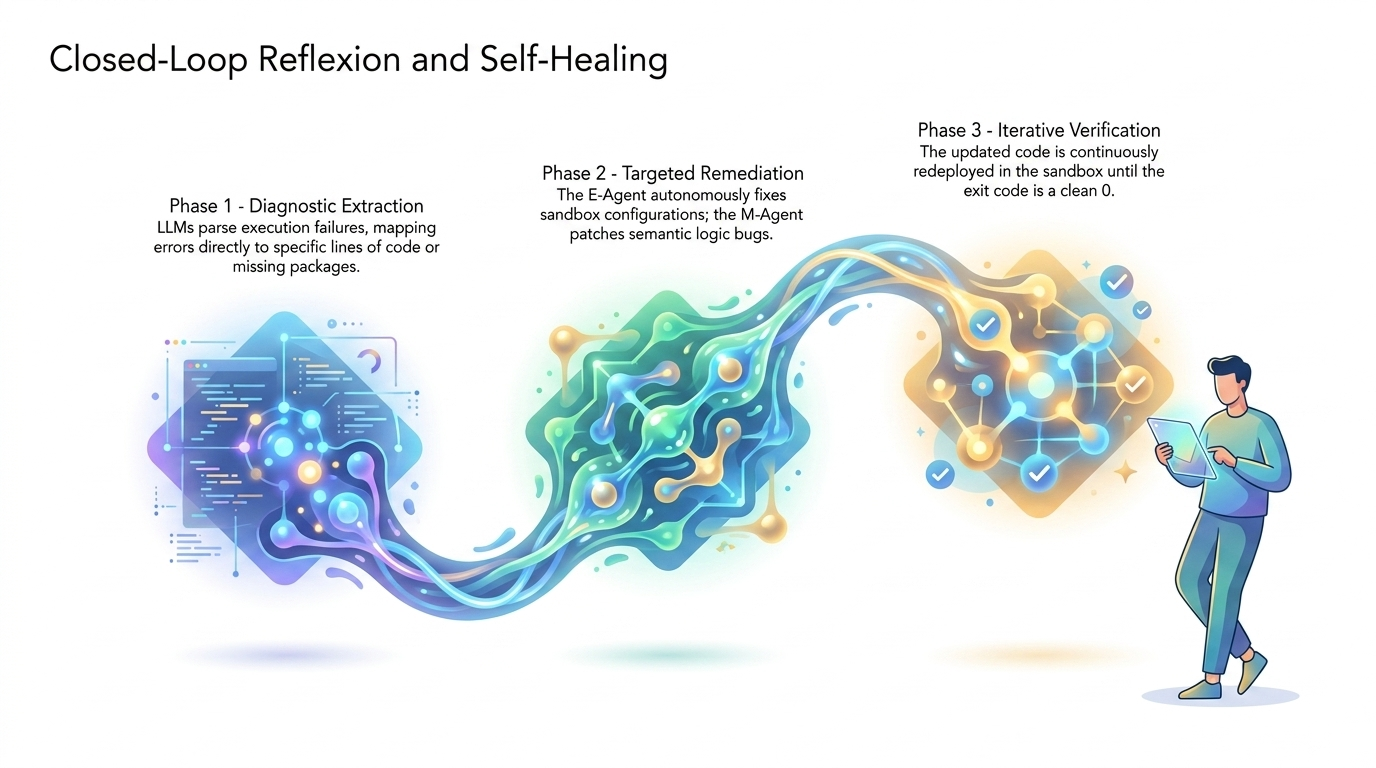
The important idea is not that an agent “fixes itself.” The important idea is that every proposed fix must travel through the same controlled loop: diagnose, patch, execute, observe, verify.
In production terms, self-healing should mean bounded autonomous remediation backed by deterministic checks, not an unlimited right to keep modifying the system until something appears to work.
6. AgentOps Is the Operational Layer Around the Swarm
As agent workflows become stateful and long-running, framework choice starts to look less like prompt engineering and more like distributed-systems engineering.
The deck positions three ecosystems along different coordination strengths:
- LangGraph for state-based multi-actor collaboration, persistent memory, and human-in-the-loop checkpoints.
- CrewAI for role-based delegation, event-driven flows, and configurable agent roles.
- BeeAI (IBM) for open-source multi-agent flexibility, with TypeScript and Python parity and an enterprise-oriented deployment story.
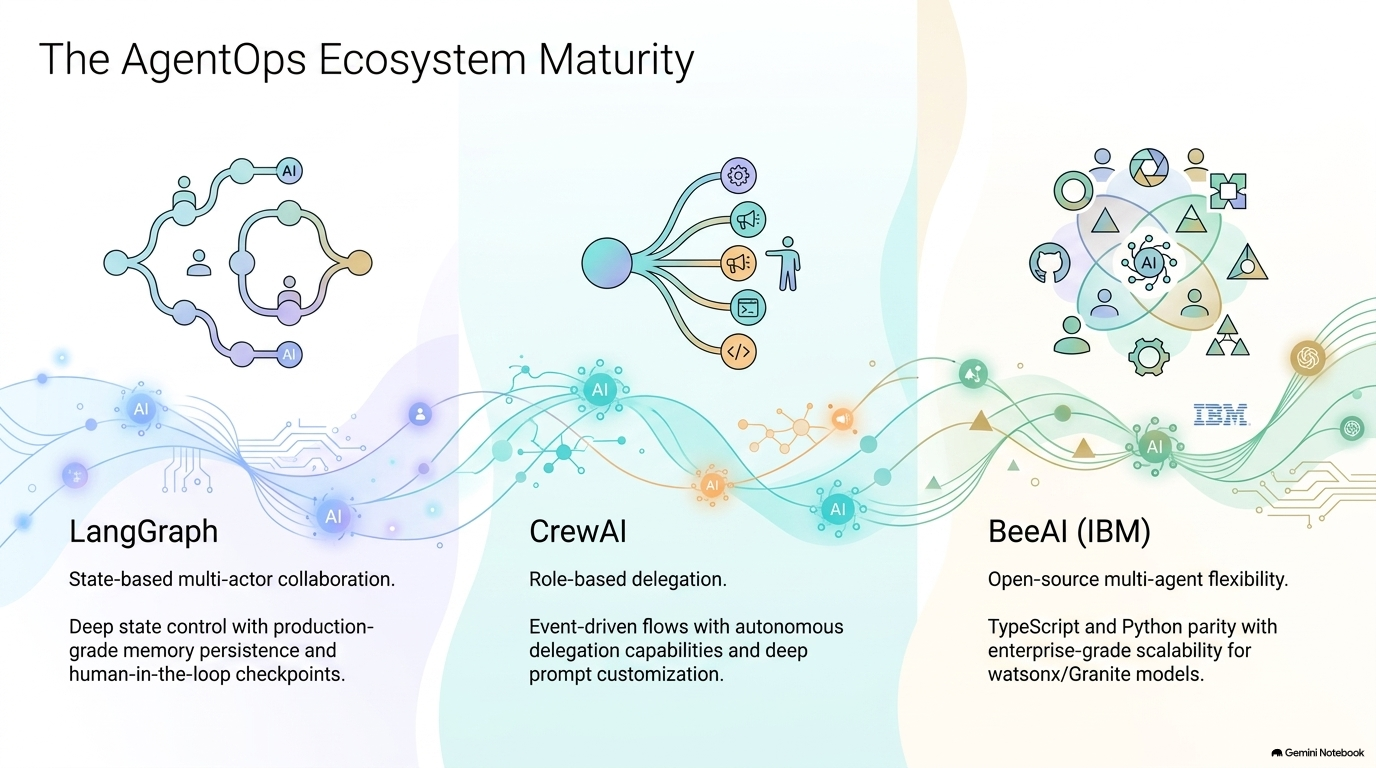
The useful takeaway is not that one framework wins. It is that production agent systems need explicit answers for state, delegation, durability, checkpoints, tool boundaries, and observability.
Frameworks can provide primitives for those concerns, but architecture still matters. A team should know where durable state lives, how failed tasks resume, which operations are idempotent, how agents are authenticated to tools, and how a human can interrupt or approve a workflow.
The “AgentOps” layer therefore sits around the model and its prompts. It is the operational machinery that makes a swarm inspectable enough to run repeatedly.
7. Reverse Documentation Makes Legacy Migration Evidence-Driven
The deck gives the reverse-documentation workflow a name: Reversa. The pattern is built around specialized teams that convert existing behavior into specifications and then use those specifications as the control surface for modernization.
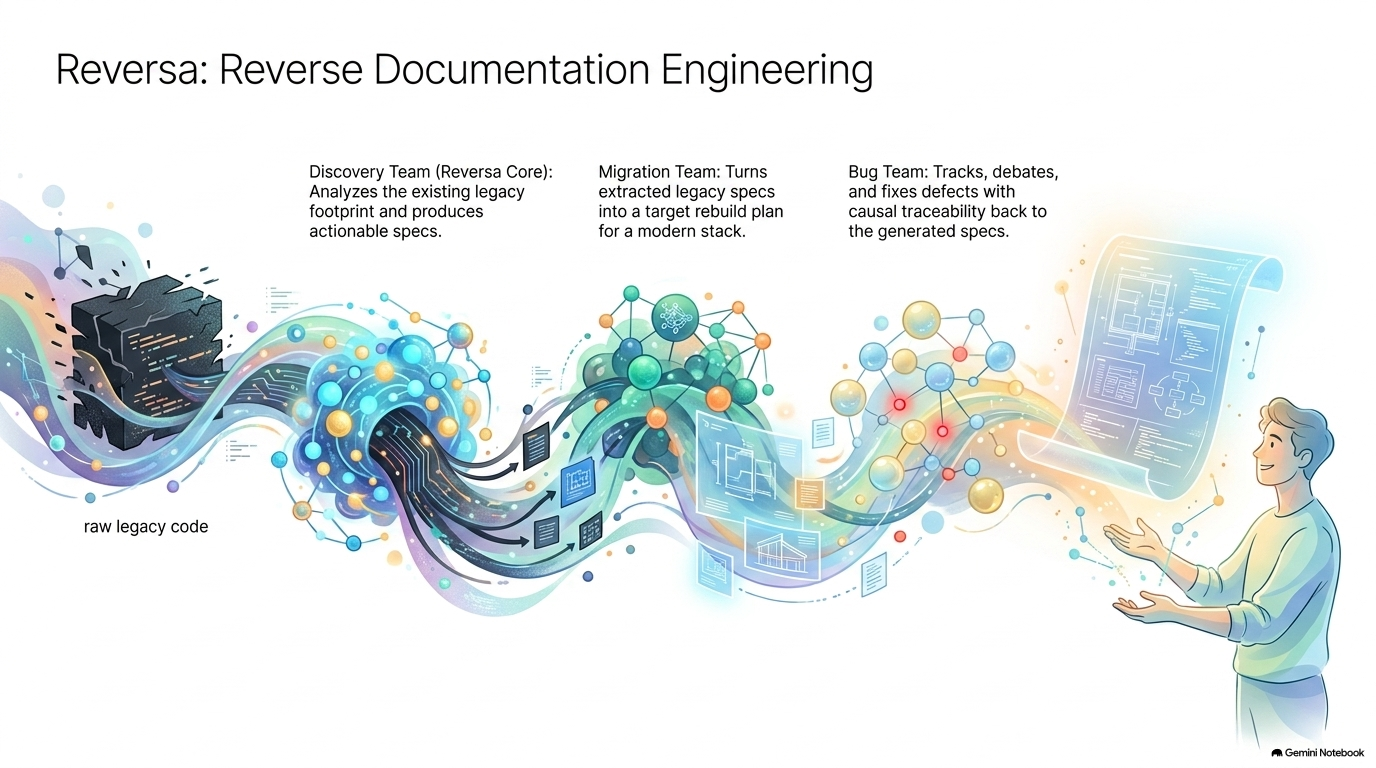
The three roles are tightly coupled:
- The Discovery Team analyzes the existing legacy footprint and produces actionable specifications.
- The Migration Team converts those extracted specifications into a rebuild plan for a modern target stack.
- The Bug Team tracks, debates, and fixes defects with causal traceability back to the generated specifications.
This model matters because it separates discovery from implementation. The migration team is not asked to guess what the legacy system means while rewriting it. Instead, it works against an explicit behavioral artifact produced by the discovery process.
The bug team then closes the loop by connecting defects back to the specification that justified the migrated behavior. That creates a path for corrections to improve both the code and the understanding of the system.
In other words, reverse documentation is not a one-time documentation phase. It becomes a living control plane for modernization.
8. Co-Agency Closes the Accountability Gap
The source material explicitly rejects the idea that enterprise deployment should be fully autonomous. It describes a trust gap that must be bridged by human governance.
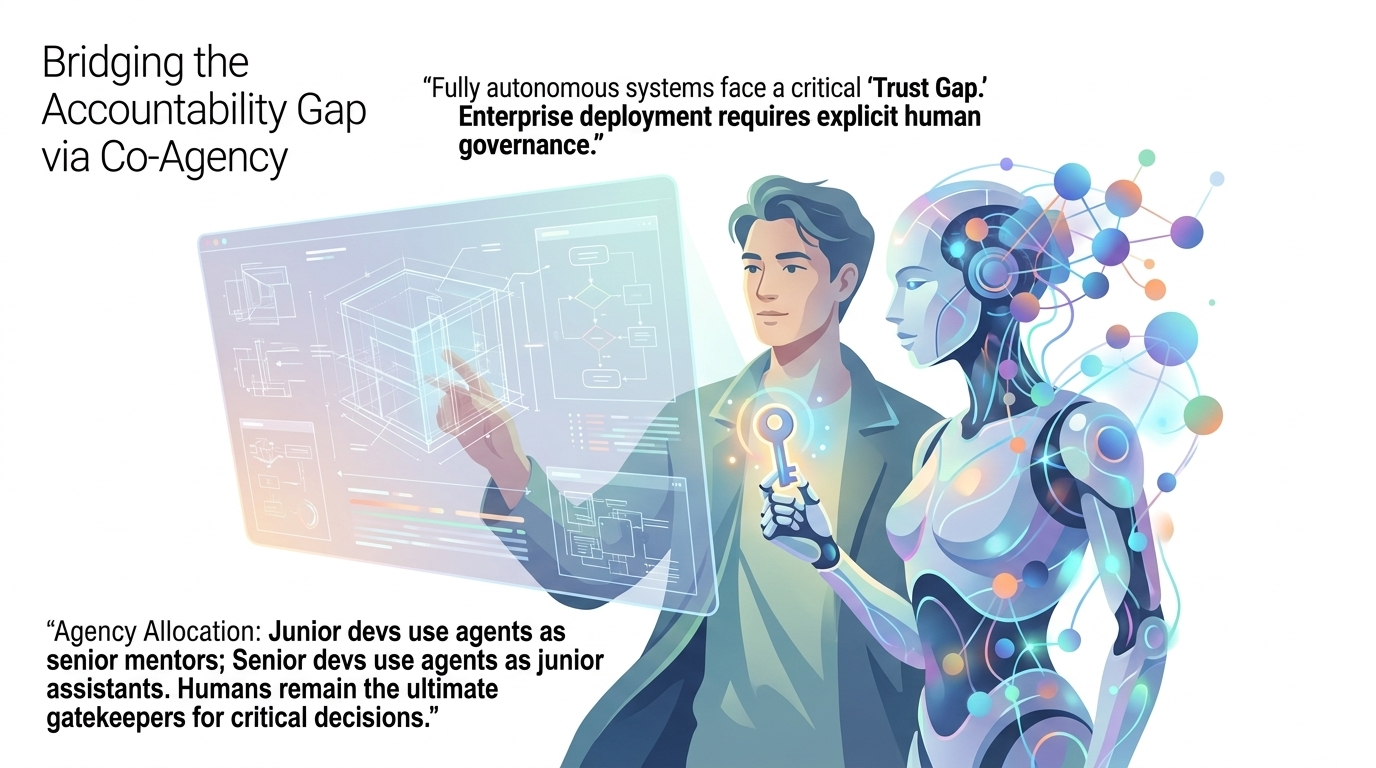
The co-agency model assigns authority according to consequence. Agents can perform exploration, generate options, execute bounded tests, and carry out routine remediation. Humans remain the gatekeepers for critical decisions.
The deck also offers a useful way to think about experience levels: junior developers can use agents as senior mentors, while senior developers can use agents as junior assistants. The point is not the literal hierarchy; it is that the human-agent relationship changes with the user's ability to evaluate the output.
A production implementation of that principle implies explicit controls around the most consequential actions:
- approvals before destructive or externally visible changes,
- provenance showing which evidence and agent decisions produced a result,
- restricted credentials and tool scopes,
- isolated QA environments where production data is not required,
- and durable audit records for decisions that cross a governance boundary.
These controls make autonomy reviewable. Co-agency is not a reduction in automation; it is automation with a clearly assigned decision owner.
9. Measure the Closed Loop, Not the Demo
Agent systems are easy to showcase and harder to evaluate. The meaningful metrics are not “how impressive the generated answer looked,” but whether the workflow improved validated engineering outcomes.
The deck presents four headline results:
- 60% reduction in invalid test cases through closed-loop QA remediation.
- 84.7% recall for finding unclassified vulnerabilities, compared with a 68.4% legacy baseline.
- 74% decrease in deployment time using microservices-based agent architectures.
- 2× increase in test coverage, described as scaling from 380 to more than 700 tests autonomously.
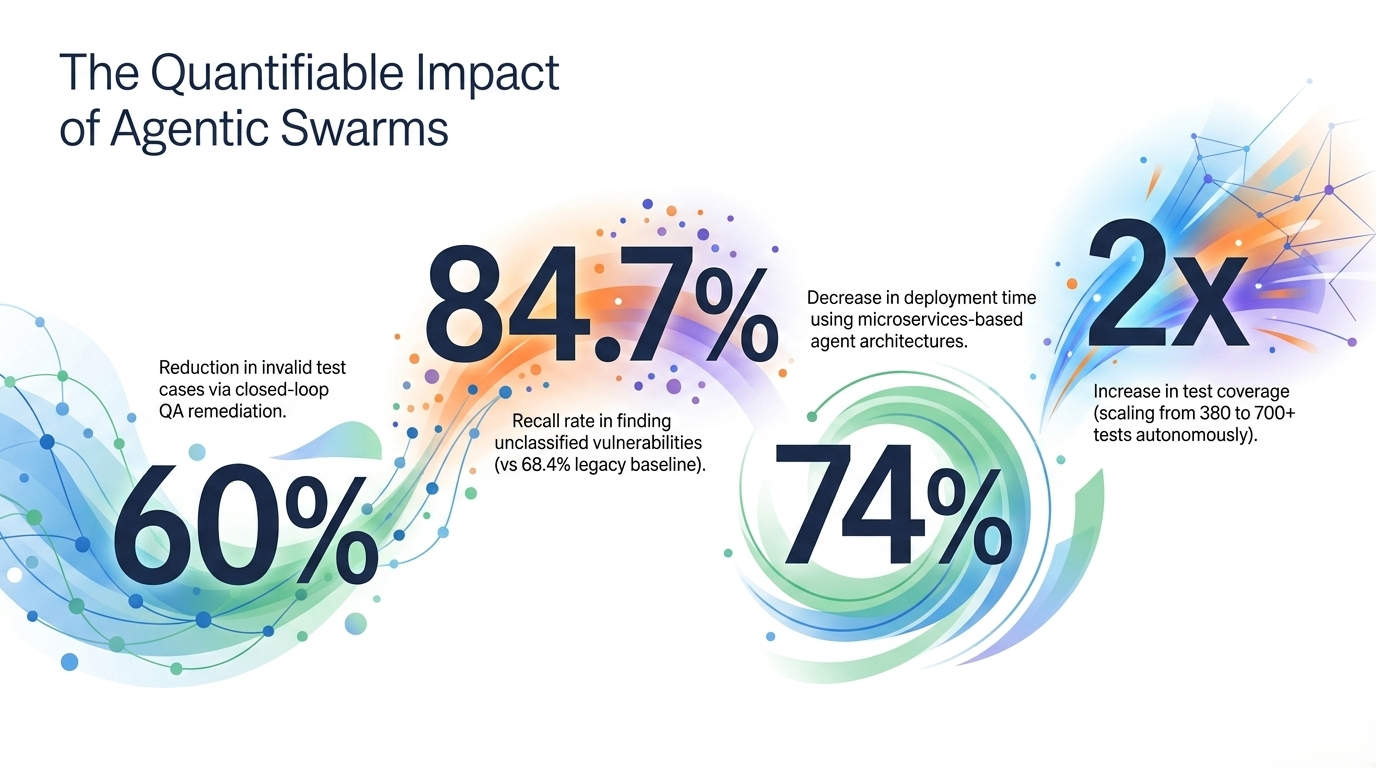
Those numbers are useful as examples of the kinds of outcomes an agentic platform should track, but the slides do not provide the underlying dataset, evaluation protocol, sample size, or measurement boundaries. They should therefore be treated as claims to validate in the target environment rather than universal benchmarks.
A rigorous evaluation program would preserve the same categories while making the measurement reproducible: invalid-test rate, defect or vulnerability recall, deployment lead time, and effective test coverage. It should also capture the cost of achieving those outcomes, including model usage, sandbox runtime, human review time, remediation retries, and false positives.
The core principle is simple: measure the behavior of the complete loop. An isolated model score says little about whether an autonomous engineering workflow is safe, efficient, or correct.
10. The Agentic SDLC Is a Continuous Control System
The final architectural shift is from treating AI as a localized coding assistant to treating it as a continuous system spanning requirements, design, code, test, deploy, and maintain.
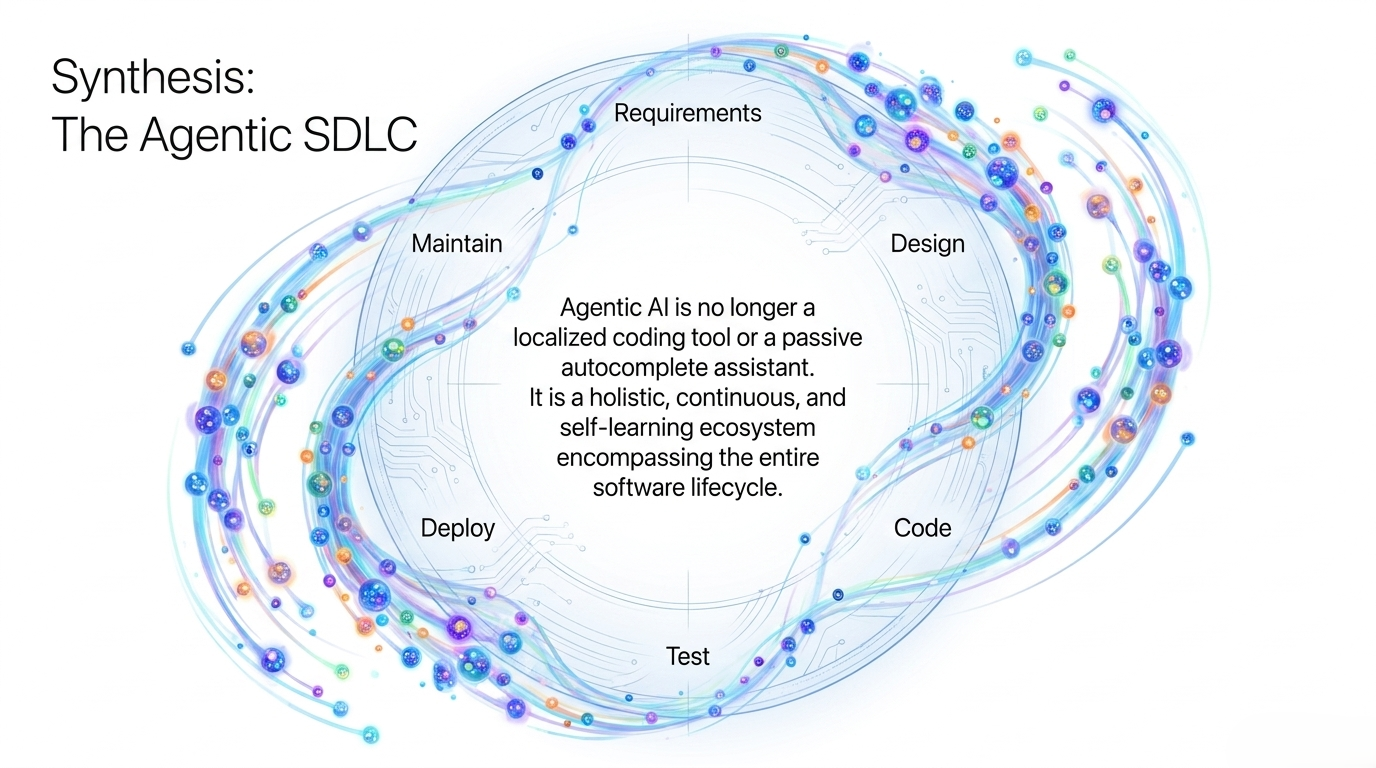
That does not mean every phase becomes fully autonomous. It means the phases share evidence and state.
Requirements can be refined from runtime observations. Design can be constrained by discovered behavior. Code can be generated against explicit specifications. Tests can expand when the environment exposes new failure modes. Deployment can be gated on machine-verifiable checks and human approval. Maintenance can feed new production or QA evidence back into the requirements model.
The result is a lifecycle where each phase both consumes and produces information for the next loop. The architecture is therefore continuous and self-correcting, but only because the system preserves the chain from intent to evidence.
Engineering Principles
The architecture ultimately depends on several principles:
-
Ground reasoning in execution evidence
Static analysis and documentation are useful, but runtime traces, compiler output, test results, and exit status provide the evidence required to validate what the system actually does. -
Use the least complex agent pattern that works
Start with a single tool-using agent and add orchestration, debate, or swarm behavior only when the problem requires more decomposition or search. -
Coordinate through typed shared state
Shared memory reduces context drift, makes agent contributions inspectable, and gives the workflow a durable source of truth. -
Separate generation from validation
Migration agents, environment agents, and test agents should have distinct responsibilities so that proposed changes are checked by mechanisms that did not simply generate the change. -
Keep humans at consequential control points
Autonomy is strongest when routine actions can proceed automatically while high-impact decisions remain attributable, reviewable, and explicitly approved. -
Treat observability as part of the reasoning loop
Logs, traces, compiler diagnostics, test artifacts, and remediation history are not merely operational exhaust; they are inputs to the next decision. -
Evaluate the system end to end
The unit of success is the closed engineering loop: a validated requirement, a reproducible change, a passing verification cycle, and a traceable decision history.
Final Synthesis
Swarm intelligence in the SDLC is best understood as an orchestration architecture. Models provide reasoning and generation, but the surrounding system supplies durable state, execution environments, tests, runtime evidence, role separation, and governance.
A production-ready implementation connects the ideas from the deck into one operating loop. System Spiders discover behavior and turn traces into candidate operational specifications. Discovery and migration agents transform those specifications into implementation work. A shared blackboard carries typed state between specialized agents. Environment agents provision sandboxes and capture evidence. Test agents convert failures into stronger assertions. Remediation agents propose bounded fixes. The loop repeats until verification succeeds or a governance boundary requires human intervention.
The production-ready system combines:
- Deterministic foundation: typed state, explicit task boundaries, reproducible environments, and durable workflow state.
- Testing layer: continuously maintained regression suites, structured failure analysis, and iterative verification.
- Agent or AI layer: specialized roles for discovery, migration, testing, remediation, and coordination.
- Security and governance: safe QA environments, scoped authority, human checkpoints, and causal traceability.
- Observability layer: runtime traces, compiler diagnostics, execution logs, test results, and remediation history.
- Production outcome: a software lifecycle that can discover, change, validate, and learn without separating automation from accountability.
Closing Thought
The most important shift is not from human-written code to machine-written code. It is from isolated generation to continuous, evidence-backed orchestration.
The future of agentic engineering is not an autonomous coder; it is a governed system that can understand, act, verify, and improve in a closed loop.