

Autonomous Data Assurance: From Observability to Self-Healing DataOps
Most data-quality systems are good at telling an engineer that something has gone wrong. Far fewer can determine why it happened, decide whether the issue is safe to repair automatically, assemble the context needed for the repair, and prove what changed afterward.
That gap is the engineering problem behind autonomous data assurance. The goal is not to replace deterministic validation with an LLM. It is to connect observability, lineage, statistical profiling, retrieval, executable remediation, and governance into a closed control loop that can move from perception to action without losing safety or explainability.
The architecture in these diagrams frames the shift as a progression: reactive rules become continuous profiling; isolated alerts become multi-agent diagnosis; row-by-row prompting becomes reusable code; and opaque automation becomes a governed workflow with explicit security boundaries and human approval where risk requires it.
1. From Reactive Alerting to Self-Healing DataOps
Traditional data-quality operations are usually organized around manually authored rules, scheduled batches, and downstream alerts. That model works when schemas are stable and failure modes are already known. It breaks down when data contracts drift, upstream APIs change without notice, or distributions move faster than teams can update checks.
The agentic model moves the control point closer to the data flow. Instead of waiting for a failed dashboard or model, the system watches metadata and records continuously, identifies deviations, and passes relevant evidence into a reasoning and remediation path.
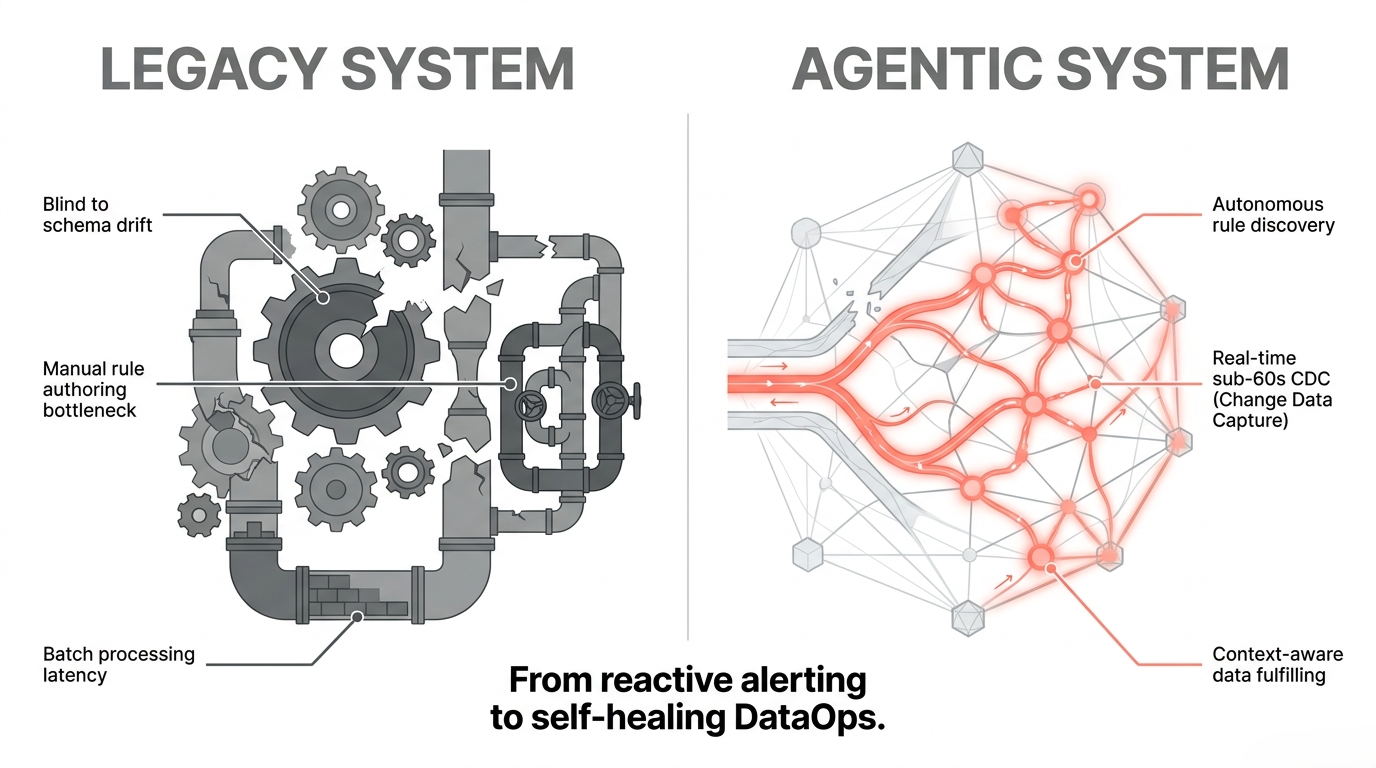
The important shift is architectural rather than cosmetic. A self-healing system needs three capabilities that a rule-only stack rarely provides on its own:
- Perception: observe schema, volume, distributions, null patterns, lineage, and change events.
- Reasoning: distinguish expected variation from a meaningful gap and identify likely root cause.
- Controlled action: produce a repair that can be tested, approved, deployed, and audited.
This is why “agentic” should not mean “let the model edit production data.” It should mean that the system can coordinate specialized steps while preserving deterministic controls around execution.
2. The Committee Pattern: Specialize Before You Automate
A useful pattern in the material is an AI committee rather than a single general-purpose agent. The committee divides the workflow into roles: a relevancy scout filters low-value work, a layout analyzer understands structural schemas, an arbiter applies decision logic, and a remediation agent drafts or dispatches the repair path.
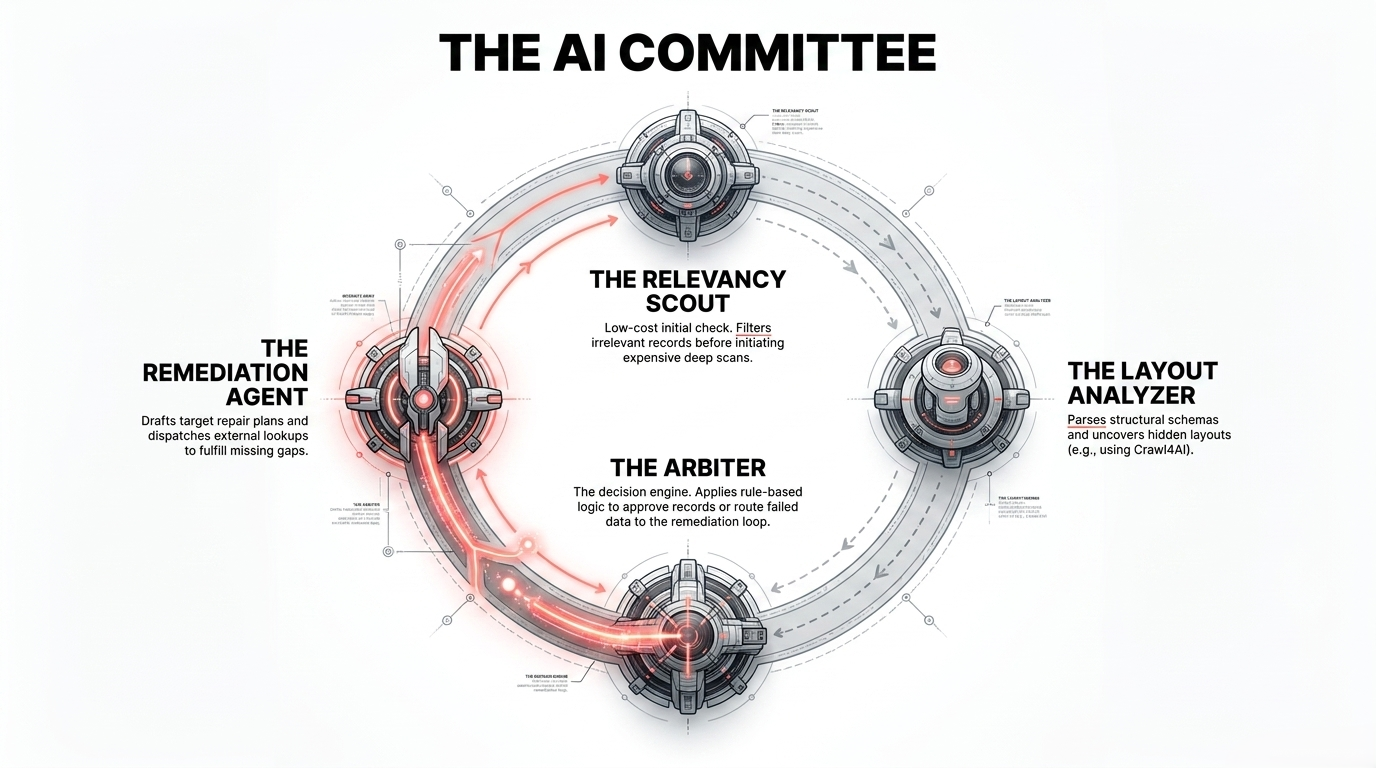
This decomposition solves two practical problems. First, it keeps expensive reasoning away from records that do not justify it. Second, it creates explicit handoff points where evidence and decisions can be inspected. A production implementation can turn those handoffs into typed messages, trace spans, approval gates, or durable workflow states.
The arbiter is especially important. It should be able to route cases into different paths:
- known and low-risk issue → deterministic remediation;
- uncertain but diagnosable issue → contextual retrieval and proposed repair;
- high-impact or low-confidence issue → human review;
- insufficient evidence → no change, but preserve the incident for investigation.
A committee therefore becomes a control plane for data assurance, not a collection of chatbots.
3. The Autonomous Data Quality Loop
The operating model is a loop: monitor, detect, diagnose, repair, validate, and continue monitoring. Pattern-based anomaly detection establishes what “normal” looks like, deep checks classify the missingness or structural gap, retrieval supplies context, and remediation closes the loop.
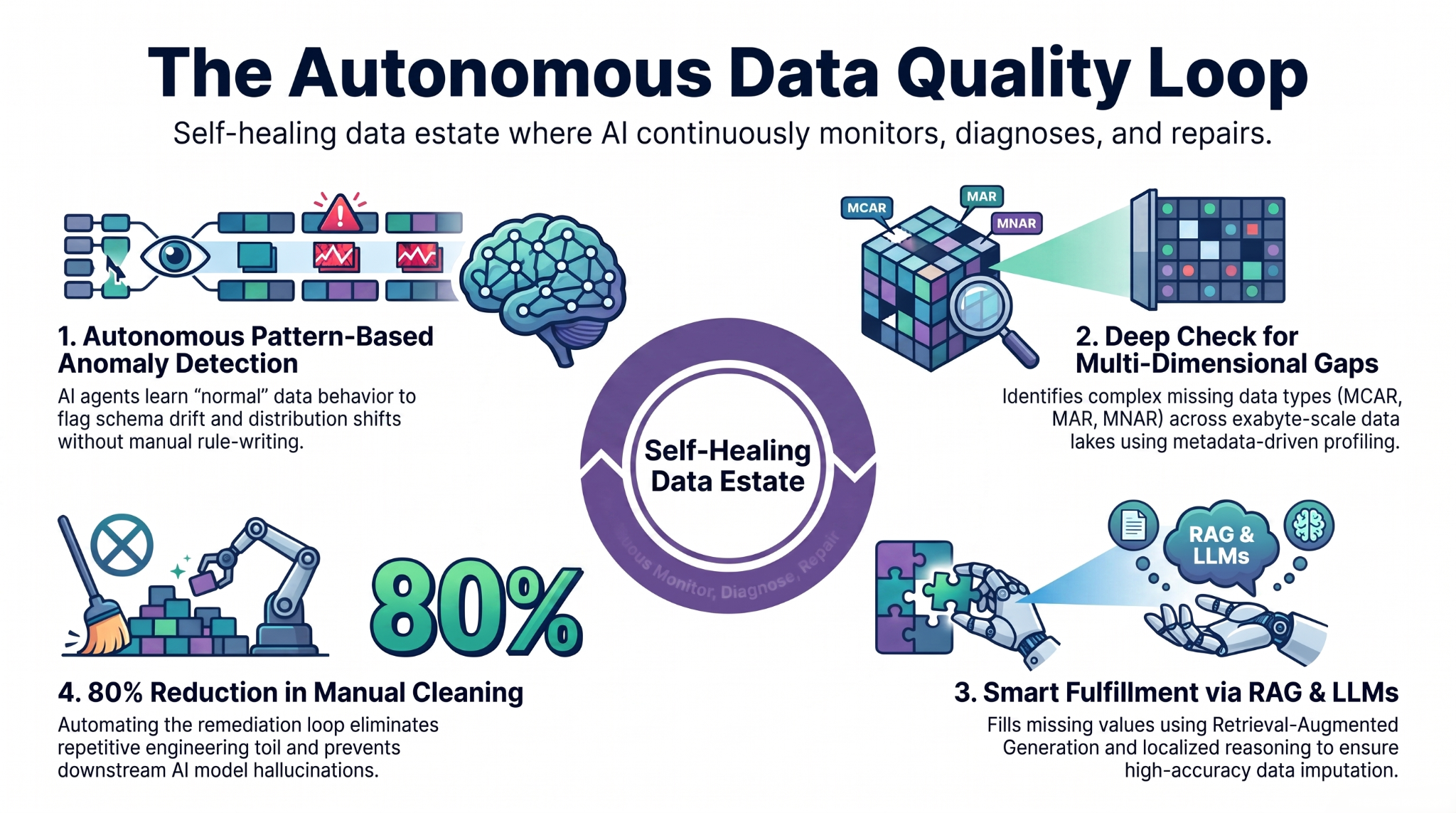
The diagram also presents an aggressive reduction in manual cleaning effort as an intended outcome. Treat that number as a hypothesis to validate, not as a guarantee. In a real deployment, the meaningful metric is not simply “how many tasks were automated,” but how many repairs were both correct and safe.
Useful success measures include precision of anomaly detection, false-positive rate, percentage of repairs accepted without modification, rollback rate, time-to-detection, time-to-remediation, and downstream incident avoidance. An autonomous loop is valuable only when its feedback signals are strong enough to prevent a bad repair from becoming the next source of corruption.
4. Profiling, Lineage, and Scale-Invariant Triage
The next layer is the diagnostic substrate. Three concepts recur in the architecture: dynamic multi-agent profiling, root-cause lineage tracing, and scale-invariant coverage.
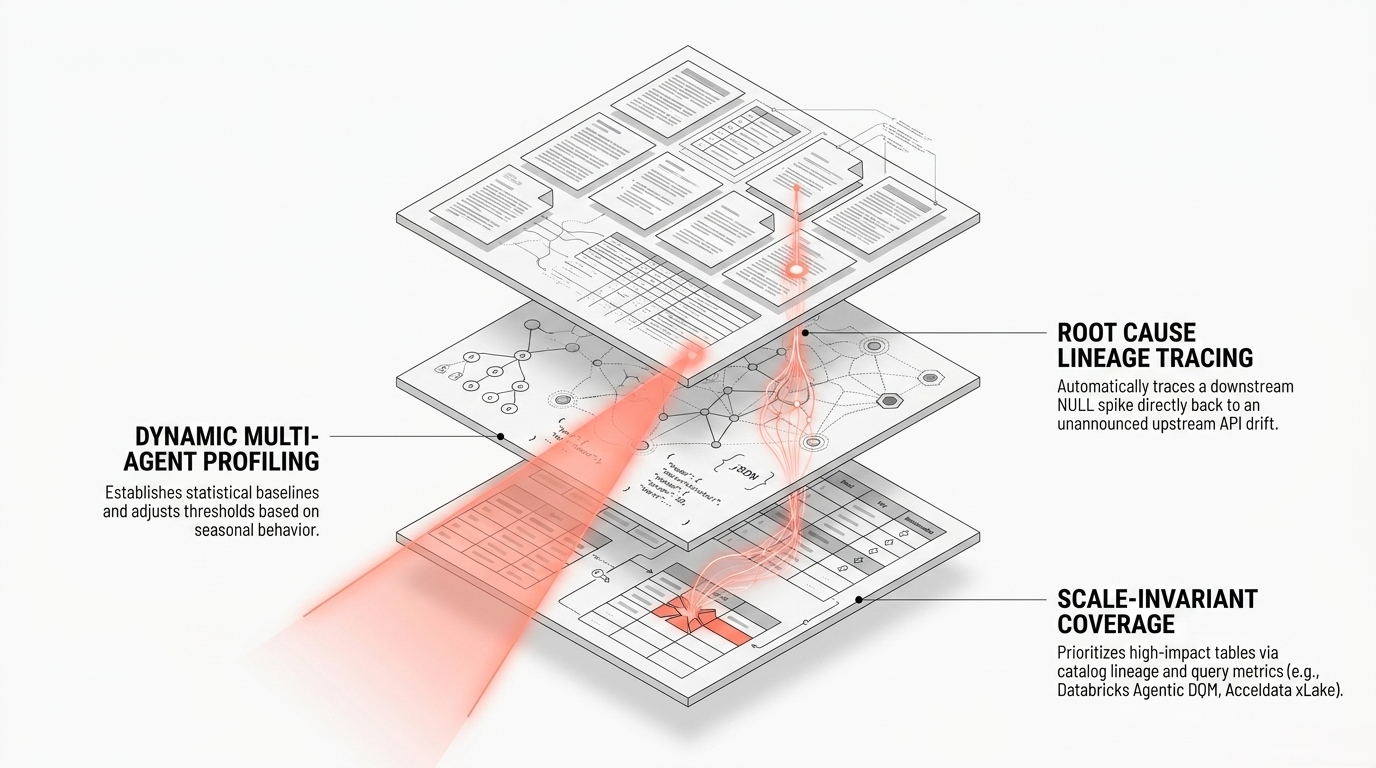
Dynamic profiling replaces one-size-fits-all thresholds with baselines that can account for seasonal or contextual behavior. A null-rate increase may be serious in a stable dimension table but expected in an event stream during a product rollout. The point is not to make thresholds “fuzzy”; it is to make them conditional on evidence.
Lineage then connects a downstream symptom to a plausible upstream cause. If a field suddenly becomes null after an API version change, the system should be able to traverse catalog lineage, schema history, and recent change metadata rather than treating every broken table as an independent incident.
Scale-invariant coverage is the final constraint. An enterprise estate may contain too many tables and columns for uniformly expensive checks. The assurance system therefore needs prioritization signals such as query frequency, business criticality, lineage centrality, change velocity, and incident history. High-impact surfaces deserve deeper analysis; cold data can receive cheaper monitoring.
5. Missingness Is Not One Problem
A major advantage of contextual diagnosis is that missing data can be treated according to why it is missing. The diagrams distinguish three classic mechanisms: MCAR, MAR, and MNAR.
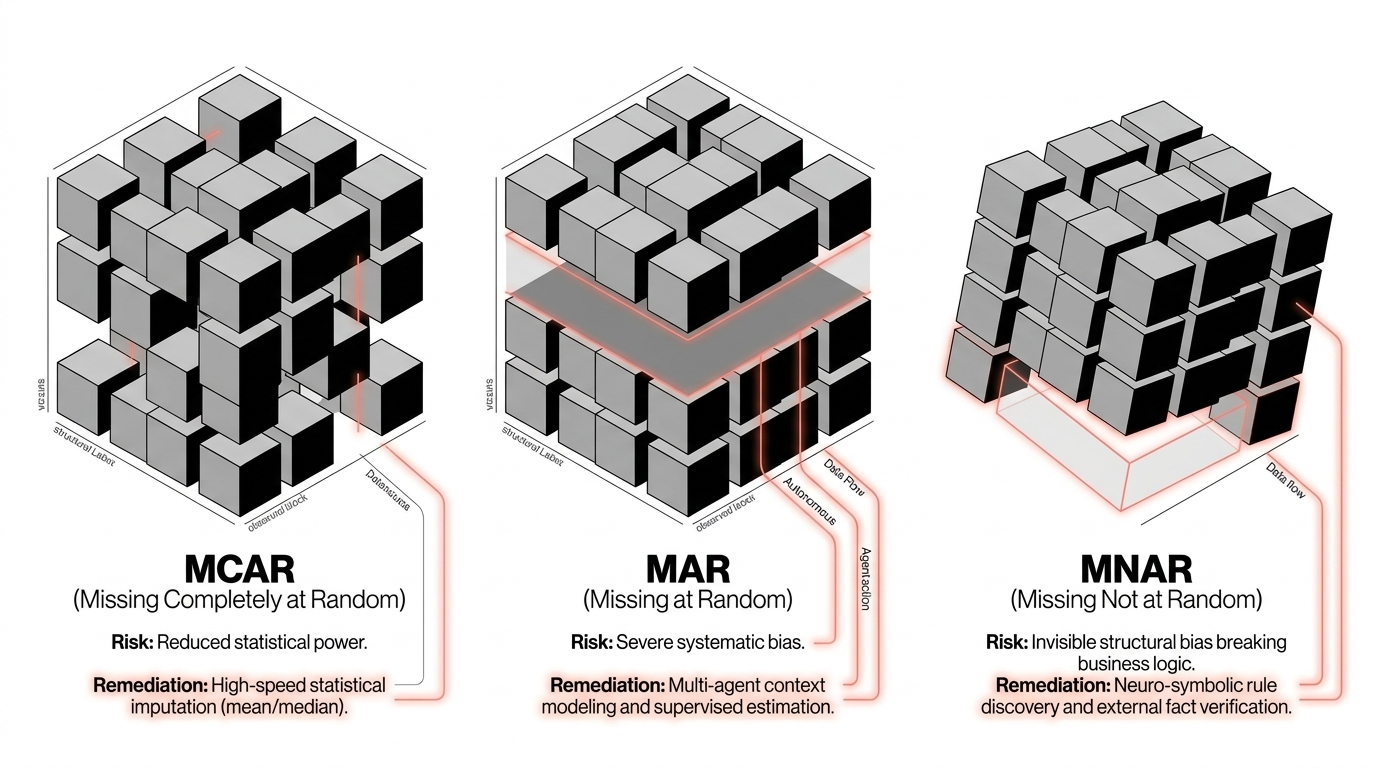
MCAR — Missing Completely at Random describes gaps that are independent of both observed and unobserved values. Simple statistical imputation can sometimes be acceptable here because the missingness mechanism itself does not introduce systematic bias.
MAR — Missing at Random means the probability of missingness depends on observed variables. Repair requires context from related attributes, segments, or historical patterns. A model may estimate the value, but the evidence used for that estimate must be retained for validation.
MNAR — Missing Not at Random is the hardest case because missingness depends on information that is itself unobserved or structurally hidden. Blind imputation can reinforce bias or encode a false business assumption. These cases should trigger stronger rules, external fact checks, domain review, or a decision not to fill the value at all.
The engineering implication is straightforward: a single “fill nulls” policy is unsafe. Detection needs to classify the gap before remediation chooses a method.
6. Retrieval as a Grounding Layer for Remediation
When a repair cannot be derived from local tabular context, the architecture introduces retrieval. Enterprise knowledge is semantically indexed, relevant evidence is recalled and re-ranked, and generation is constrained by the retrieved facts.
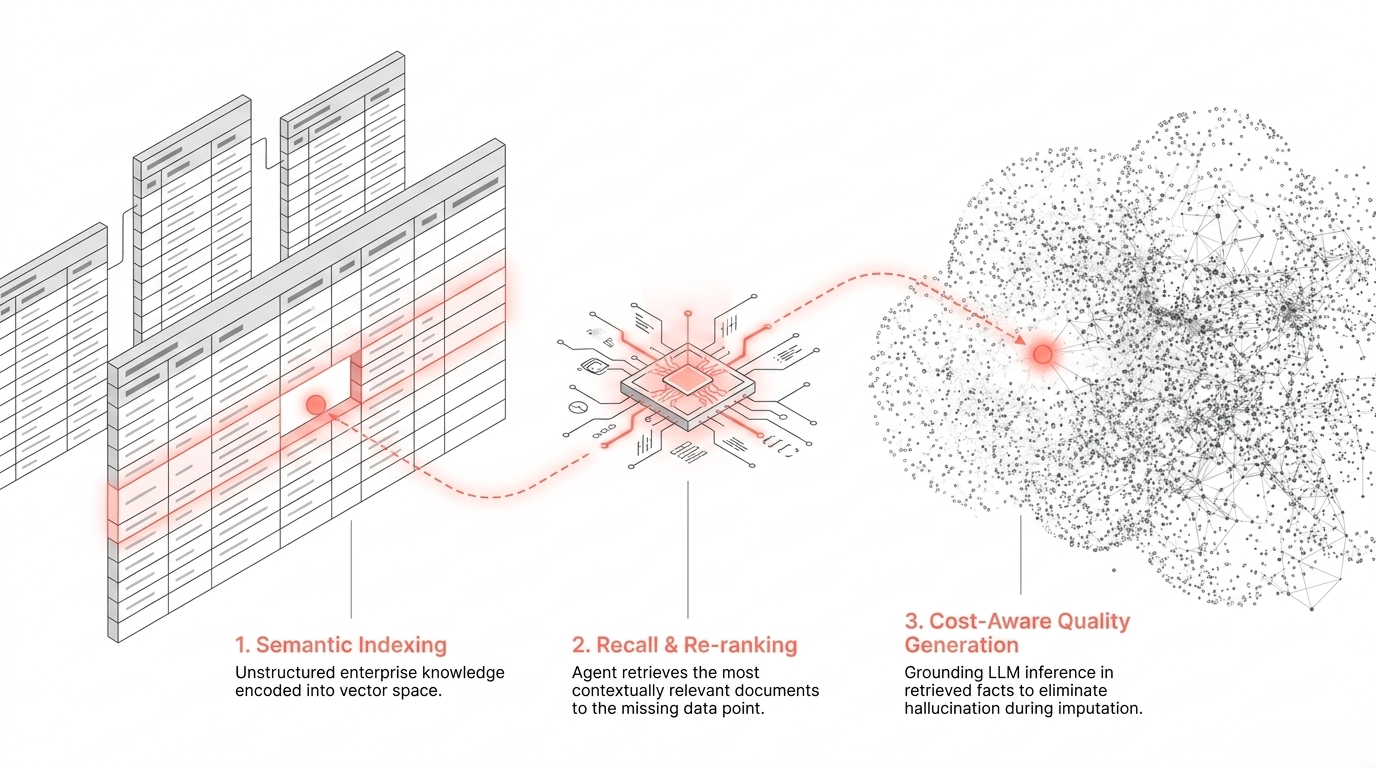
This changes RAG from a user-facing question-answering pattern into an infrastructure component for data quality. The retrieval corpus might contain schema documentation, data contracts, codebooks, incident records, product catalogs, API specifications, or validated reference datasets.
Three design rules matter:
- Retrieve narrowly. Broad context increases cost and makes conflicting evidence harder to resolve.
- Re-rank for the exact gap. The best document for a table is not always the best evidence for a single missing field.
- Cite provenance internally. Every inferred value should carry the source records, retrieval score, model version, and decision path used to produce it.
Grounded generation is not the same as guaranteed truth, but it gives the system something testable: evidence can be checked independently from the model that consumed it.
7. Make the Imputation Decision Local and Explicit
The imputation example narrows context in three steps: select the relevant attributes, select similar tuples, then let the model reason only over the local evidence. The visual uses a city and phone-area-code relationship to illustrate the pattern.
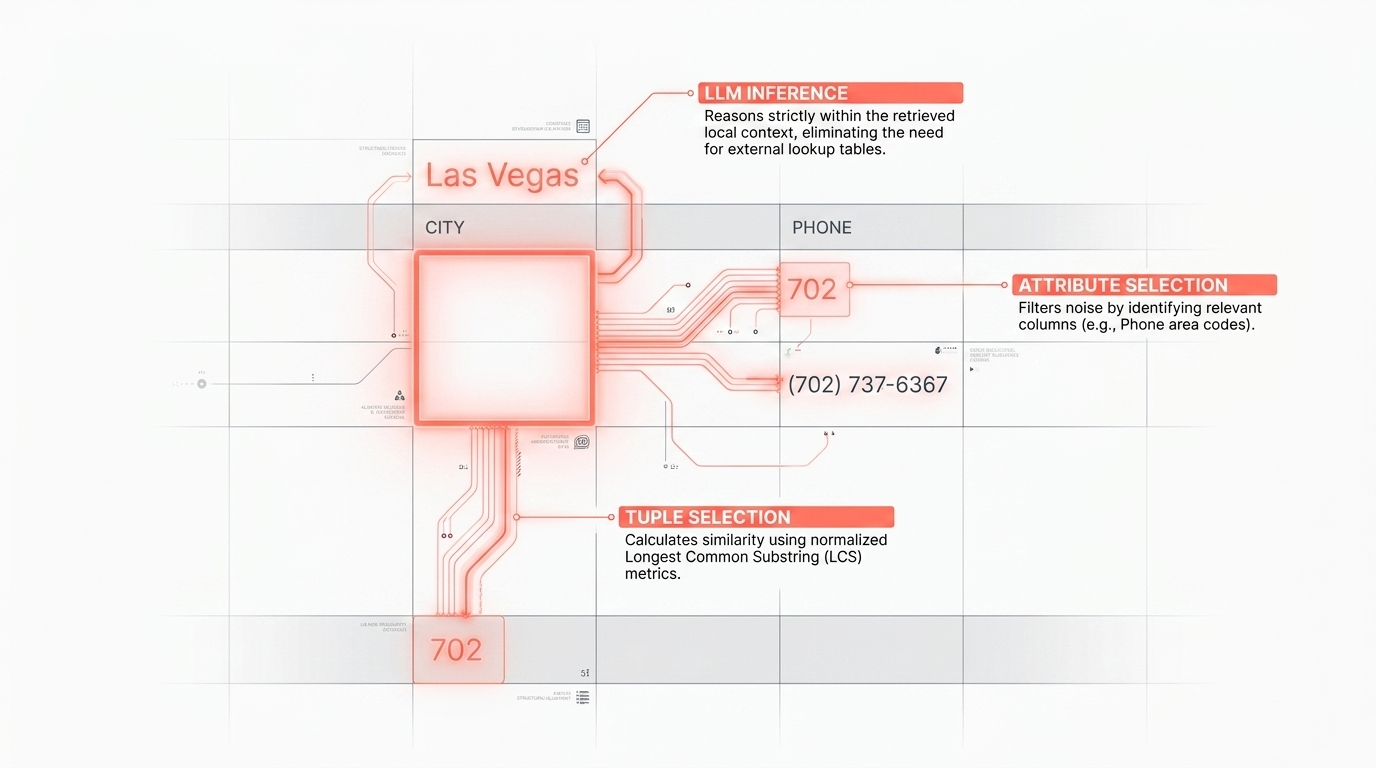
This is a strong production pattern because it separates feature selection from generation. The system can first identify which columns are actually relevant, then retrieve the most comparable rows, and only then invoke probabilistic reasoning.
That separation enables stronger validation. Attribute selection can be tested against known dependencies, tuple similarity can be measured deterministically, and the final candidate value can be constrained by format checks, domain rules, uniqueness constraints, or referential integrity.
It also reduces data exposure. The model does not need an entire table when a small, purpose-built slice is sufficient.
8. Compile Reasoning into Reusable Code
Row-by-row LLM inference is expensive, difficult to reproduce, and operationally noisy. The TabClean cycle in the material proposes a better path: use an LLM to synthesize executable Python or SQL, test it in a sandbox, evaluate precision, and deploy the validated logic as a scalable fix.
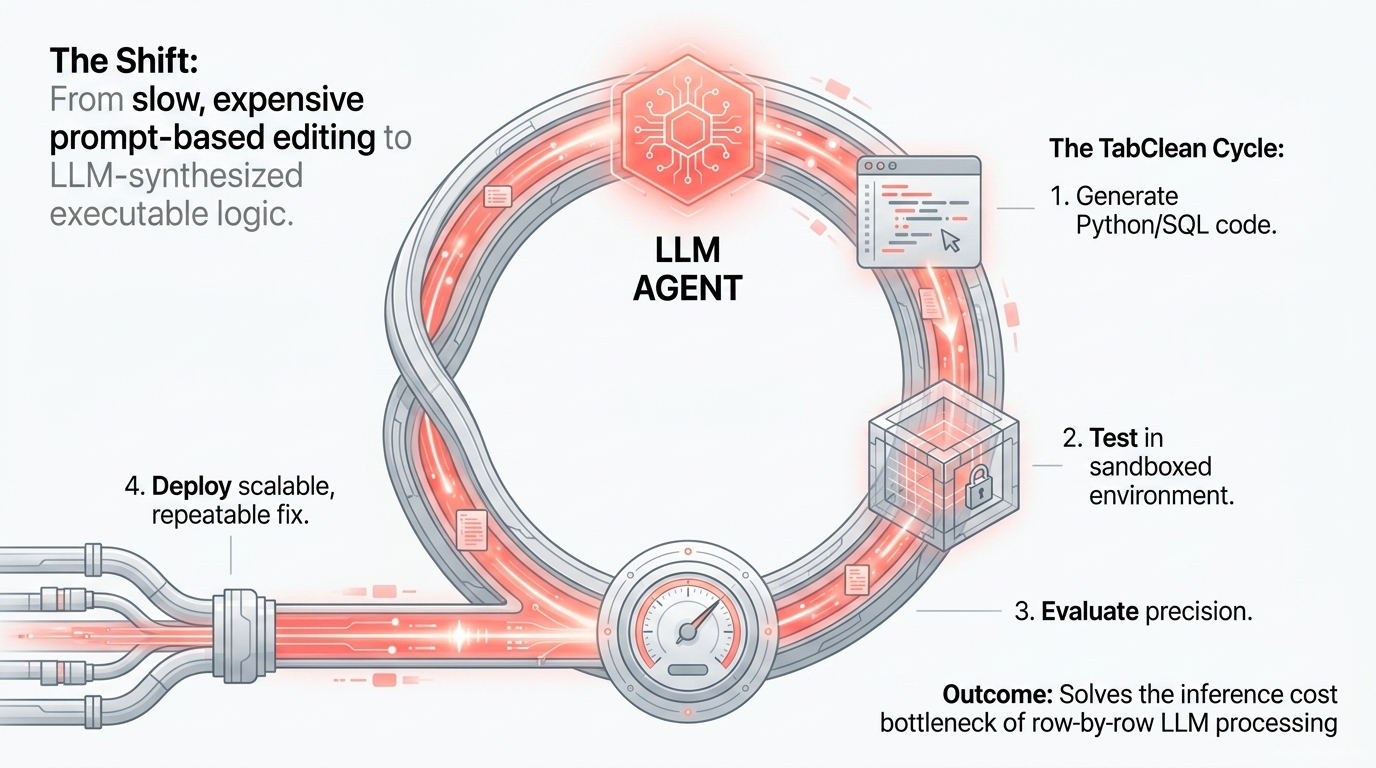
This is an important architectural boundary. The LLM acts as a program synthesizer, while the data platform executes deterministic code. Once a repair rule is accepted, subsequent rows do not need a fresh model call.
A safe implementation should include:
- a restricted execution environment with no unapproved network or credential access;
- static checks for dangerous operations and unbounded writes;
- representative test fixtures, including adversarial and edge cases;
- explicit acceptance thresholds for precision and regression behavior;
- versioned deployment with rollback;
- post-deployment monitoring that compares repaired and unrepaired populations.
The result is a system that can learn a remediation pattern once and then operationalize it as ordinary data engineering.
9. Choose the Right Integration Point
Agentic data quality can sit in different places depending on the failure mode. The diagrams show three common integration points: pipeline-integrated, observability-first, and code-driven.
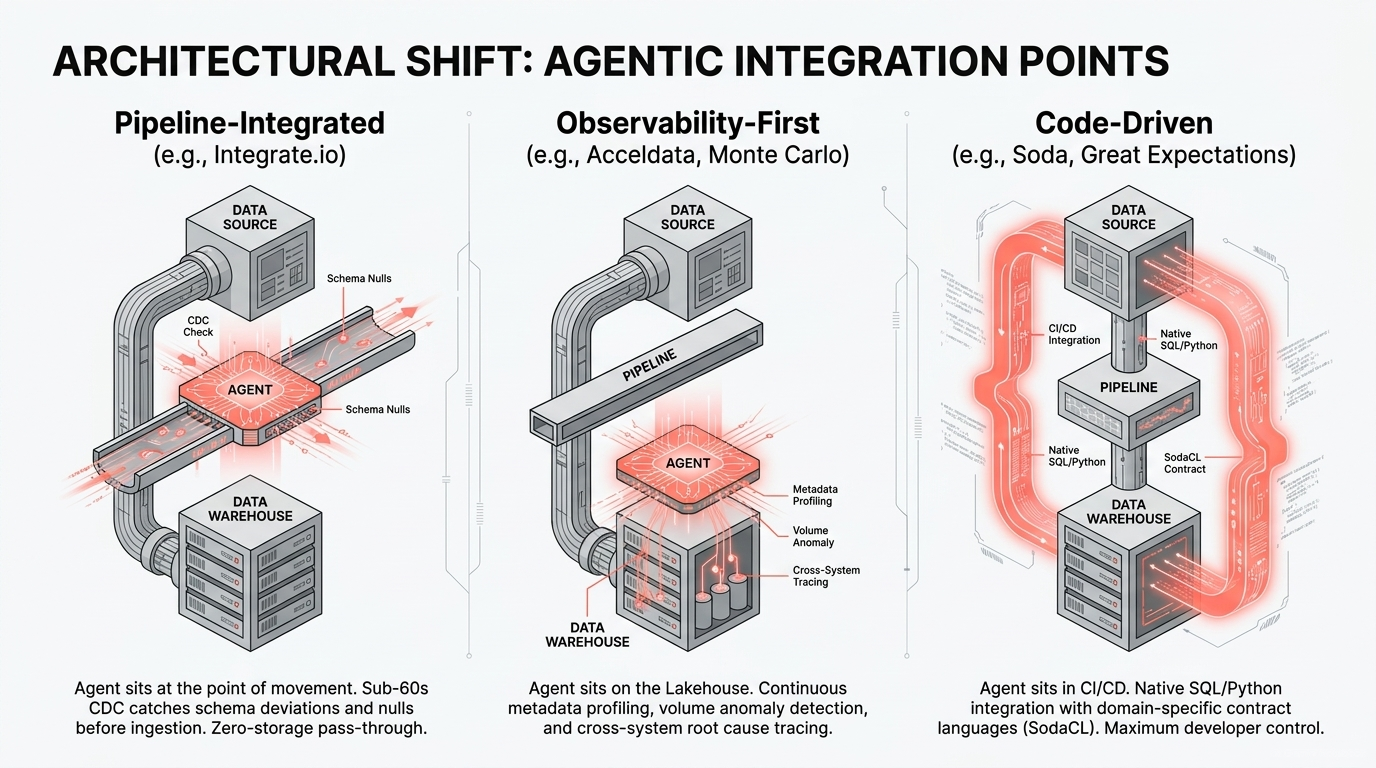
A pipeline-integrated agent sits at the point of movement. It can react to CDC events, schema deviations, or nulls before data is committed downstream. This minimizes time-to-detection but requires careful back-pressure and failure handling so the quality layer does not become the ingestion bottleneck.
An observability-first agent sits over the estate. It continuously profiles metadata, volume, and lineage and is well suited to cross-system root-cause analysis. Its strength is breadth; its risk is becoming detached from the execution path that must ultimately apply a fix.
A code-driven model sits inside CI/CD and contract workflows. Here the agent drafts SQL, Python, or validation contracts, but software-engineering controls own deployment. This gives developers maximum control and is often the easiest place to introduce agentic assistance into regulated environments.
The right design can use all three, provided there is a single incident identity and lineage model connecting them.
10. Platform Capabilities Are Not Interchangeable
The comparison matrix in the source material positions several tools across architecture, scalability, gap-detection mechanics, and security boundary.
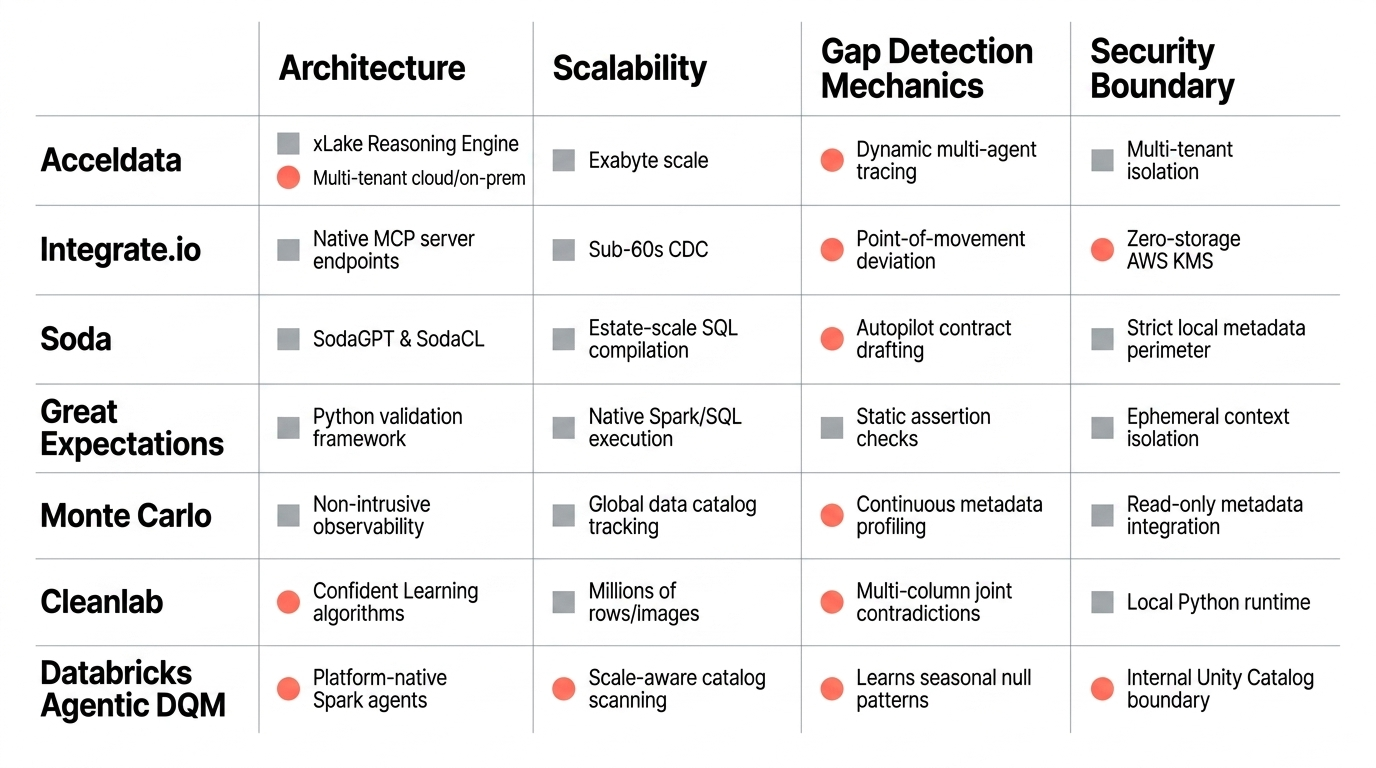
The useful takeaway is not that one platform universally wins. It is that product categories emphasize different control points: some are strongest in pipeline integration, some in observability and metadata, some in code-first validation, and some in native lakehouse execution.
The slide specifically names Acceldata, Integrate.io, Soda, Great Expectations, Monte Carlo, Cleanlab, and Databricks Agentic DQM, and assigns each a set of architectural characteristics. Those classifications should be treated as the deck's framing and verified against current product documentation before making a procurement decision.
For an architecture review, the more durable comparison questions are:
- Where does detection execute: movement layer, metadata plane, compute engine, or CI/CD?
- What data must leave the tenant boundary?
- Can the system generate actions, or only alerts?
- How are generated rules tested and promoted?
- Does it retain lineage and evidence for every remediation?
- What happens when the agent is uncertain or unavailable?
Those questions remain useful even as products evolve.
11. Security and Governance Are Part of the Control Loop
Autonomous remediation is only credible when privileges are narrower than the reasoning scope. The secure workflow in the diagrams centers on least privilege, explainability, and human-in-the-loop safeguards.
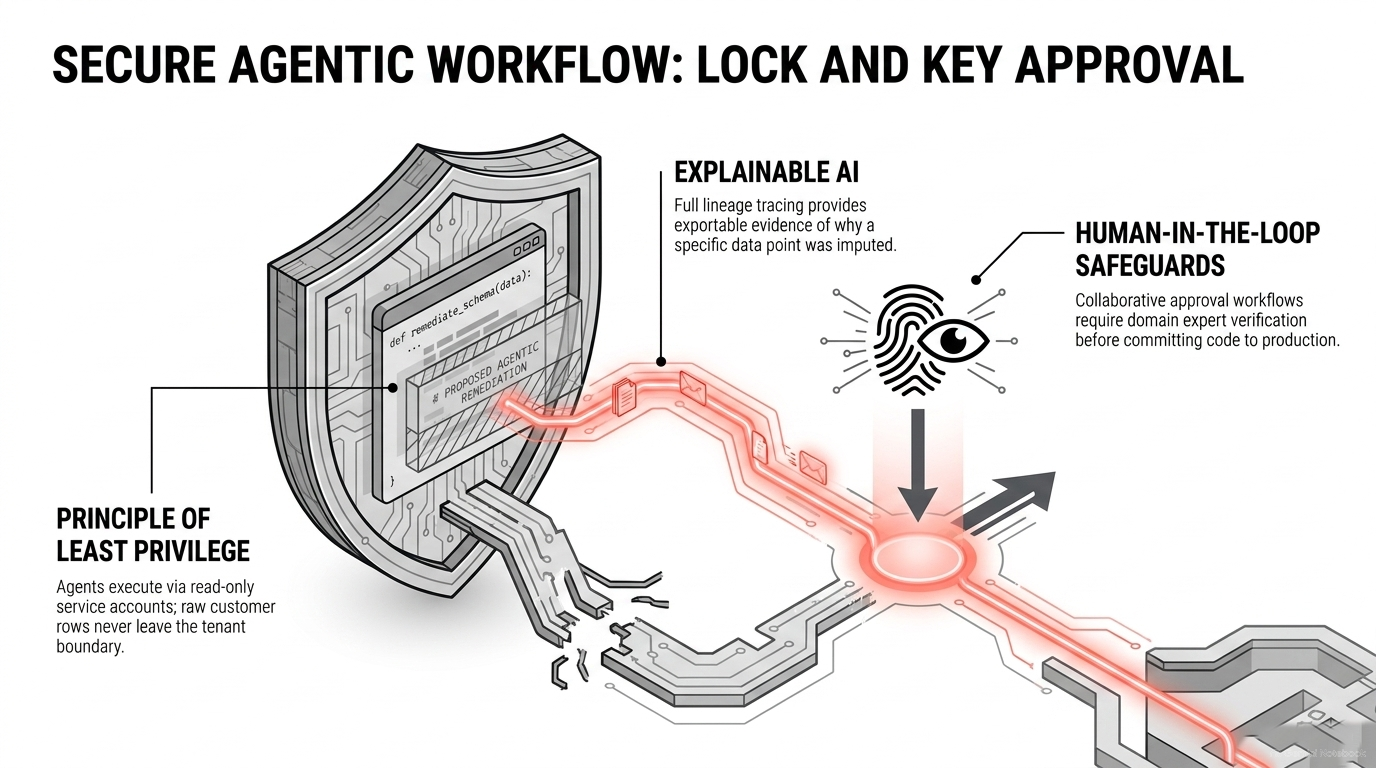
Least privilege means the agent should inspect more than it can mutate. A sensible default is read-only access for observation and diagnosis, with changes executed through a separate constrained identity or deployment mechanism. Raw tenant data should remain inside the permitted security boundary wherever possible.
Explainability is operational evidence, not a prose justification. For every proposed change, the system should retain the triggering anomaly, relevant lineage, retrieved context, generated code or rule, test results, approver identity, execution timestamp, and resulting data diff.
Human review should be risk-based rather than universal. A low-impact format normalization with deterministic tests may be auto-approved. A repair that modifies financial fields, identity attributes, training labels, or large portions of a critical table should require explicit sign-off.
The safest autonomous system is one that can clearly explain when it chose not to act.
12. Measure Reliability, Not Automation Theater
The outcome slide depicts manual engineering effort falling while a data reliability score rises toward 99.9%, alongside claims about eliminating repetitive remediation and achieving near-immediate detection.
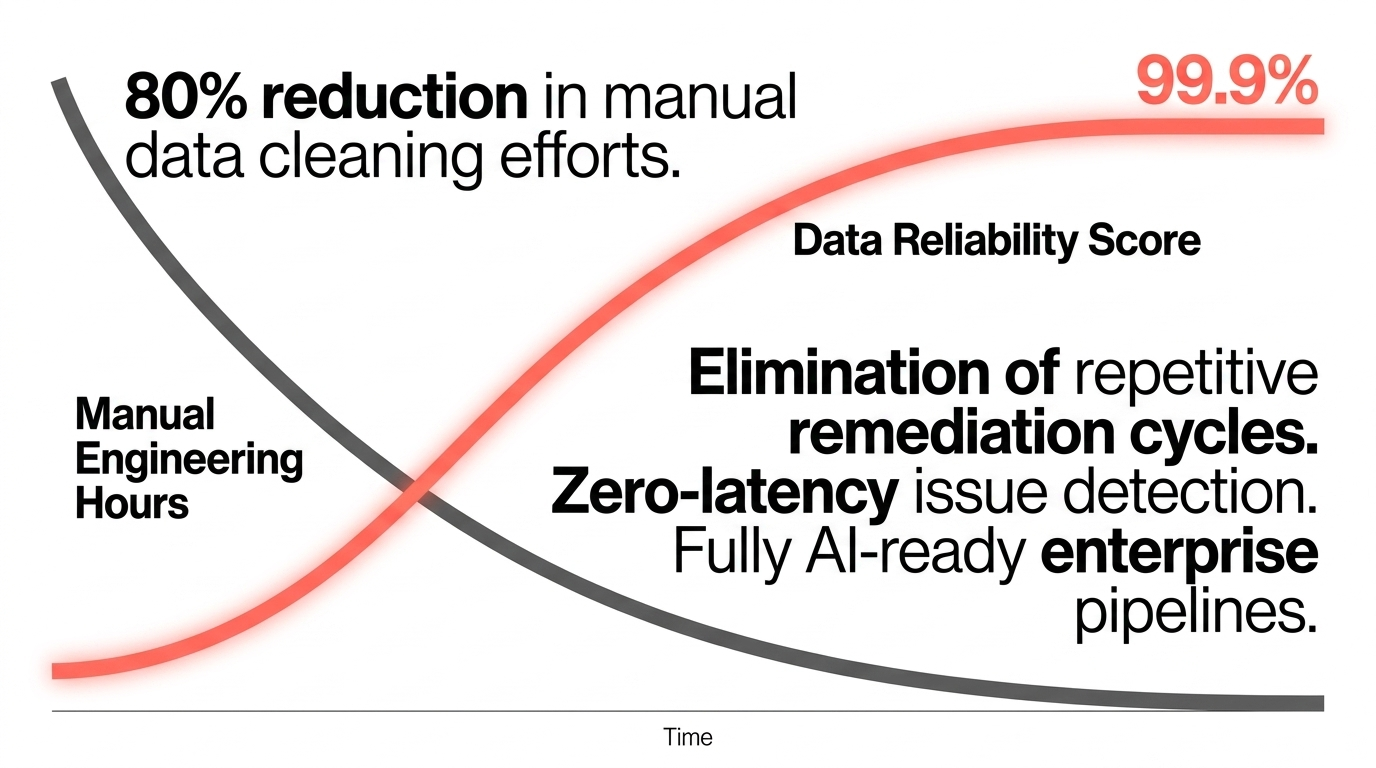
These are useful directional objectives, but production measurement needs operational definitions. “Reliability score” should be decomposed into observable components such as freshness, completeness, validity, consistency, and incident impact. “Zero latency” should become a measurable detection SLO. “Reduction in manual cleaning” should be calculated from a baseline and should exclude work merely shifted into reviewing bad automated fixes.
A good deployment therefore tracks both automation rate and automation quality. If autonomous coverage increases while rollback frequency or downstream defects also increase, the system is not improving reliability.
The purpose of the loop is to reduce toil because correctness is improving, not to optimize for fewer human touches at any cost.
Engineering Principles
The architecture ultimately depends on several principles:
-
Observe continuously, decide selectively.
Cheap profiling should run broadly, while expensive scans and model reasoning should be triggered only when evidence justifies them. -
Separate diagnosis from execution.
Agents may interpret ambiguous context, but production changes should pass through deterministic tests, scoped credentials, and versioned workflows. -
Treat provenance as a first-class data product.
Every inferred value and generated rule needs traceable source evidence, lineage, model metadata, and a reproducible decision record. -
Make remediation proportional to uncertainty and impact.
Confidence, blast radius, business criticality, and reversibility should determine whether the system acts automatically, proposes a change, or escalates. -
Close the loop with post-change validation.
A repair is not complete when code runs successfully. The system must verify the downstream data state and continue monitoring for regressions.
Final Synthesis
Taken together, the material describes an agentic data-management control loop that starts with raw, chaotic ingestion and ends with analytics-ready, governed output. Detection identifies deviations, diagnosis connects them to context and lineage, retrieval supplies missing evidence, remediation compiles that reasoning into controlled action, and validation determines whether the action should persist.
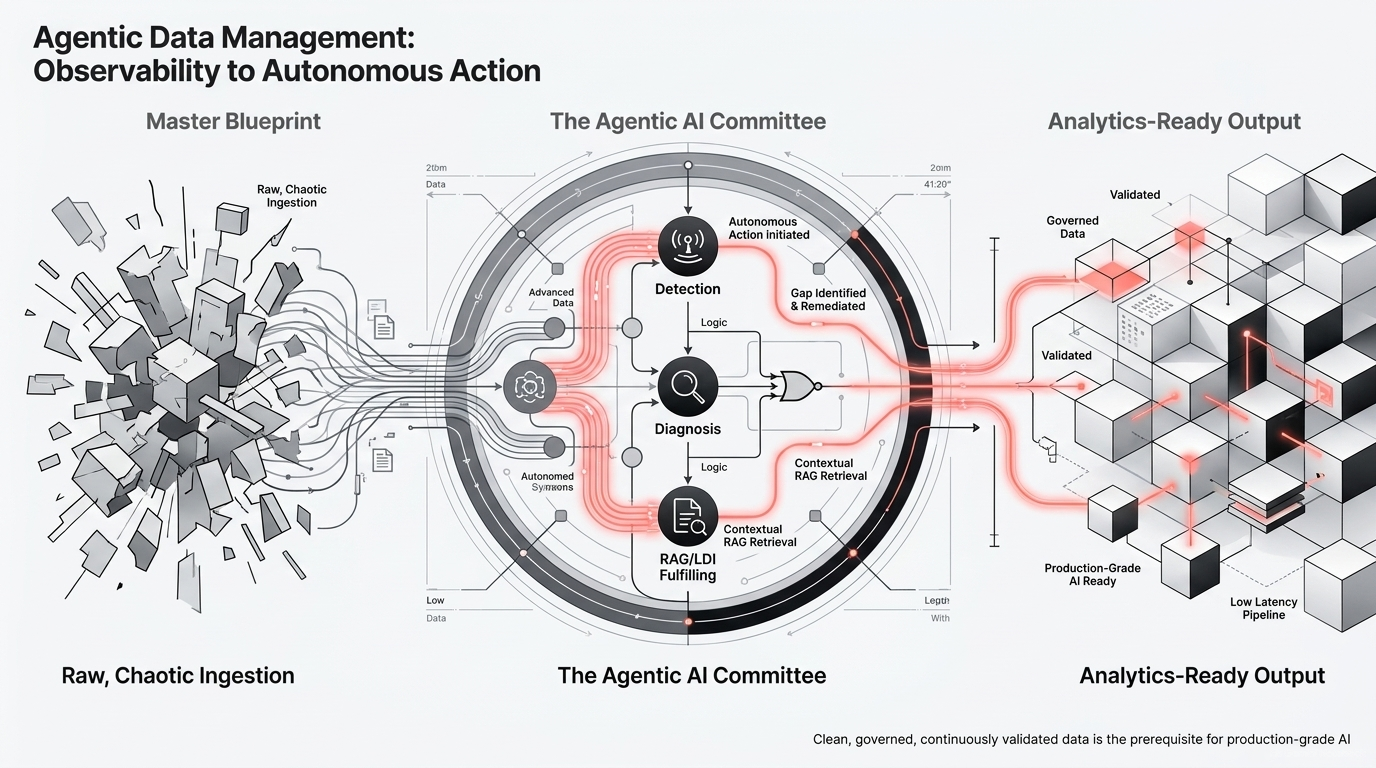
The strongest part of this blueprint is that autonomy is not a single component. It is the result of coordinating multiple layers: observability supplies signals, lineage narrows causes, retrieval grounds ambiguous cases, agents coordinate decisions, code execution scales accepted fixes, security boundaries constrain privileges, and validation turns every remediation into a feedback event.
The production-ready system combines:
- Deterministic foundation: schema checks, contracts, statistical tests, constraints, and typed execution paths.
- Testing layer: sandboxed code generation, regression fixtures, precision thresholds, diff validation, and rollback.
- Agent or AI layer: specialized routing, contextual diagnosis, retrieval, and repair-plan generation.
- Security and governance: least privilege, tenant boundaries, approval gates, immutable audit history, and evidence retention.
- Observability layer: metadata profiling, lineage, change detection, reliability SLOs, and post-remediation monitoring.
- Production outcome: cleaner, governed, continuously validated data that can support downstream analytics and AI with less repetitive manual intervention.
The key architectural idea is a transition from alerting about data quality to operating data quality as a closed-loop control system.
Closing Thought
Autonomous data assurance is not achieved by giving an LLM write access to a warehouse. It is achieved by engineering a system in which probabilistic reasoning is surrounded by deterministic evidence, constrained execution, and continuous validation.
The path to self-healing DataOps is not more autonomy everywhere; it is carefully governed autonomy at the points where evidence is strong enough to act.