

The Agentic OS: Architecting Multi-Agent Orchestration and Vision-Grounded Execution
The next step in agentic systems is not simply a larger model with a longer prompt. It is a shift from treating an agent as a self-contained conversational process to treating autonomous work as an operating-system problem.
Long-running work has familiar systems requirements: tasks must be decomposed, dependencies must be respected, context must persist beyond one model call, failures must be isolated and retried, and actions must remain bounded by explicit permissions. When the work moves into graphical interfaces, one more constraint appears: the system has to understand and manipulate what is actually visible on screen.
The architecture presented here treats those concerns as a unified stack. A planner turns objectives into work. A scheduler manages the dependency graph. Memory services supply the right context at the right time. Specialized workers execute tasks in parallel. A visual grounding layer converts semantic intent into screen coordinates. Recovery loops respond to failed actions. Security capsules constrain what each agent is allowed to touch.
The result is less like a chatbot with tools and more like a runtime for autonomous digital work.
1. Why the Single-Agent Pattern Hits a Ceiling
A single general-purpose agent is attractive because the control loop is simple: observe, reason, act, repeat. That simplicity becomes a liability as tasks become longer, more heterogeneous, and more dependent on intermediate state.
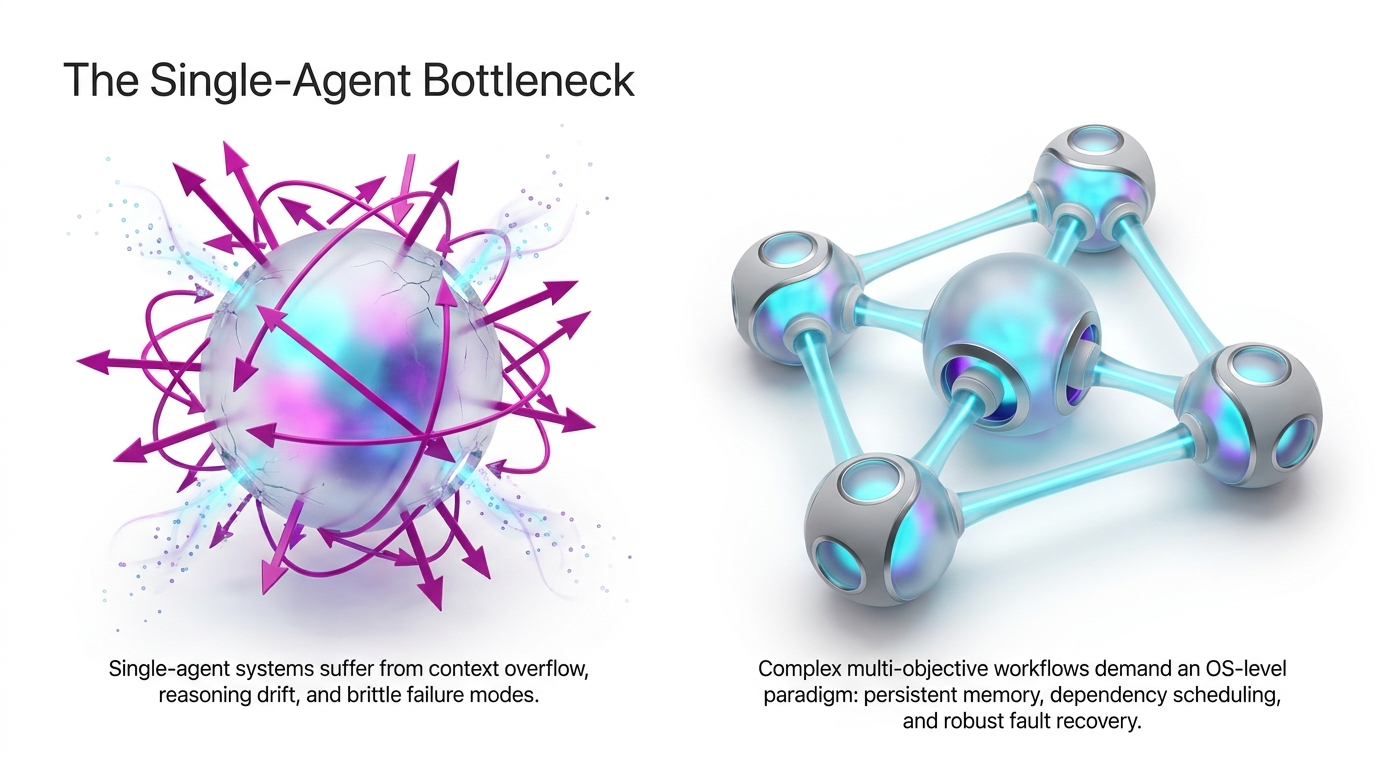
Three failure modes tend to compound.
First, context overflow forces the agent to compress, discard, or repeatedly reconstruct information. Second, reasoning drift makes later decisions less anchored to the original objective as the trajectory grows. Third, brittle failure modes turn a local mistake into a global derailment because the same process owns planning, memory, execution, and recovery.
The systems response is separation of concerns. Instead of asking one agent to do everything, the runtime assigns explicit responsibilities to components that can be monitored, retried, or replaced independently. The important design change is not “more agents.” It is structured orchestration.
A multi-agent system without scheduling, memory policy, and fault boundaries can be more chaotic than a single agent. The useful abstraction is therefore an OS-like control plane for agents, not a collection of autonomous prompts.
2. The AAIOS Control Plane
The proposed AAIOS architecture centers on four control-plane functions: a gateway, planner, DAG scheduler, and memory manager. Specialized workers sit below that plane and can be assigned roles such as research, coding, and writing.
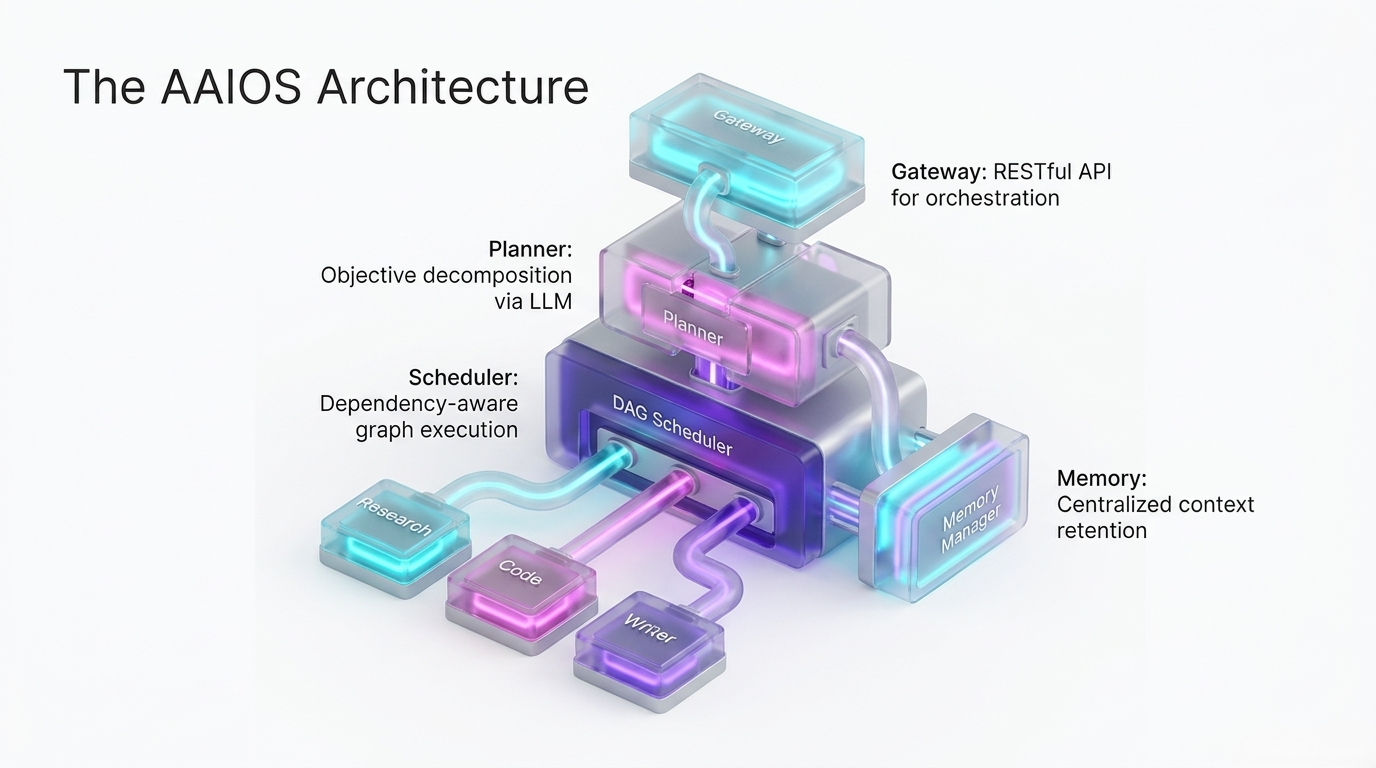
The gateway exposes orchestration through a service boundary. This gives the runtime a stable entry point for objectives and makes policy enforcement, authentication, observability, and external integration possible without coupling clients to the internal agent topology.
The planner converts a high-level objective into a structured set of tasks. In practice, this is where an LLM is most valuable: interpreting ambiguous goals, proposing decomposition, identifying required artifacts, and expressing dependencies.
The DAG scheduler then takes over responsibility for execution order. Once a task graph exists, deterministic scheduling logic can decide what is ready, what is blocked, and what can run concurrently. This keeps dependency handling out of the language model's implicit reasoning loop.
The memory manager acts as shared context infrastructure. Workers no longer need to carry the full history themselves; they retrieve only the context relevant to their current task and persist outputs for downstream consumers.
This split is important. The model remains useful where semantic judgment is needed, while the runtime handles state, ordering, concurrency, and lifecycle with explicit mechanisms.
3. Scheduling Is More Than “Run Ready Tasks”
A dependency graph establishes correctness constraints, but production scheduling also has to optimize limited compute, model calls, tool access, and wall-clock time.
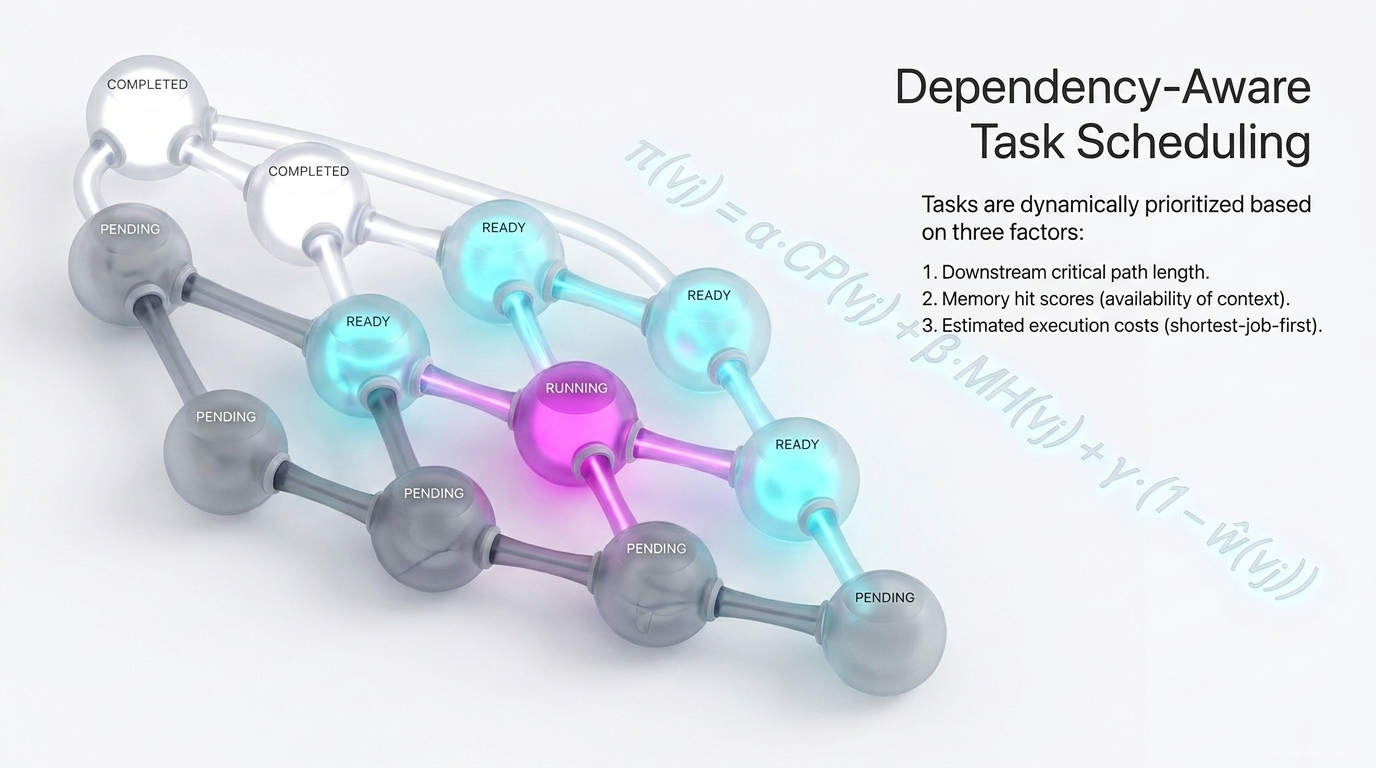
The scheduling policy shown in the deck prioritizes tasks using three signals:
- Downstream critical-path length — tasks that unlock long or important chains should move earlier.
- Memory hit score — tasks with readily available context may be cheaper and faster to execute now.
- Estimated execution cost — shorter or less expensive tasks can be favored when that improves throughput.
Conceptually, the priority function can be understood as a weighted combination of urgency, context availability, and execution cost. The exact weights are less important than the separation itself: readiness is a correctness property, while priority is an optimization policy.
That distinction lets the scheduler evolve without changing the planner. A system could later incorporate deadline risk, model availability, worker specialization, rate limits, confidence scores, or business value into the priority function while preserving the same task graph.
The production implication is straightforward: agent orchestration needs a real scheduler. Prompt instructions such as “do these tasks in parallel” are not a substitute for explicit dependency state.
4. Memory Should Be Hierarchical, Not Monolithic
Persistent memory is often discussed as a single vector store. That is too coarse for an agent runtime because not all context has the same lifetime, access pattern, or precision requirement.

The architecture separates memory into at least two layers.
Short-term memory (STM) serves immediate session context. It favors fast, exact retrieval and a controlled time-to-live. This is useful for transient values such as current task state, recent tool results, execution handles, and temporary decisions.
Long-term memory (LTM) persists reusable context across tasks and agents. Approximate nearest-neighbor retrieval supports semantic recall when the system needs related prior work rather than an exact key lookup.
The important architectural principle is not the storage technology. It is that memory has policy. Every write should answer questions such as: How long should this live? Who may retrieve it? Is exact lookup required? Is semantic similarity acceptable? What provenance should travel with the value? Can the value be summarized, or must the original artifact remain available?
Cross-agent memory also creates risk. A shared store can spread stale assumptions, sensitive data, or incorrect intermediate results across the system. Production memory therefore needs namespaces, ownership, provenance, retention rules, and permission checks in addition to retrieval quality.
5. Evaluation Needs to Separate Capability From Architecture
The deck compares a single-agent baseline, AutoGen, LangGraph, and AAIOS on Task Completion Rate (TCR) and Memory Utilization Efficiency (MUE).
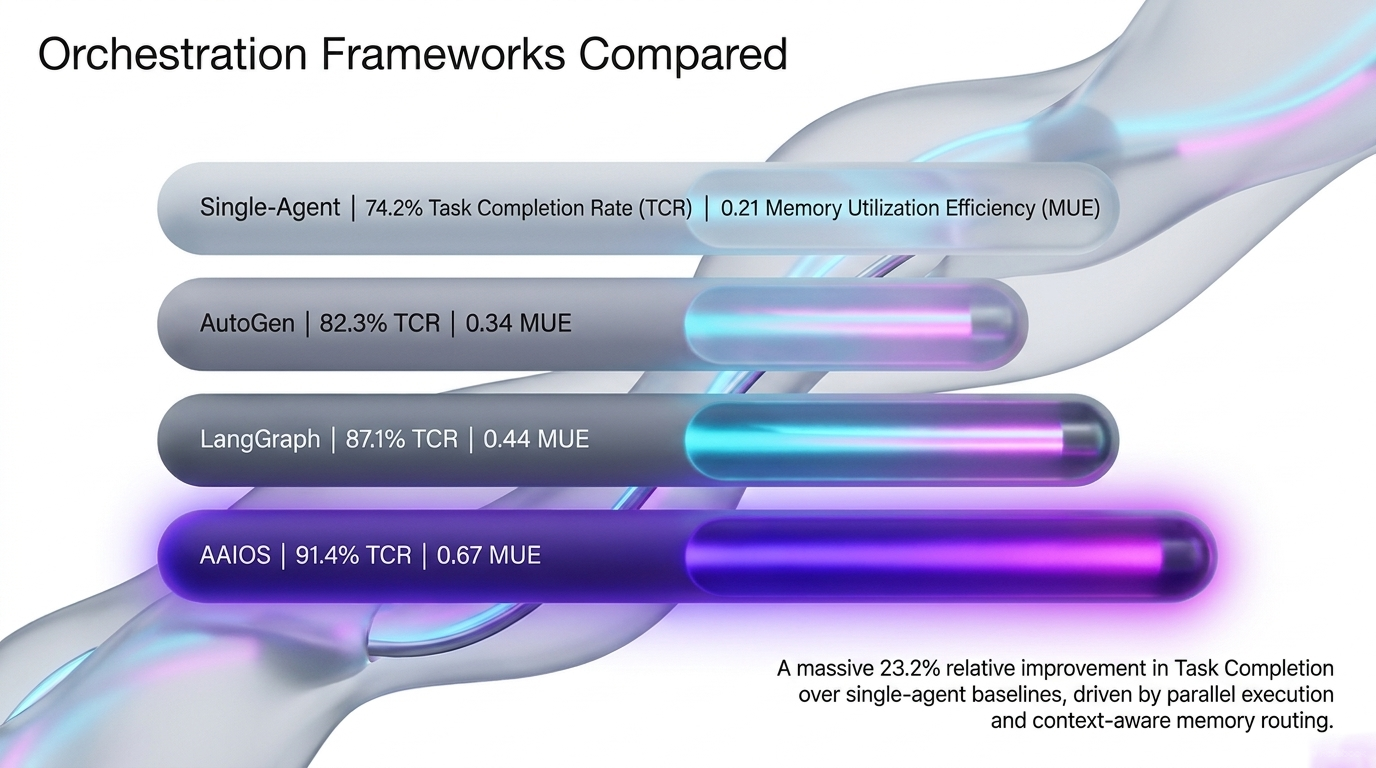
The reported figures are:
- Single-Agent: 74.2% TCR, 0.21 MUE
- AutoGen: 82.3% TCR, 0.34 MUE
- LangGraph: 87.1% TCR, 0.44 MUE
- AAIOS: 91.4% TCR, 0.67 MUE
Those numbers are useful as a design signal, but they should be read as results reported by this system presentation, not as universal benchmarks. A credible evaluation would also publish the task suite, model versions, tool environment, retry policy, concurrency limits, memory configuration, success criteria, and variance across repeated runs.
This matters because agent performance is unusually sensitive to evaluation setup. A higher task-completion rate can come from better decomposition, more retries, a stronger base model, longer timeouts, more tool calls, or more permissive success criteria—not only from the orchestration architecture.
The right engineering question is therefore: which architectural mechanisms produce measurable gains under controlled conditions? That is the standard needed before performance claims become transferable.
6. Experience-Augmented Planning: A Manager/Worker Pattern
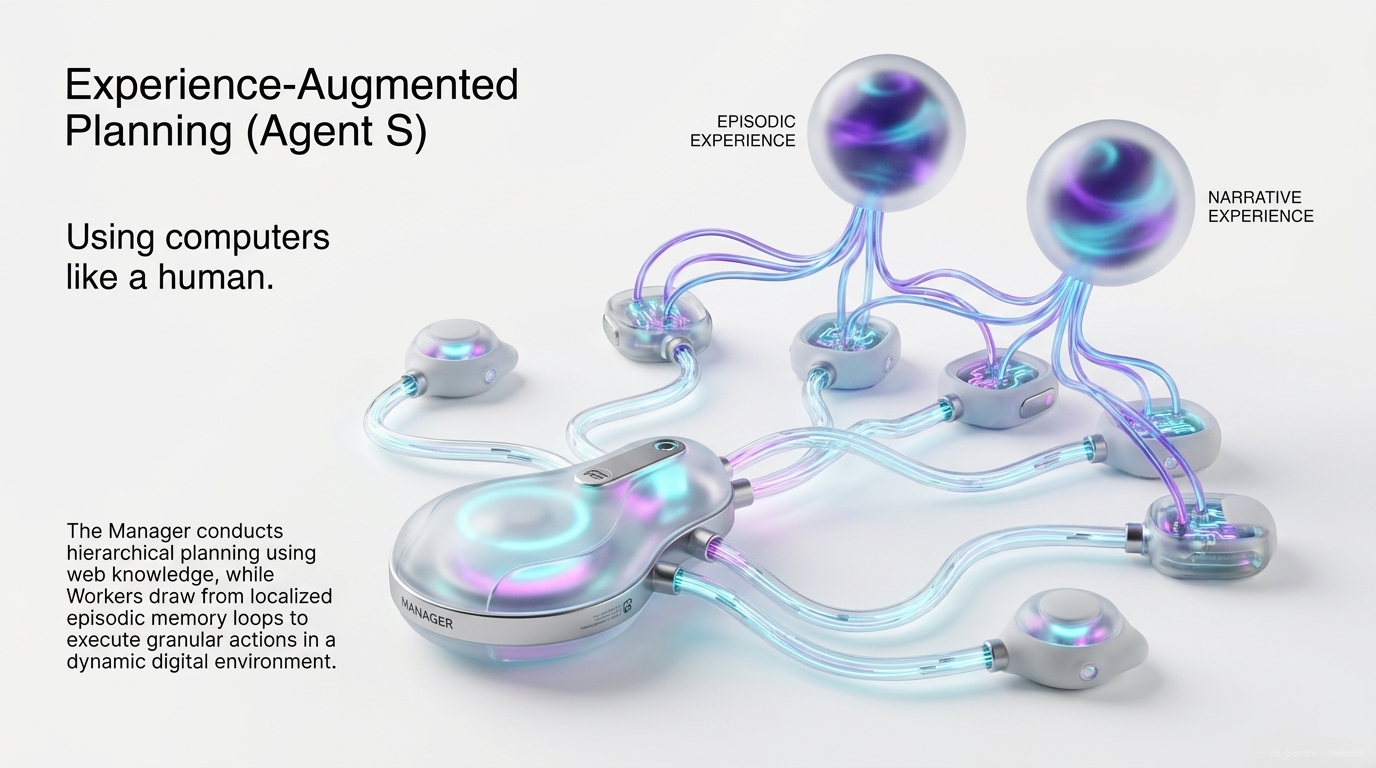
The architecture then extends planning with experience. A manager performs hierarchical planning while workers execute localized actions using episodic context.
This pattern separates two time horizons.
The manager maintains the longer arc: objective interpretation, decomposition, reassignment, and synthesis. The workers operate on narrower action loops where local observations and recent execution history matter more than the entire project narrative.
The deck distinguishes episodic experience from narrative experience. Episodic memory captures what happened in a particular interaction or execution sequence. Narrative memory abstracts those episodes into reusable guidance: what tends to work, what tends to fail, and how to approach a class of tasks.
That distinction can reduce repeated mistakes, but it should be implemented conservatively. Automatically turning every successful trajectory into a general rule can create brittle habits. Experience should carry provenance, confidence, and scope, and should be invalidated when the environment changes.
A practical learning loop is therefore: record the episode, evaluate the outcome, extract a candidate lesson, test that lesson across additional cases, and only then promote it into reusable planning context.
7. Computer Use Changes the Interface Contract
Backend agents can often operate through structured APIs. Computer-use agents must act inside interfaces designed for humans, where the observable truth is the rendered screen.
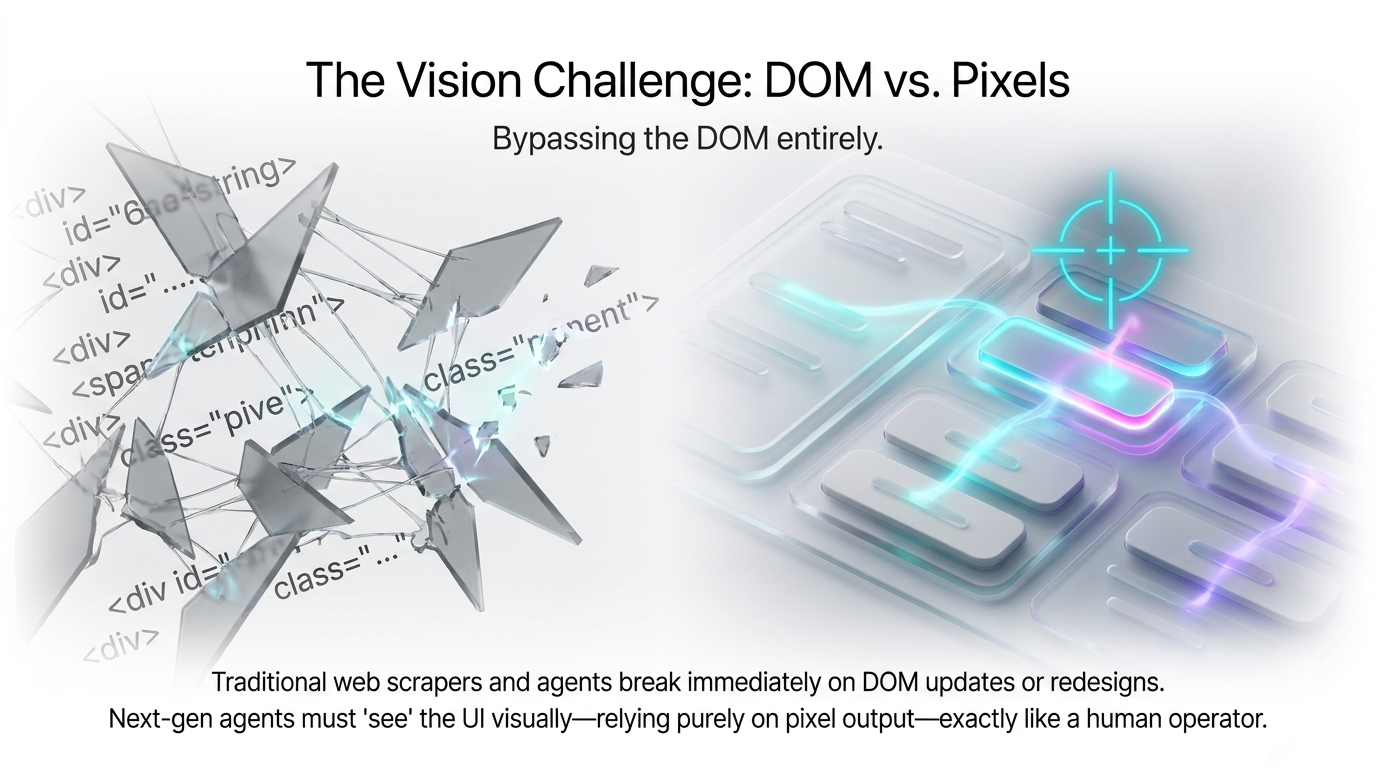
Traditional browser automation frequently relies on the DOM, selectors, accessibility trees, or element identifiers. Those signals are efficient when they are stable and available. They also couple the automation to a particular implementation of the interface.
A vision-grounded agent instead treats the screen as the primary interaction surface. That makes it possible to work across applications or remote environments where structured UI metadata is missing, incomplete, or unreliable.
The trade-off is significant. Pixels are universal, but they are less explicit. The system must infer which visual region corresponds to the intended control, whether that control is enabled, and where exactly to click or type. Small localization errors become execution failures.
For production systems, “pixels versus DOM” is not necessarily an all-or-nothing choice. The robust approach is to treat visual perception as the grounding authority while opportunistically using structured signals when they are trustworthy and policy-appropriate. Redundant perception channels can improve both accuracy and debuggability.
8. Split Semantic Reasoning From Visual Grounding
One of the strongest ideas in the deck is to separate what the user means from where the system should act.
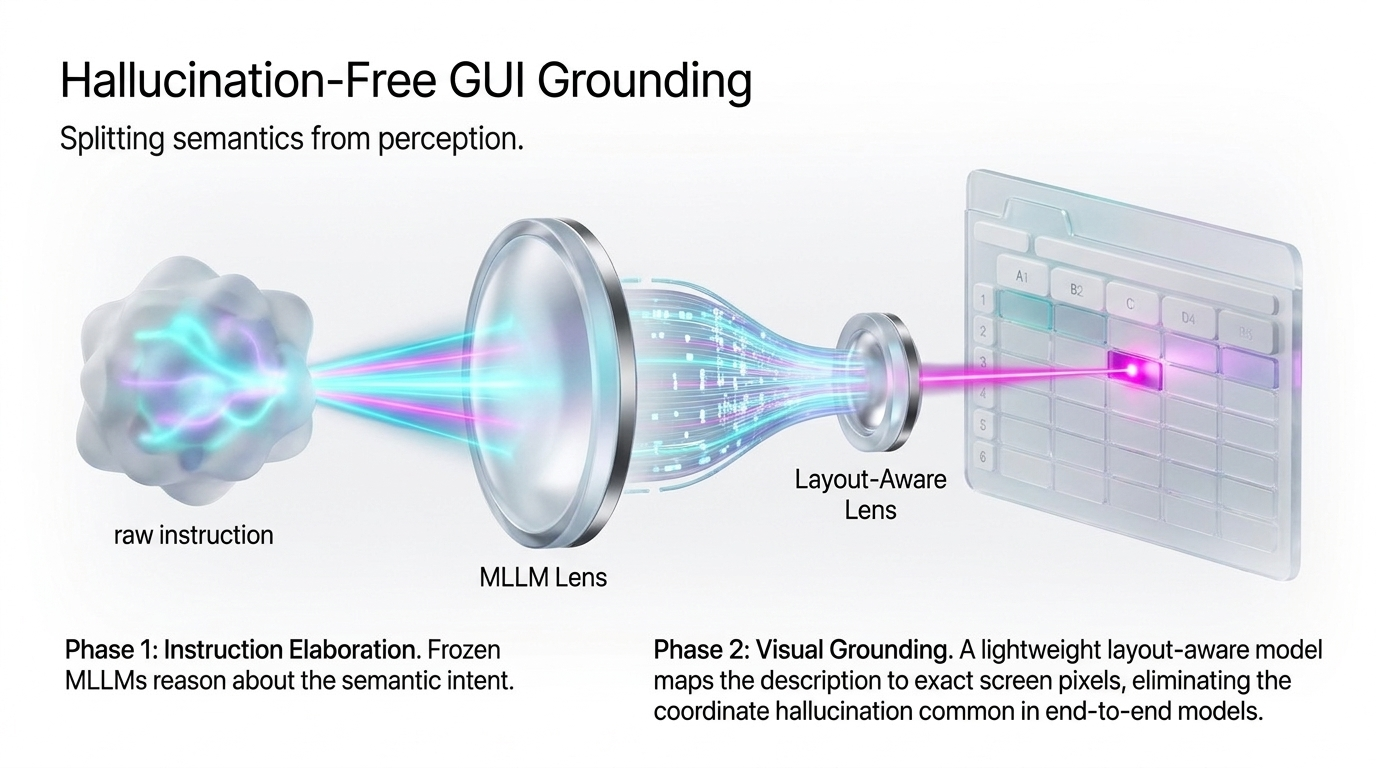
In the first phase, a multimodal language model elaborates the instruction. Its job is semantic: interpret intent, resolve references, and describe the target UI element in context.
In the second phase, a lighter layout-aware grounding model maps that semantic description onto the current screen and produces the precise target location.
This decomposition addresses a common failure mode in end-to-end computer-use systems. A language model may understand the instruction perfectly but still invent or misplace coordinates because semantic reasoning and geometric localization are different tasks.
Separating them provides several benefits:
- the semantic model can be optimized for reasoning quality;
- the grounding model can be trained and tested specifically for spatial accuracy;
- each stage can expose confidence independently;
- failures become easier to diagnose;
- the system can refresh grounding without re-running the entire reasoning chain.
The broader principle is reusable: do not force one model to solve every layer of the problem when the layers have different error modes.
9. Visual Fidelity Has a Token and Latency Budget
Computer-use agents need enough visual detail to identify small targets, but higher-resolution observations increase input size, latency, and cost.
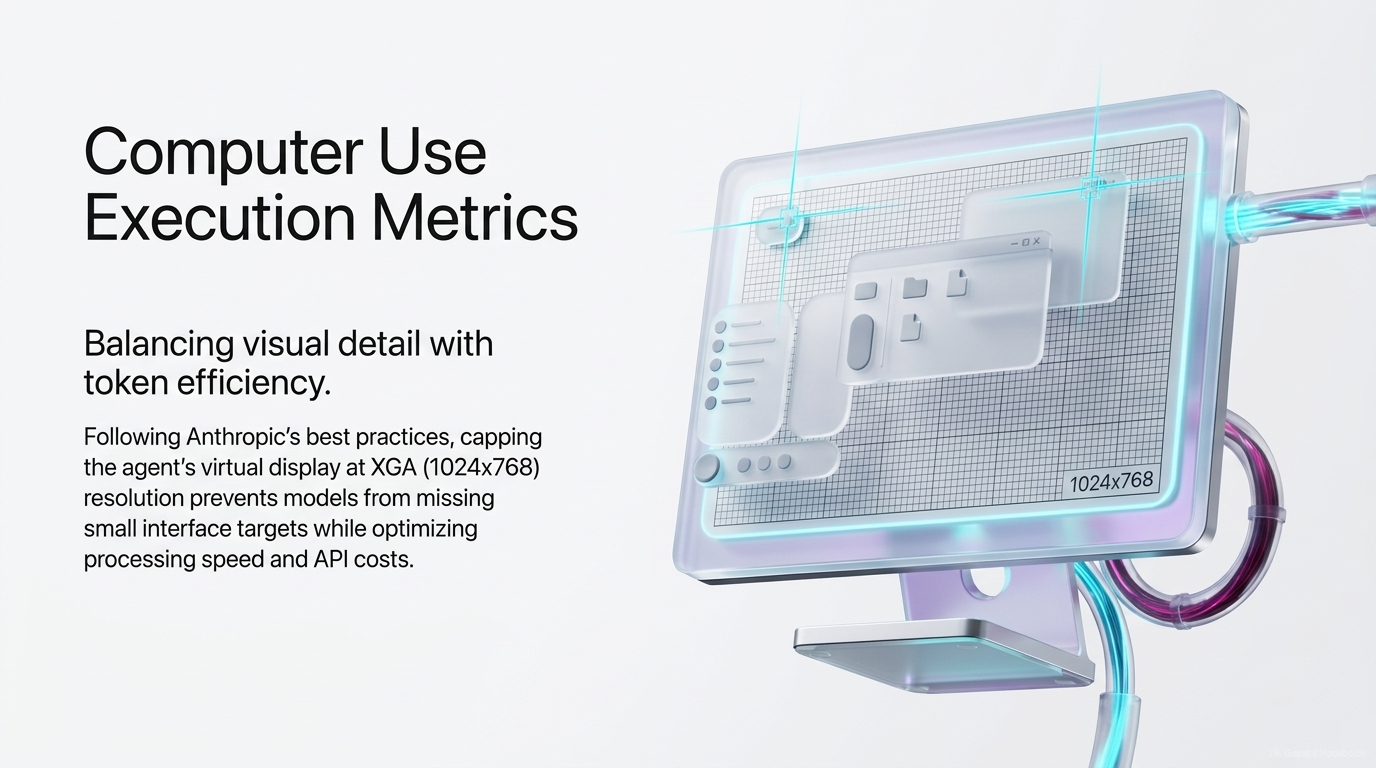
The deck adopts an XGA-style 1024×768 virtual display as a working compromise. The specific resolution should be treated as an implementation choice rather than a universal optimum, but the optimization problem is real: visual fidelity must be high enough for reliable grounding without making every observation unnecessarily expensive.
A production system should measure this directly. Useful metrics include target-detection accuracy by element size, click success rate, screenshot token consumption, perception latency, retry rate, and end-to-end task cost.
Resolution can also be adaptive. The agent may use a lower-cost full-screen observation to orient itself, then request a higher-resolution crop around a candidate region before acting. This mirrors how computer vision systems use coarse-to-fine processing and can reduce cost without sacrificing small-target accuracy.
The goal is not maximum resolution. It is minimum sufficient visual information for reliable action.
10. Auto-Healing Turns Interaction Failure Into New Evidence
A real interface changes underneath the agent. Elements move, dialogs appear, pages load slowly, selectors fail, and previous assumptions become invalid.

The deck's recovery loop treats a failed action as an observation rather than an immediate crash. The system captures the live visual state, sends that state back into reasoning, and generates a new action. Retries are bounded, with the illustrated policy stopping after a maximum of three attempts.
That is a strong runtime pattern because it makes failures loud and local. The worker can recover from a transient interaction problem without corrupting the entire workflow, while a retry ceiling prevents infinite loops and runaway cost.
Production recovery should classify failures before retrying. A missed click, authentication failure, permission denial, stale page, rate limit, and destructive confirmation dialog are not equivalent. Some failures are safe to retry automatically; others should be escalated or terminate the task.
A useful recovery record includes the attempted action, pre-action screen, post-action screen, detected failure type, retry count, generated alternative, and final outcome. That record becomes both observability data and future training material.
11. Parallelism Is Valuable Only When State Is Controlled
The deck reports a peak 93.8% Task Completion Rate on research-synthesis tasks and near-linear scaling up to eight concurrent task streams.
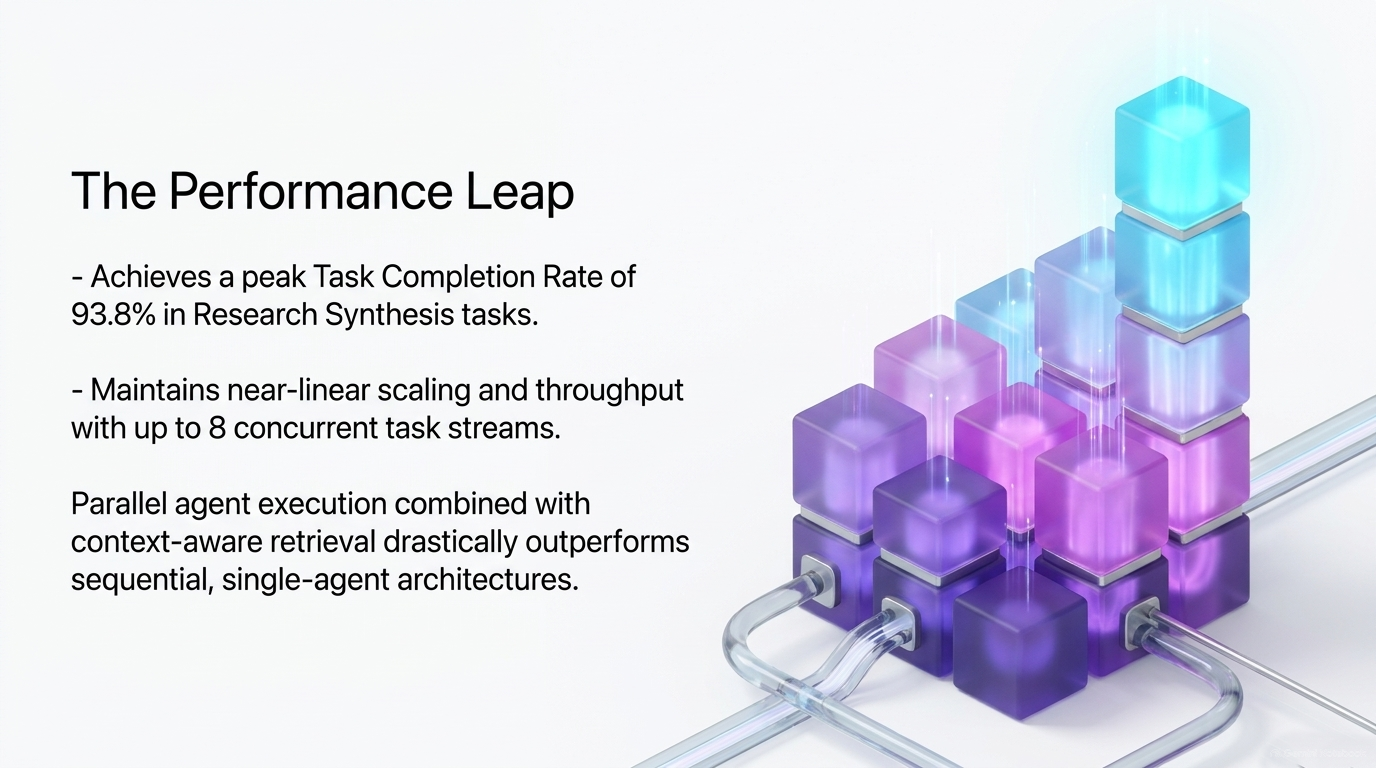
Again, those should be read as reported results from the presented system, pending the benchmark details needed for external reproduction. The architectural takeaway is still important: parallel workers can reduce wall-clock time and improve coverage when the task graph contains genuine independence.
Parallelism does not come for free. Concurrent workers can duplicate effort, race on shared state, overwrite artifacts, saturate external APIs, or produce contradictory intermediate conclusions. The more aggressively the system parallelizes, the more important task ownership and memory isolation become.
The scheduler therefore needs to distinguish logical independence from mere absence of an explicit edge. In many workflows, two tasks may not depend on each other's outputs but still contend for the same resource or mutate the same external object.
Useful runtime controls include concurrency caps, per-resource locks, idempotent writes, merge policies, rate-limit awareness, and deterministic task identifiers. Throughput gains are real only when the resulting state remains coherent.
12. The Mind-to-Mouse Loop
The synthesis slide describes the full architecture as a mind-to-mouse ecosystem: backend orchestration connects abstract intent to literal interaction with software.

That phrase captures the central systems loop:
intent → plan → task graph → context retrieval → worker reasoning → visual grounding → action → observation → memory → replanning
Each arrow is a contract. If the planner does not emit a structured task, scheduling becomes ambiguous. If memory lacks provenance, workers cannot judge retrieved context. If grounding does not expose confidence, actions become risky. If execution does not return observations, recovery cannot work. If results are not persisted, downstream tasks repeat work.
The value of an “Agentic OS” is therefore not that it hides complexity. It makes complexity explicit and governable.
That is also the difference between a compelling demo and a production runtime. Demos optimize the happy path. Operating systems exist because the unhappy paths—contention, failures, permissions, partial state, restarts, and recovery—are the normal case at scale.
13. Security Should Be Expressed as Intent Before Runtime
Autonomous agents become materially more capable when they can browse networks, read files, run tools, and manipulate external systems. That capability must be bounded before execution begins.

The deck proposes an Agent Capsule with a manifest-only runtime. Before startup, an agent submits a structured intent manifest declaring allowed network domains, file scopes, and tool access. No manifest means no interface access.
This is a useful security model because it converts implicit autonomy into explicit capability grants. The runtime can evaluate permissions before a task runs and can deny access independently of what the model requests later.
A production manifest should be both least-privilege and task-scoped. It should answer: Which resources are allowed? Which operations are allowed on them? For how long? Under which identity? Are destructive actions permitted? What requires human approval? What must be logged?
Isolation also limits blast radius. If one worker is compromised by malicious content or faulty reasoning, its capsule should prevent it from acquiring unrelated files, credentials, network destinations, or tools.
The critical principle is that security policy belongs outside the model. A prompt saying “do not access sensitive data” is guidance. A runtime capability boundary is enforcement.
14. What Still Needs to Be Proven
The architecture is coherent, but several areas require rigorous validation before it should be trusted for high-stakes autonomous work.
Benchmark reproducibility. The reported TCR, MUE, scaling, and task-specific peak results need documented datasets, model versions, retry budgets, tool configurations, and repeated-run statistics.
Memory correctness. Retrieval quality alone is insufficient. The system needs tests for stale context, cross-agent contamination, conflicting memories, deletion, retention, and provenance integrity.
Scheduler behavior under contention. Priority policies should be tested for starvation, deadlocks, resource conflicts, backpressure, and cost blowouts under concurrent workloads.
Visual grounding robustness. Evaluation should cover responsive layouts, zoom changes, localization, overlays, animation, disabled controls, small targets, and adversarial interface content.
Recovery safety. Retries must distinguish recoverable interaction failures from authorization failures or dangerous state transitions. Bounded retries are necessary but not sufficient.
Security enforcement. The capsule model needs hard guarantees around process isolation, secret handling, network egress, filesystem scope, tool permissions, audit logs, and approval boundaries.
These are not peripheral details. They determine whether the system is merely autonomous or reliably autonomous.
15. The Future of Autonomous Work
The final slide frames the transition clearly: software is moving from tools that humans operate toward systems that can operate tools on behalf of humans.
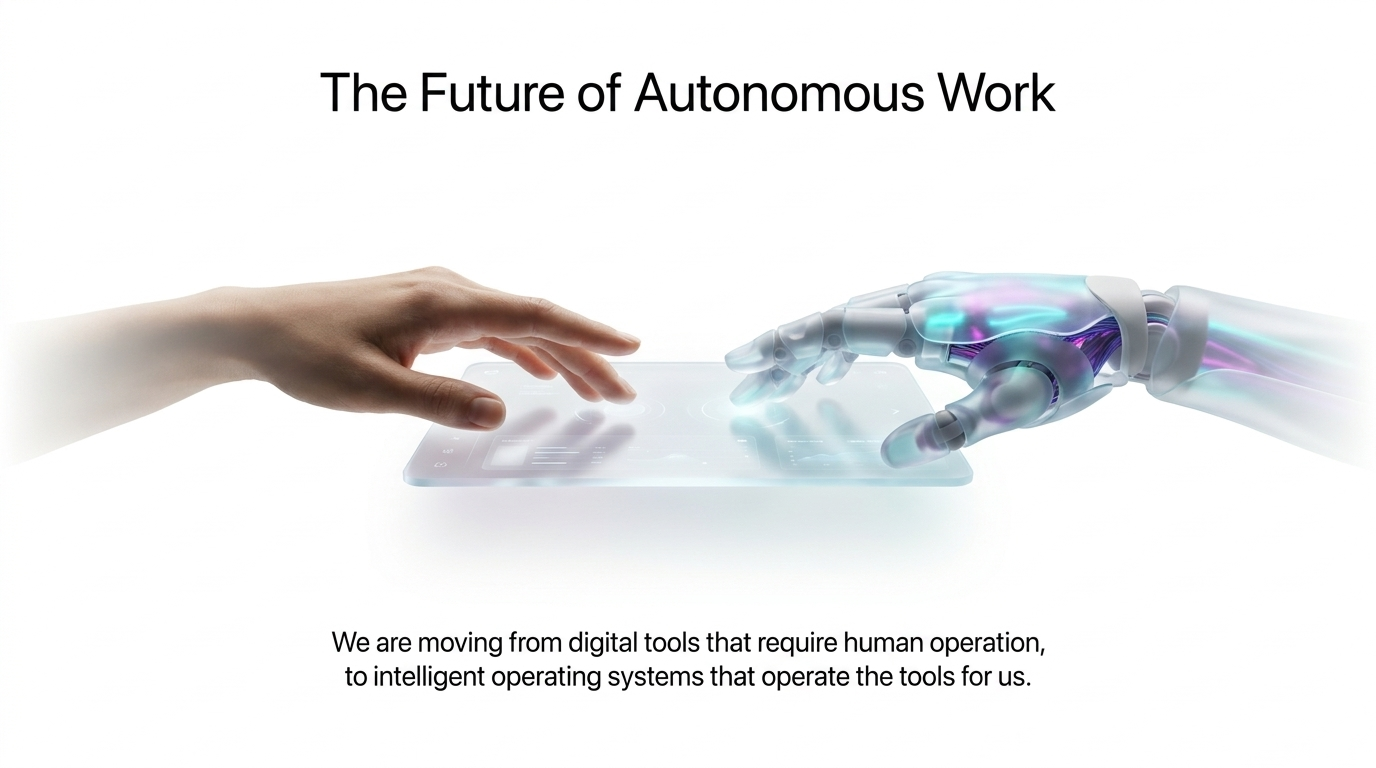
That does not eliminate the human role. It changes the interface between human intent and machine execution.
Humans become responsible for defining objectives, constraints, approvals, escalation rules, and acceptable outcomes. The runtime takes on decomposition, scheduling, retrieval, routine interaction, recovery, and evidence collection. The handoff works only when the system can show what it plans to do, what it actually did, and why it believes the result satisfies the objective.
The most important product surface may therefore be neither the planner nor the worker. It may be the control plane for trust: manifests, plans, approvals, execution traces, memory provenance, cost, and outcomes presented in a form that a human can audit.
Autonomy without that control plane is difficult to govern. Autonomy with it becomes an engineering system rather than an act of faith.
Engineering Principles
The architecture ultimately depends on several principles:
-
Separate semantic intelligence from deterministic control.
Use models for interpretation, decomposition, and adaptation; use explicit runtime mechanisms for dependencies, lifecycle, permissions, and state transitions. -
Treat context as managed infrastructure.
Memory needs tiers, provenance, ownership, retention, and access policy rather than one undifferentiated conversation history. -
Make failure observable and bounded.
Every action should produce evidence, every retry should have a reason, and every recovery loop should stop under defined conditions. -
Ground actions in the live environment.
When interacting with GUIs, semantic understanding must be converted into verified spatial targets using the current screen state. -
Enforce intent with capabilities, not prompts.
Security boundaries should be defined outside the model and granted only for the resources and operations required by the task.
Final Synthesis
The Agentic OS is best understood as a runtime architecture for turning human objectives into controlled machine execution. The planner creates structure. The scheduler turns that structure into ordered and parallel work. Hierarchical memory supplies relevant context. Specialized workers execute. Visual grounding connects reasoning to interfaces. Auto-healing keeps local failures from collapsing the workflow. Security capsules constrain what each component is allowed to do.
The architecture becomes compelling when those pieces are treated as independent, testable subsystems rather than hidden inside a single agent loop.
A production-ready implementation would combine:
- a deterministic orchestration foundation for task state, dependencies, concurrency, and retries;
- an evaluation layer for task success, grounding precision, latency, cost, and regression testing;
- an agent layer for planning, synthesis, tool selection, and adaptive reasoning;
- security and governance controls based on scoped capabilities, manifests, identity, and approvals;
- observability infrastructure for traces, memory provenance, screenshots, actions, failures, and recovery paths;
- a human control surface that exposes intent, plan, evidence, cost, risk, and final outcome.
That combination is what makes the “operating system” metaphor useful. The system is not one intelligent process. It is a governed environment in which many intelligent processes can safely cooperate.
Closing Thought
The central challenge in autonomous software is no longer simply whether a model can reason about a task. The harder question is whether a system can preserve intent, coordinate work, retain context, act precisely, recover safely, and prove what happened.
The future of agentic computing will be decided by runtime architecture as much as by model intelligence.