
The Agentic Shift: Unifying Software Quality and Macroeconomics through Multi-Agent Systems
Two domains that appear unrelated—software quality engineering and macroeconomic modeling—break for a surprisingly similar reason: complex systems evolve faster than static rules can keep up.
In UI automation, hard-coded selectors fail when interfaces are refactored. In macroeconomics, equilibrium assumptions struggle when agents adapt out of equilibrium. The shared response is an architectural shift away from fixed scripts and toward systems that can sense, deliberate, act, verify, and recover.
The central thesis is simple: execution can increasingly be delegated to autonomous agents, but trust depends on how rigorously those agents are verified.
1. The Legacy Breaking Point
The old design pattern is static: encode the world as rules, then assume the world will remain close enough to those rules for the system to keep working.
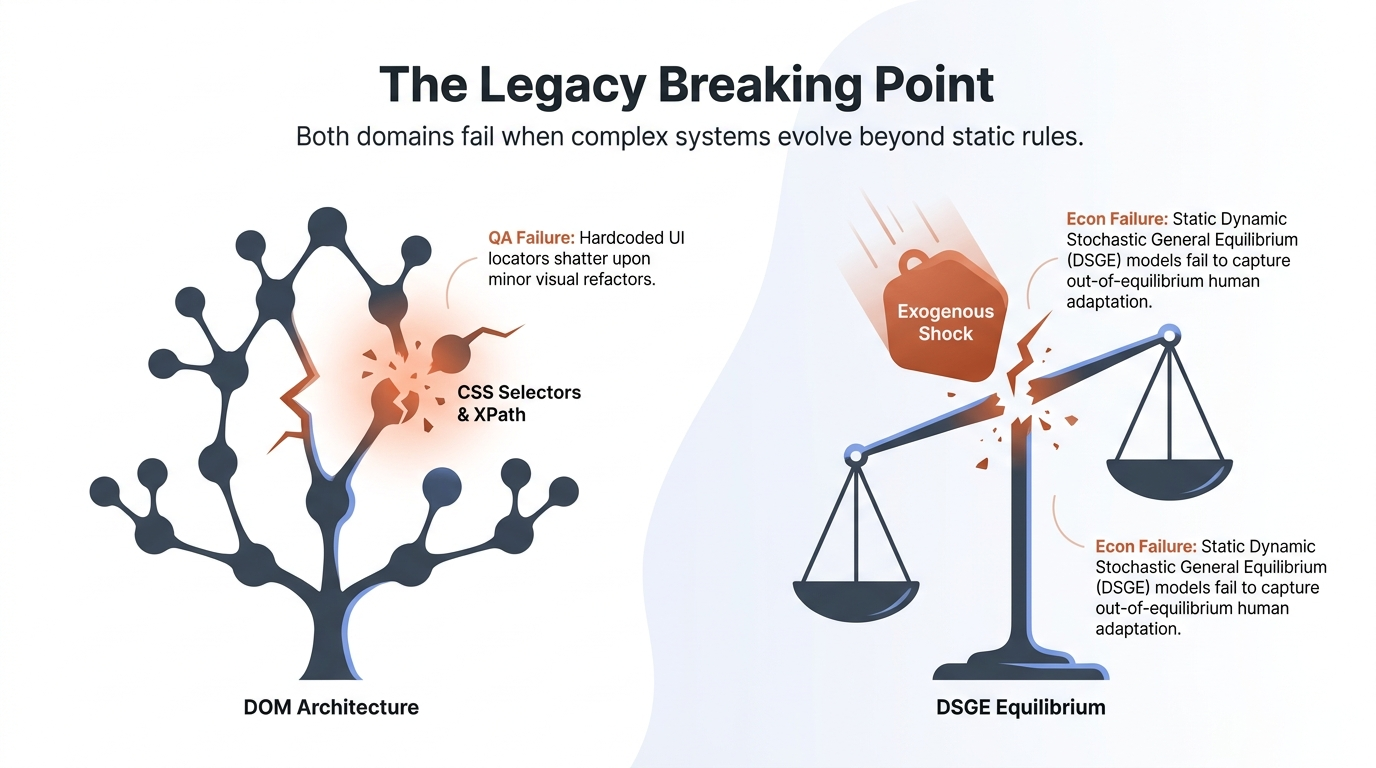
The diagram pairs two failure modes:
- In software QA, CSS selectors and XPath expressions can shatter when a visual refactor changes structure without changing user intent.
- In economics, linearized Dynamic Stochastic General Equilibrium (DSGE) models can miss adaptive behavior when real agents react to shocks outside the assumed equilibrium path.
The engineering lesson is broader than either example. When the environment itself is adaptive, the control system must also be adaptive.
2. The Sense–Deliberate–Act Loop
Agentic systems replace direct rule execution with a recurring control loop.
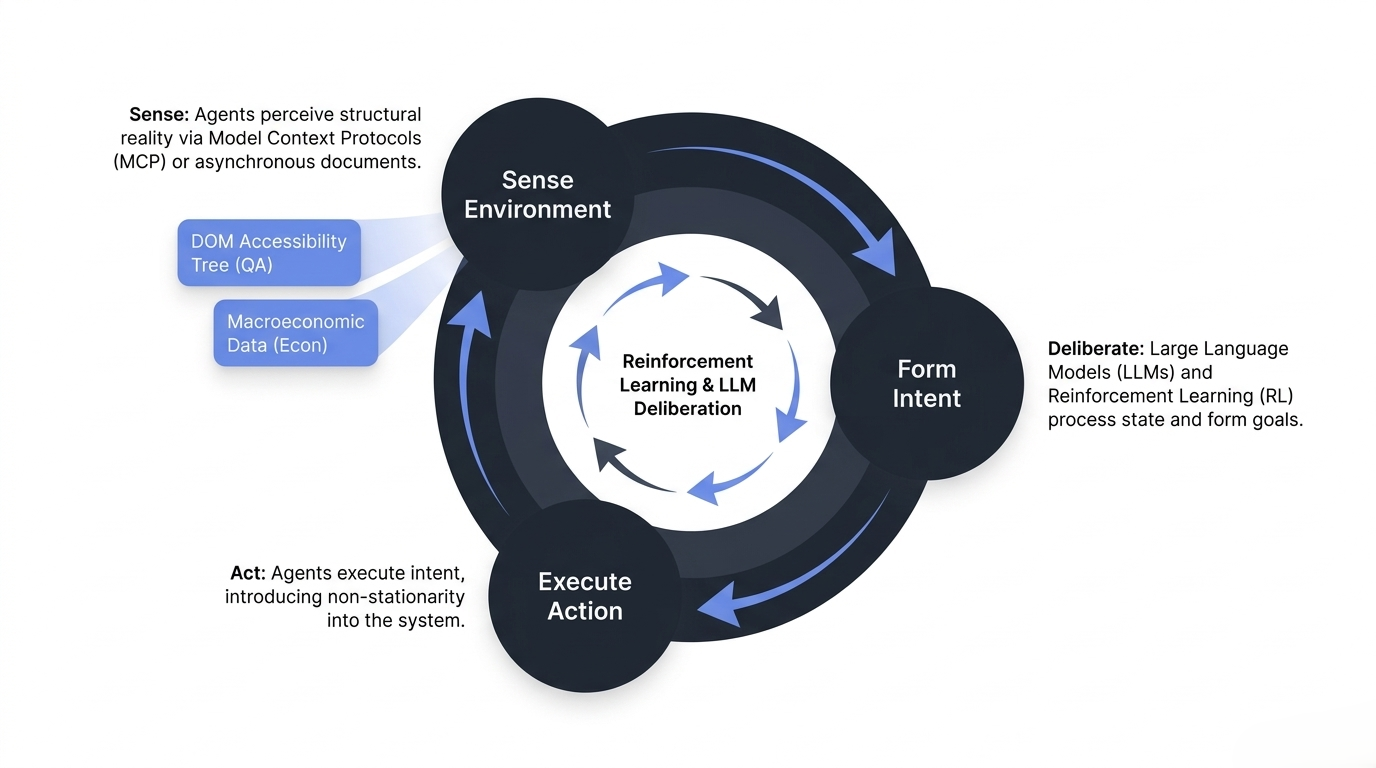
The architecture has three core stages:
- Sense the environment. Agents consume structured signals such as a DOM accessibility tree or macroeconomic data.
- Form intent. LLMs and reinforcement-learning components interpret state and choose goals or actions.
- Execute action. The system acts on the environment, changing the state it will observe next.
This loop is inherently non-stationary: every action can alter future observations. That makes verification and observability part of the architecture, not an afterthought.
3. The 10/90 Rule: Generation Is Cheap, Verification Is the Work
The slides summarize the operational stance as a 10/90 rule: a small share of effort goes into generation, while most of the effort belongs to verification.
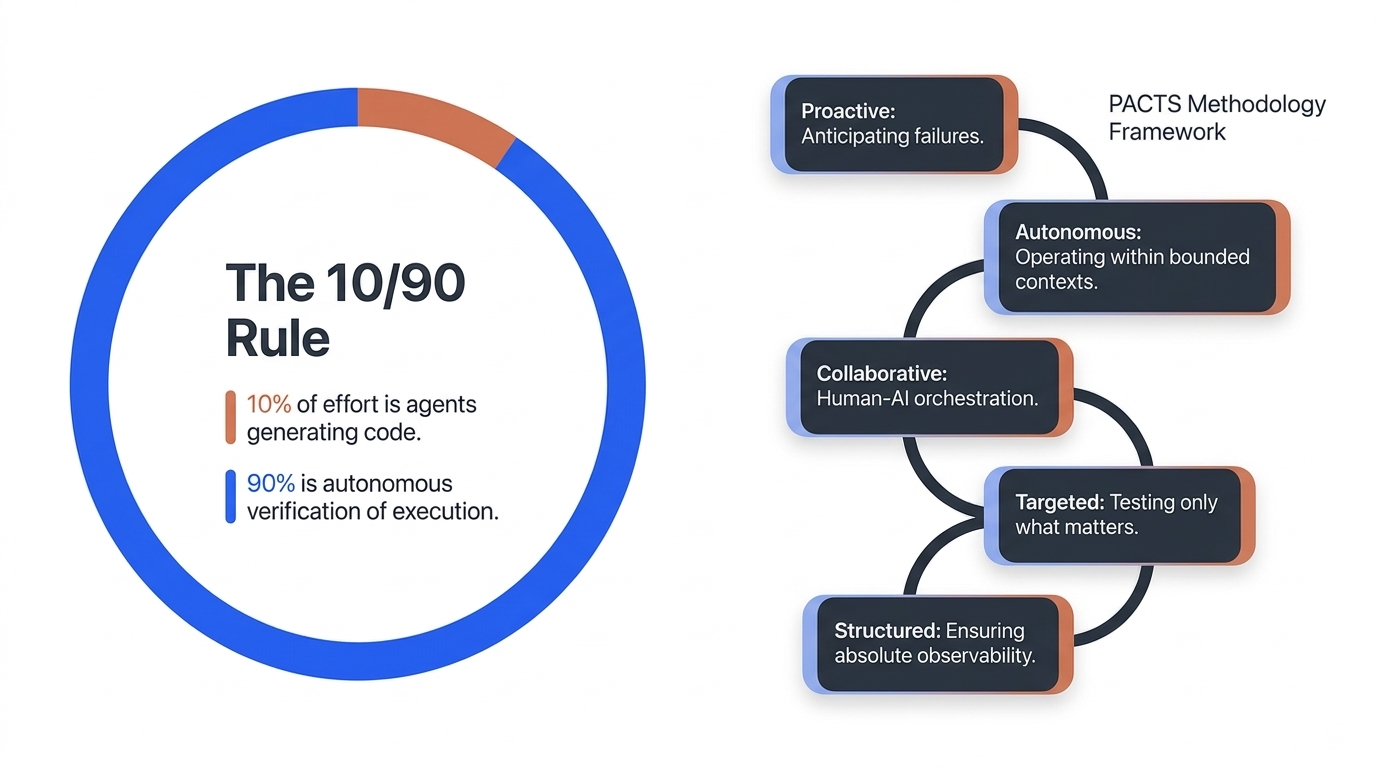
That framing appears in the PACTS methodology:
- Proactive: anticipate failures instead of waiting for them.
- Autonomous: operate within bounded contexts.
- Collaborative: combine human judgment with agent execution.
- Targeted: test the parts that materially affect outcomes.
- Structured: preserve observability so every decision can be inspected.
The important point is not the exact ratio as a universal constant. It is the engineering priority: autonomy without verification is just faster uncertainty.
4. Zero-Cost Self-Healing Through Ranked Locator Strategies
Self-healing is most useful when it is constrained and deterministic.
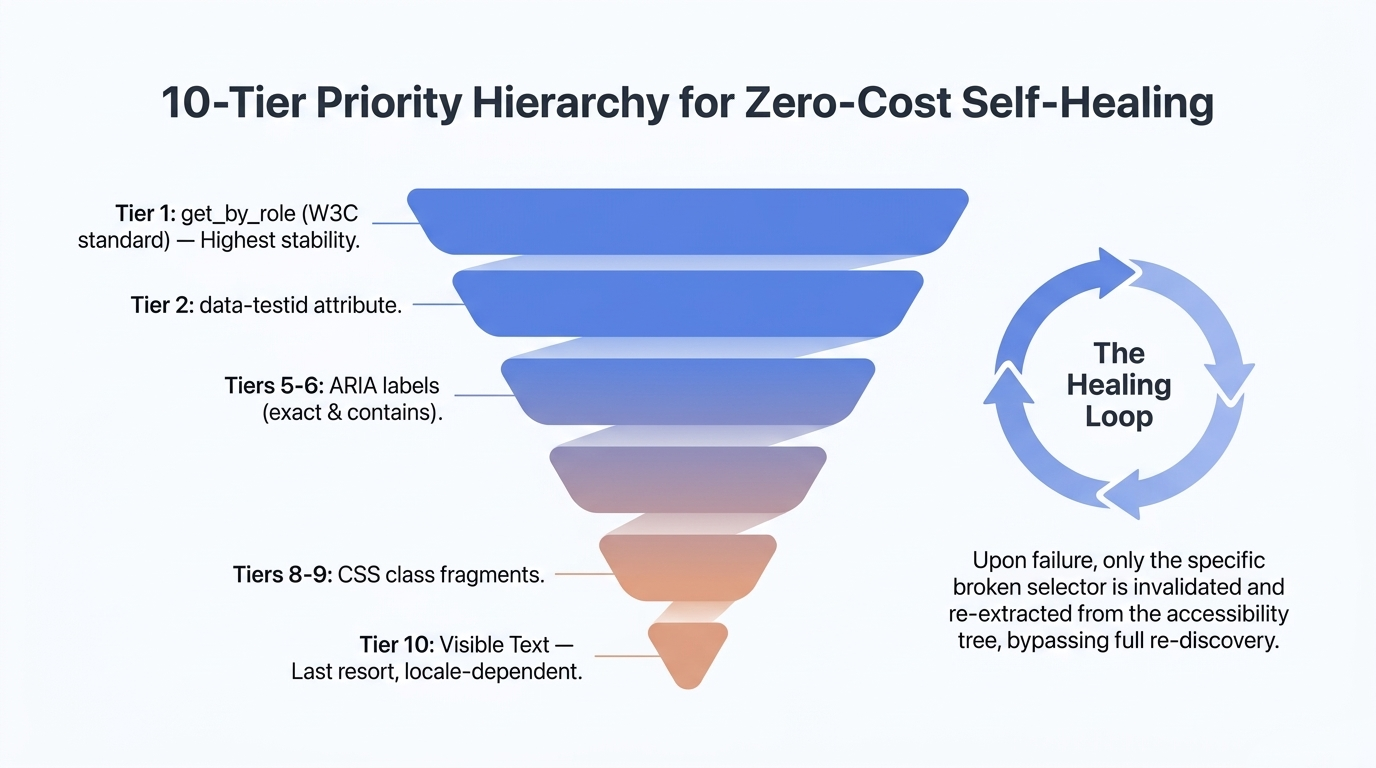
The locator strategy shown here favors stable semantic signals before fragile surface-level ones. At the top are role-based and test-id selectors; lower tiers rely increasingly on ARIA labels, CSS fragments, and visible text.
The healing loop is intentionally narrow: when a selector fails, the system invalidates only the broken locator and re-extracts the relevant structure instead of rediscovering the entire page.
This design has three advantages:
- it limits recovery scope,
- preserves already-valid work,
- and reduces the chance that healing silently rewrites unrelated behavior.
Self-healing becomes a bounded repair mechanism rather than an unconstrained re-generation step.
5. Layering the QA Architecture
A reliable agentic QA stack separates business intent from browser mechanics.
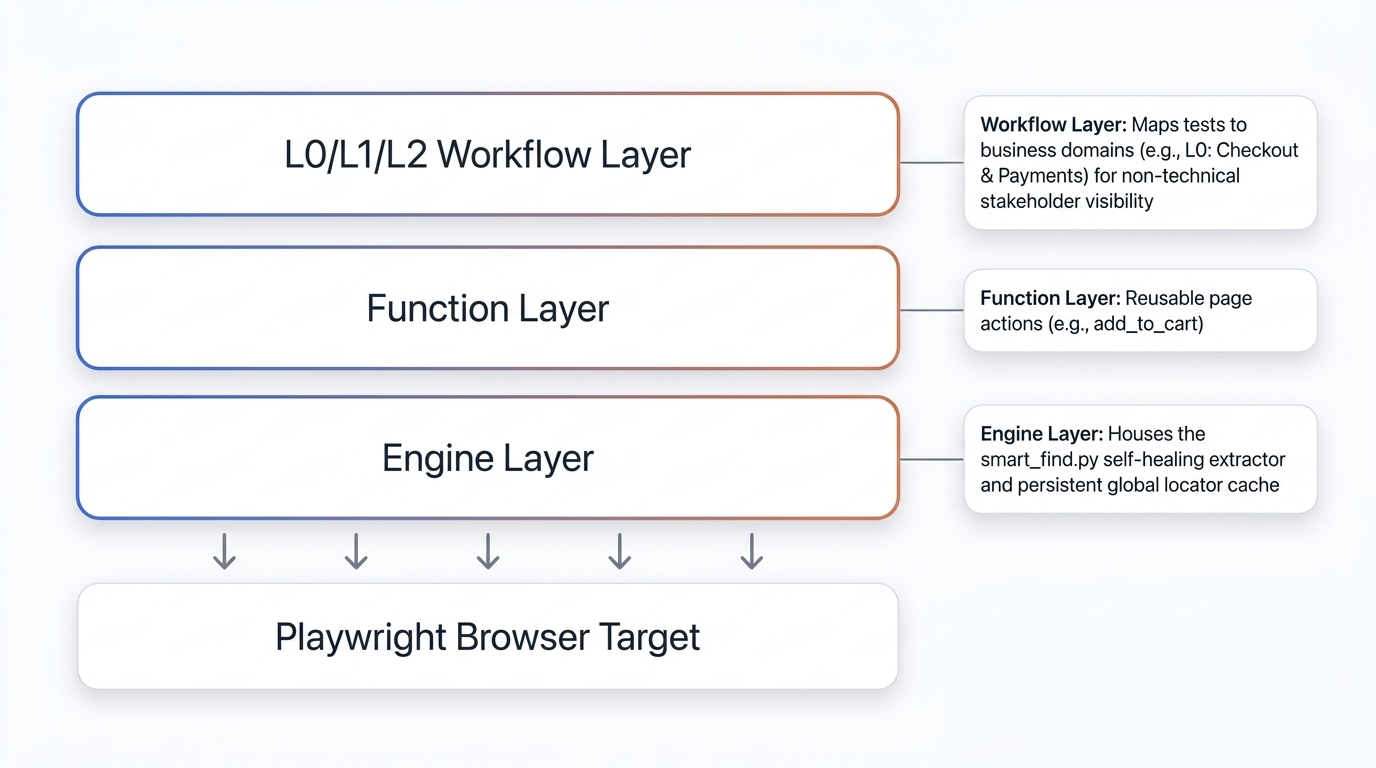
The layered model contains:
- Workflow layer: maps tests to business domains so non-technical stakeholders can see what is being validated.
- Function layer: encapsulates reusable page actions such as adding an item to a cart.
- Engine layer: contains the self-healing extractor and persistent locator cache.
- Browser target: Playwright executes the final interaction against the application.
This separation matters because it localizes change. Business workflows can remain stable while lower-level locator logic heals and evolves independently.
6. Beyond the DOM: Visual Reasoning for Canvas and Mobile Interfaces
DOM extraction is powerful, but it is not universal.
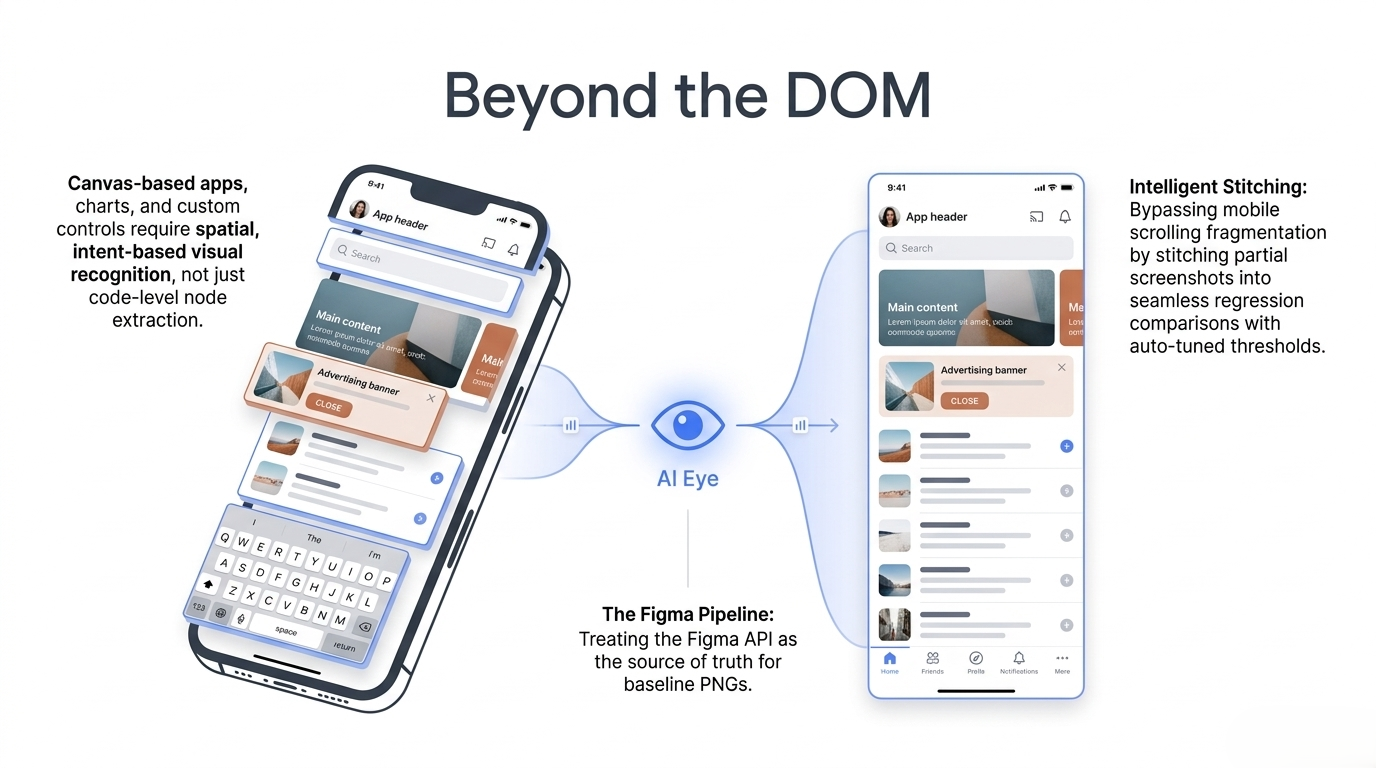
Canvas-based applications, charts, custom controls, and mobile screens may not expose enough semantic structure for reliable node-level automation. In those cases, the architecture adds a visual pathway:
- visual recognition for spatial and intent-based interpretation,
- Figma-sourced baselines for expected rendering,
- intelligent stitching for fragmented mobile screenshots,
- visual comparison with tuned thresholds.
This expands agentic QA from “find the element in the tree” to “understand what a user sees.”
7. Multi-Agent Verification as Deliberation
The architecture does not trust a single verifier.
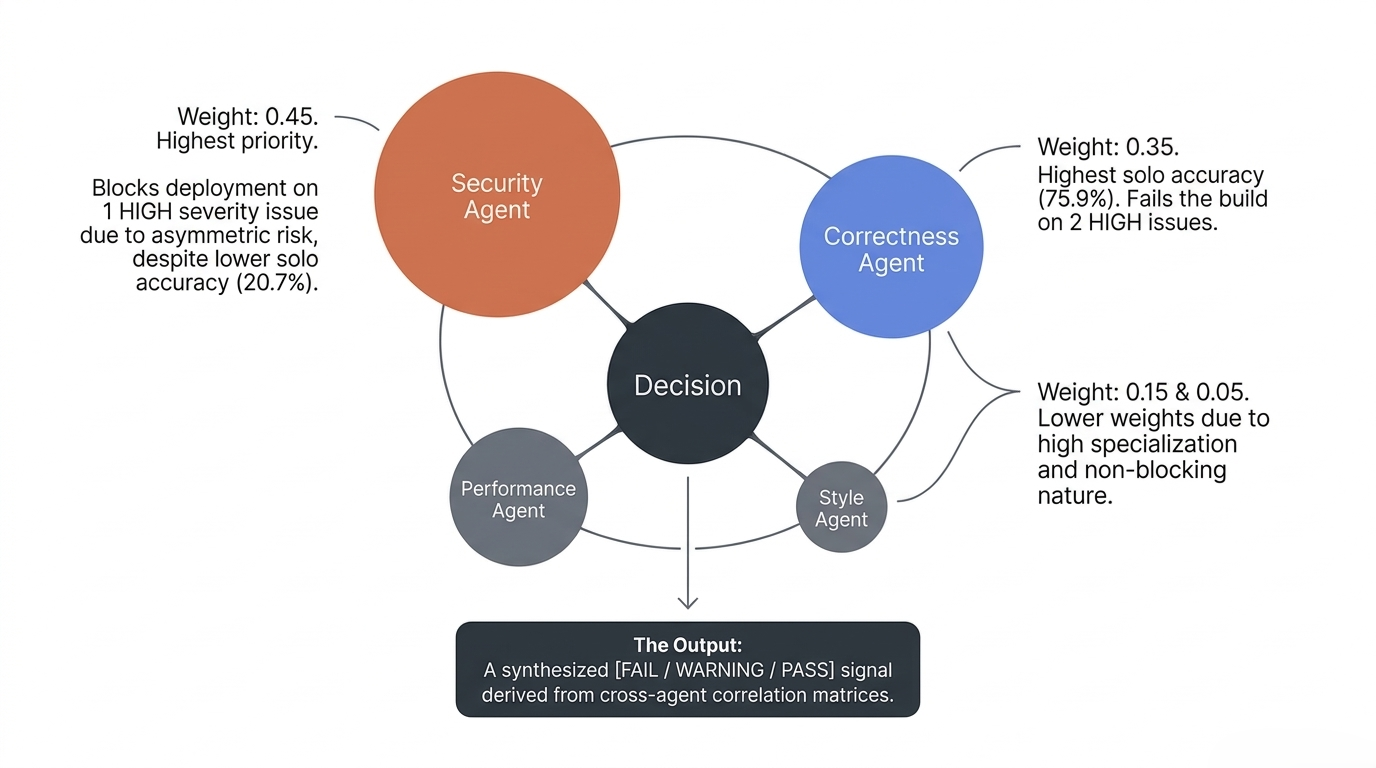
Instead, specialized agents contribute different perspectives:
- Security receives the highest weight because a single severe issue may justify blocking deployment.
- Correctness contributes strong functional evidence.
- Performance and style have lower weights because they are narrower and, in this design, non-blocking.
The final decision is synthesized from cross-agent correlation rather than simple majority voting.
This is a useful pattern for any autonomous system with asymmetric risk: not all errors cost the same, so not all agents should vote equally.
8. Agent-Based Macroeconomics as the Same Architectural Problem
The same move from static rules to adaptive agents appears in the economic half of the blueprint.
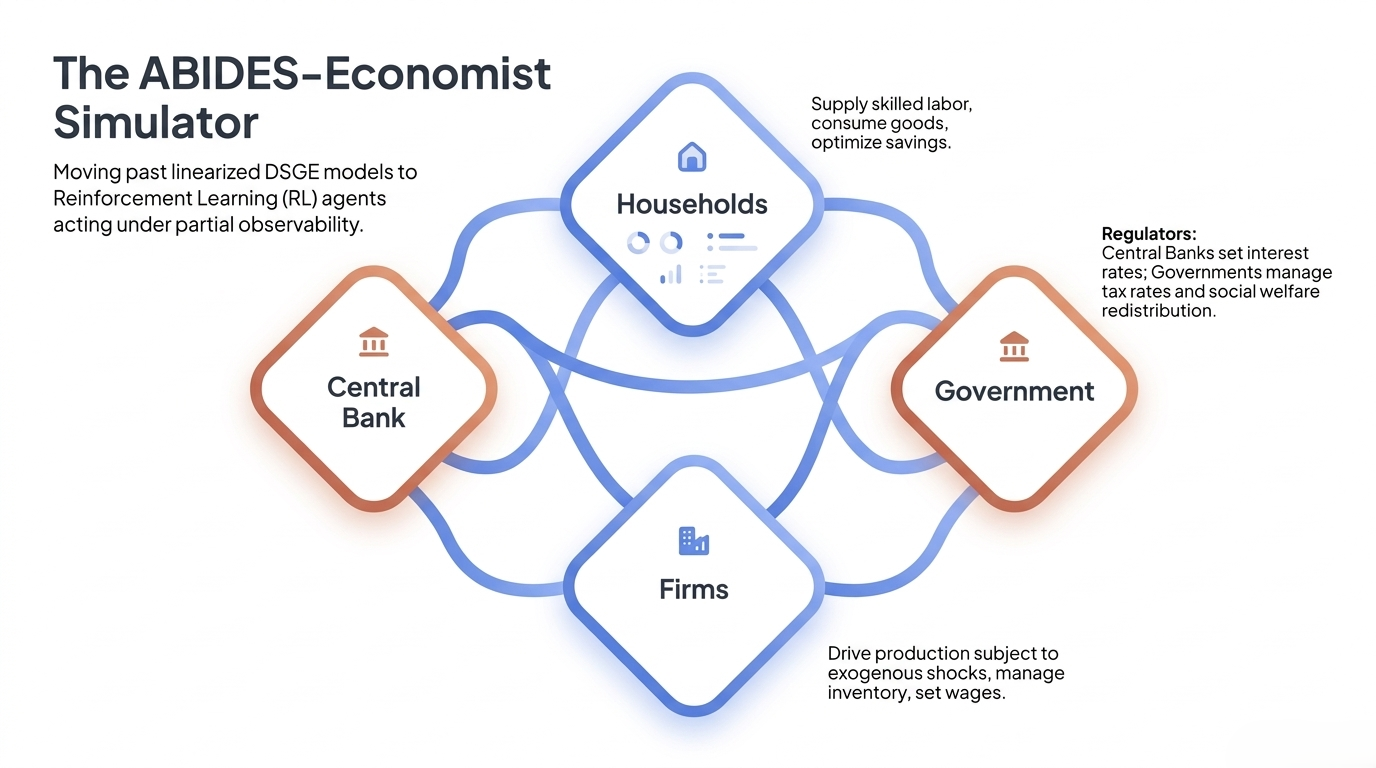
The ABIDES-Economist simulator models multiple interacting actors:
- households supply labor, consume goods, and optimize savings,
- firms set production, manage inventory, and set wages,
- central banks set interest rates,
- governments set tax rates and manage welfare redistribution.
Rather than solving one equilibrium and perturbing around it, the system allows heterogeneous agents to respond under partial observability.
That makes the economy a dynamic multi-agent environment rather than a closed-form static object.
9. Emergent Adaptation Under Shock
Agentic macro simulation becomes most interesting when the environment changes unexpectedly.
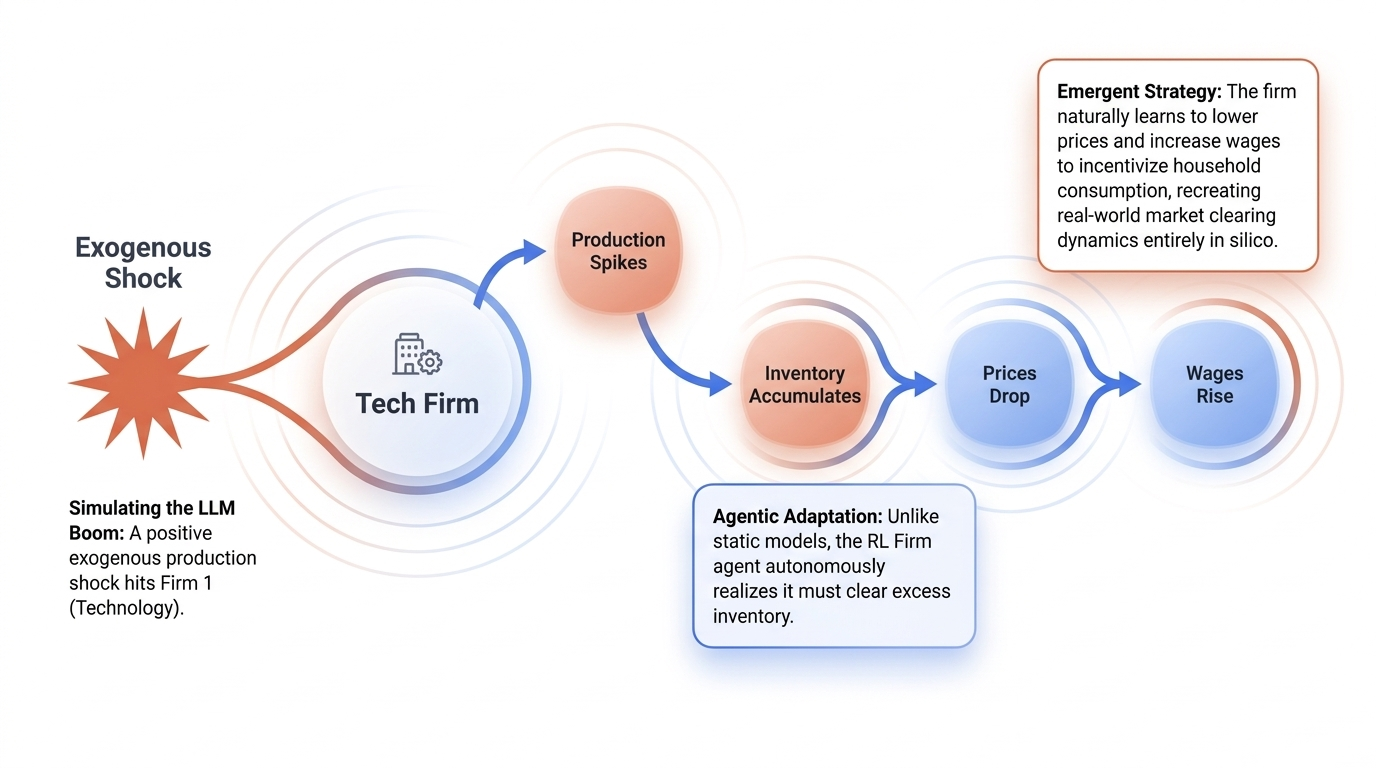
In the illustrated scenario, an exogenous positive shock raises technology-firm production. Inventory accumulates. The firm agent then adapts by lowering prices and raising wages to stimulate consumption and clear excess inventory.
The important property is emergence: the strategy is not shown as a pre-scripted if/then rule. It arises from an agent reacting to state.
This is the macroeconomic analogue of self-healing QA. In both cases, the system must recover from a state that violates its previous assumptions.
10. FOMC in Silico: Temporal Discipline for Multi-Agent Forecasting
Adaptive systems can still fail through data leakage.
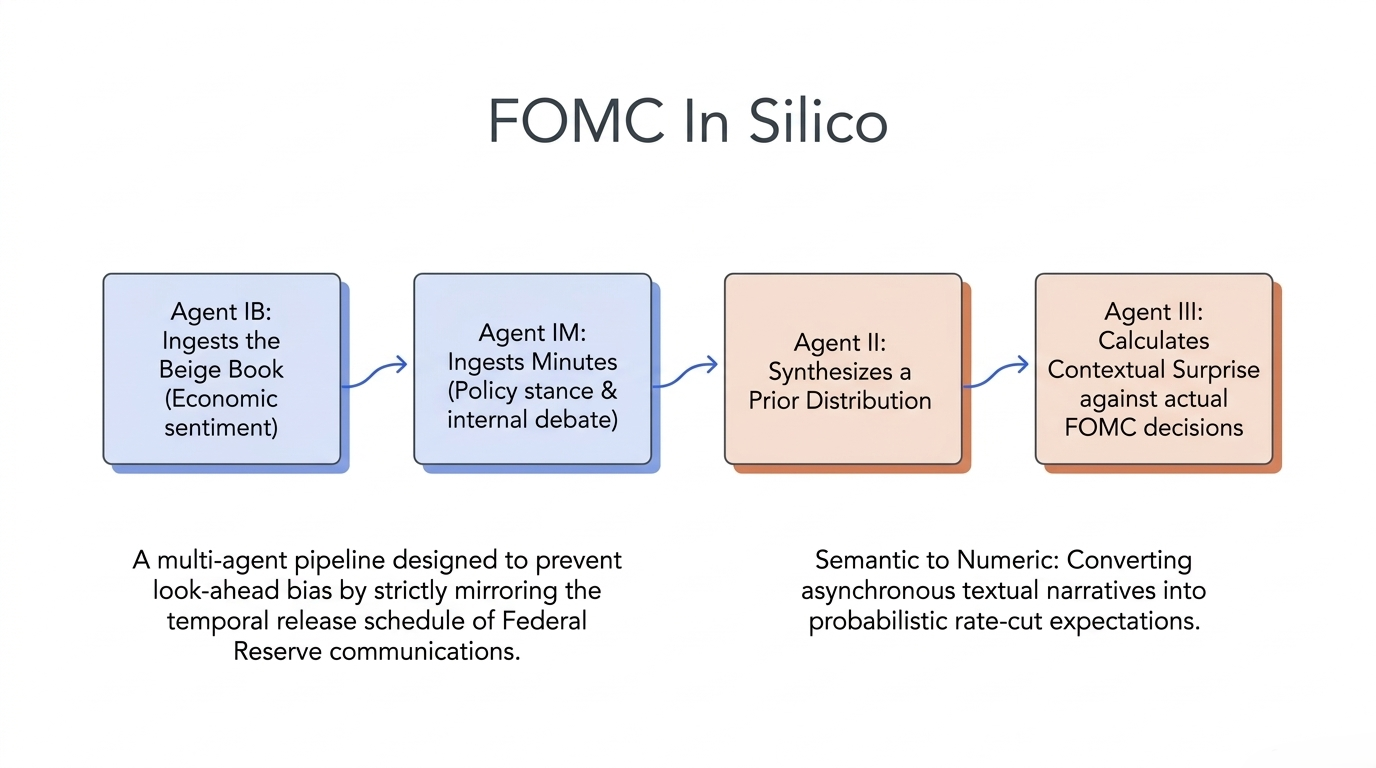
The FOMC pipeline addresses that risk by separating responsibilities across agents:
- one agent ingests Beige Book information as economic sentiment,
- another ingests meeting minutes as policy stance and internal debate,
- a synthesis agent forms a prior distribution,
- a final agent measures contextual surprise against the actual FOMC decision.
The design explicitly mirrors the temporal release schedule of Federal Reserve communications to avoid look-ahead bias.
This is a critical verification lesson: a sophisticated model is still invalid if the information boundary is wrong.
11. Quantifying Fedspeak
Qualitative policy language becomes useful only when the system can transform it into a reproducible signal.
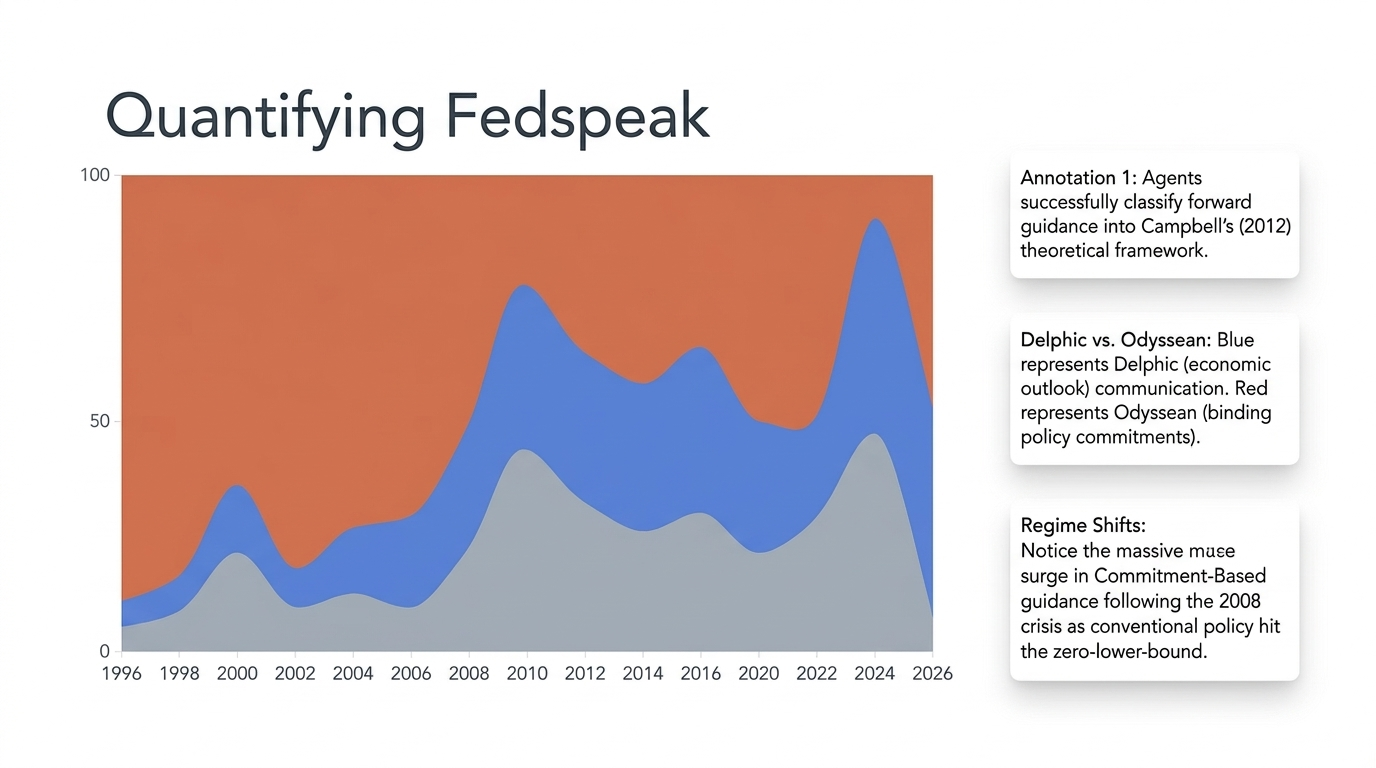
The workflow classifies forward guidance into categories aligned with the theoretical distinction between:
- Delphic guidance, which communicates an economic outlook,
- Odyssean guidance, which signals stronger policy commitment.
The chart emphasizes regime shifts in the composition of communication, especially around periods when conventional policy tools were constrained.
The value of the agentic approach is not merely text classification. It is the conversion of asynchronous narrative into a time-aligned quantitative object that can be tested and compared.
12. A Universal Agentic Architecture
Once the two domains are placed side by side, a common structure appears.
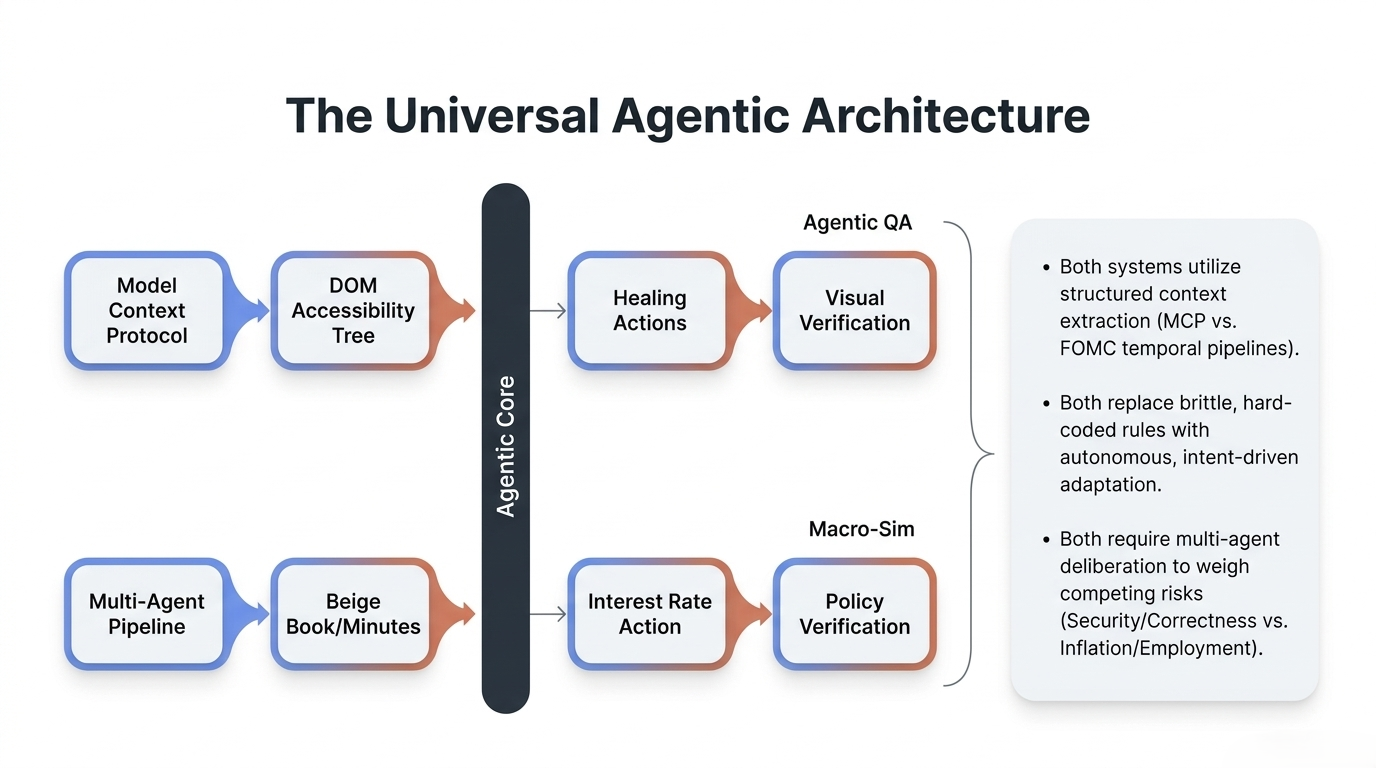
On the QA side, structured context flows through model-context and accessibility representations into a shared agentic core, then into healing and visual verification.
On the macro side, multi-agent inputs such as Beige Book and minutes flow through the same conceptual core, then into interest-rate actions and policy verification.
Both systems share three ideas:
- Structured context extraction replaces raw, brittle inputs.
- Intent-driven adaptation replaces hard-coded decision rules.
- Multi-agent verification manages competing risks rather than collapsing them into one score too early.
The architecture is “universal” not because every domain uses identical tools, but because the control pattern is reusable.
13. The Human Conductor
The human role changes when execution becomes autonomous.
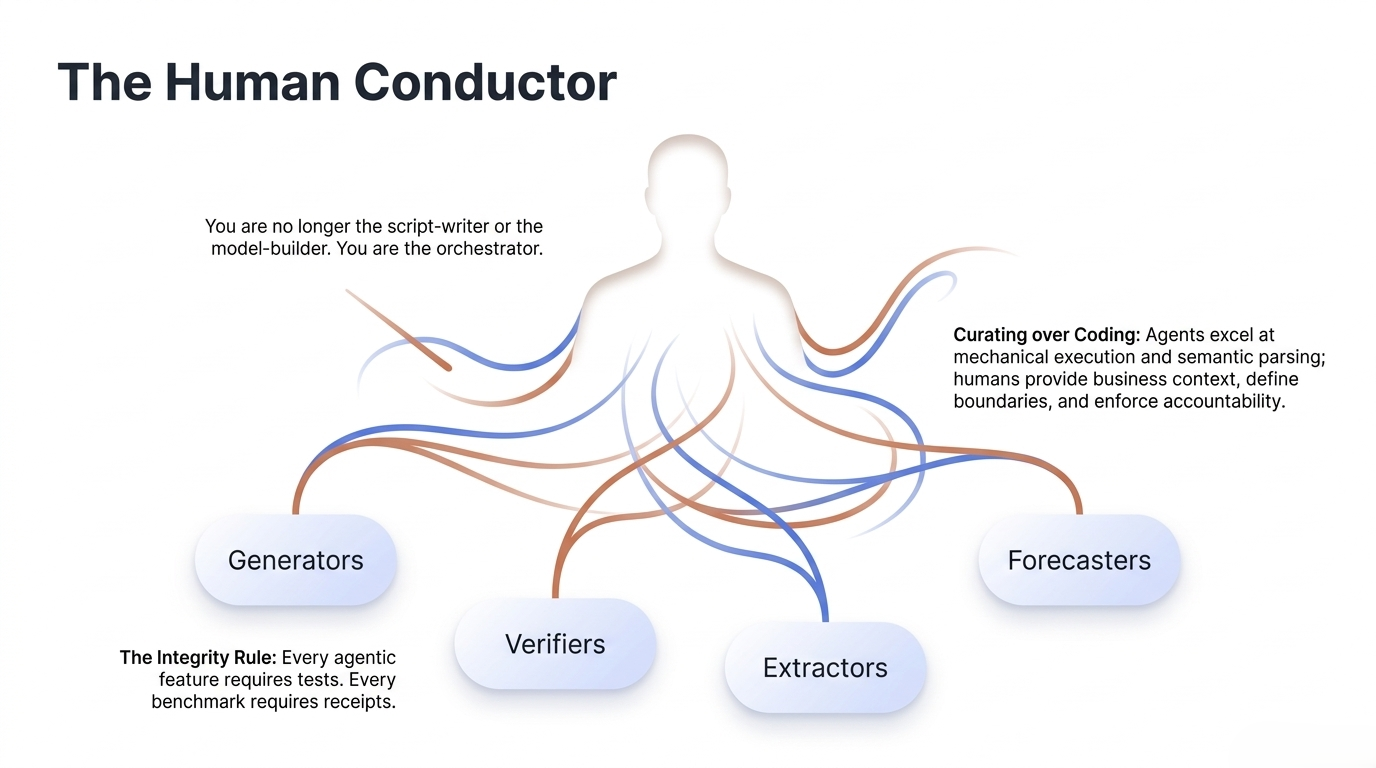
Instead of writing every script or building every model directly, the human becomes the orchestrator of specialized agents: generators, verifiers, extractors, and forecasters.
Two principles follow:
- Curating over coding: humans define context, boundaries, and accountability while agents handle repetitive execution and semantic parsing.
- Integrity over output volume: every agentic feature needs tests, and every benchmark needs evidence that can be inspected.
Human oversight becomes less about micromanaging steps and more about governing the system that chooses those steps.
14. The Borderless Blueprint Realized
At the highest level, the software and macroeconomic examples collapse into one idea.
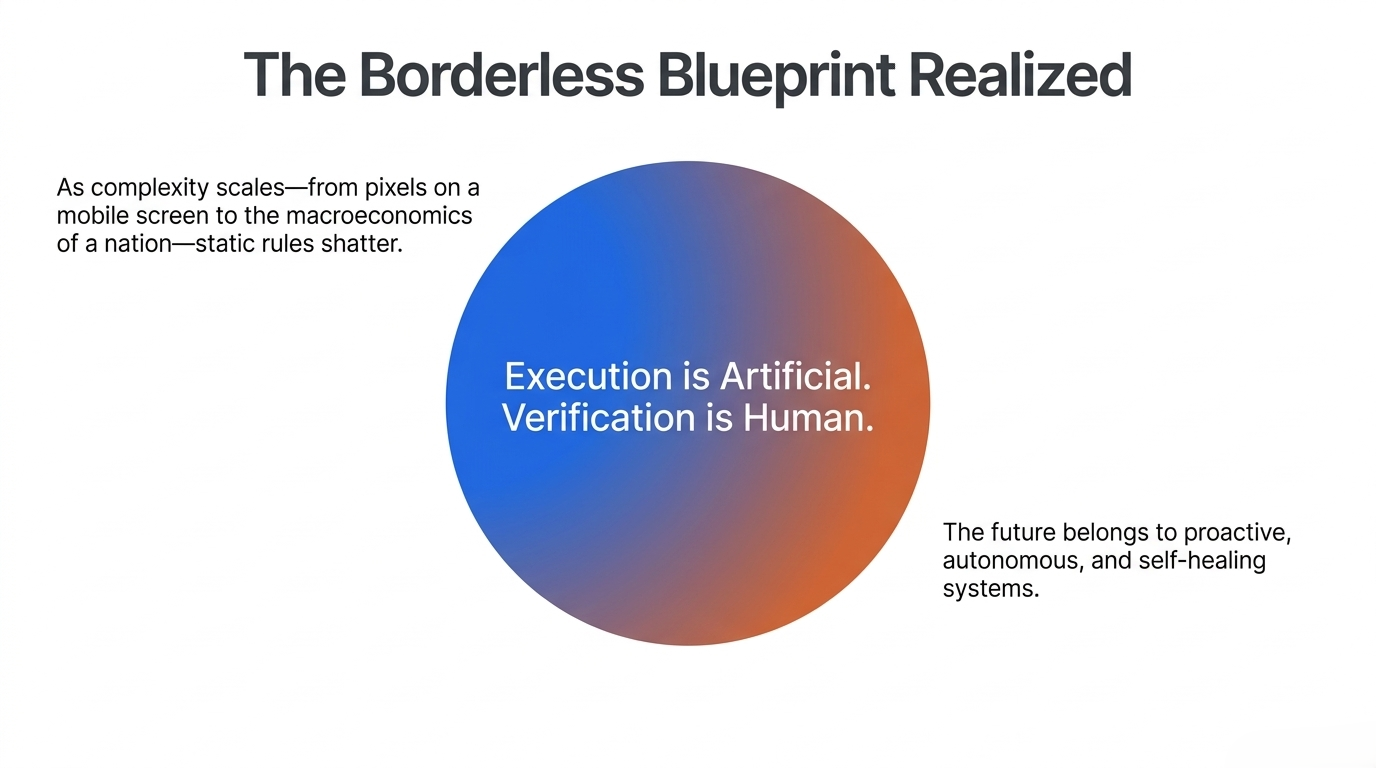
As complexity scales—from pixels on a mobile screen to the macroeconomics of a nation—static rules eventually fracture.
The future architecture described by these slides is therefore proactive, autonomous, and self-healing. But it is also intentionally bounded by verification.
The goal is not to remove humans from the loop. It is to move human effort to the part that remains most valuable: deciding what matters, what is acceptable, and what evidence is sufficient to trust the system.
Engineering Principles
The architecture ultimately depends on several principles:
-
Structure before autonomy
Agents need stable, meaningful context before they can act reliably. -
Verification before scale
More autonomous execution increases the need for independent checking, not the opposite. -
Bounded healing over unrestricted regeneration
Recovery should be local, traceable, and limited to the broken component whenever possible. -
Specialization with weighted governance
Multi-agent systems work best when agents have clear responsibilities and risk-sensitive influence. -
Temporal and semantic integrity
Data availability, causal ordering, and evaluation boundaries must be preserved or the result cannot be trusted.
Final Synthesis
The common pattern across QA and macroeconomic simulation is a closed-loop system that senses structure, forms intent, acts, and then verifies the result.
In software quality, that means replacing brittle selectors with semantic extraction, healing, visual validation, and specialized verification agents. In macroeconomics, it means replacing rigid equilibrium assumptions with interacting agents, temporally disciplined information pipelines, and explicit policy verification.
The production-ready system combines:
- Structured context: accessibility trees, semantic UI models, macroeconomic data, minutes, and narrative inputs.
- Adaptive execution: LLM and reinforcement-learning agents that act under changing conditions.
- Verification: visual checks, policy checks, specialized agents, and temporal integrity constraints.
- Governance: weighted deliberation, bounded autonomy, and human-defined risk priorities.
- Observability: evidence that makes every action and benchmark inspectable.
- Self-healing: localized recovery when assumptions, selectors, or strategies fail.
Closing Thought
The agentic shift is not simply a move from deterministic software to probabilistic AI. It is a move from static rule execution to governed adaptive systems.
Execution can be autonomous. Trust must be engineered.